
Control Line: NAVY CARRIER
Dick Perry
The unidentified carrier aircraft in my January column was an unsuccessful competitor against the Fairey Gannet anti-submarine aircraft of the British Royal Navy. The Blackburn Y.A.5 shared a common awkwardness of form with the Gannet, almost as if the specification to which they were built required it. The particular variant illustrated was the first of four configurations. With a modified vertical stabilizer and rudder, it became the Y.A.7. The outer wing panels were modified and swept back and a third crew member position added on the second prototype, the Y.A.8.
The third and last prototype, the Y.B.1, had the Y.A.8 configuration with an Armstrong Siddeley Double Mamba turbine powerplant replacing the Rolls-Royce Griffon 56 piston engine of the first two aircraft.
As I write this, I have not yet received any replies, so I'll announce the winner in my May column.
This month's Mystery Aircraft is not an uncommon airplane, but it is almost never recognized as a carrier aircraft. I'll tell you.
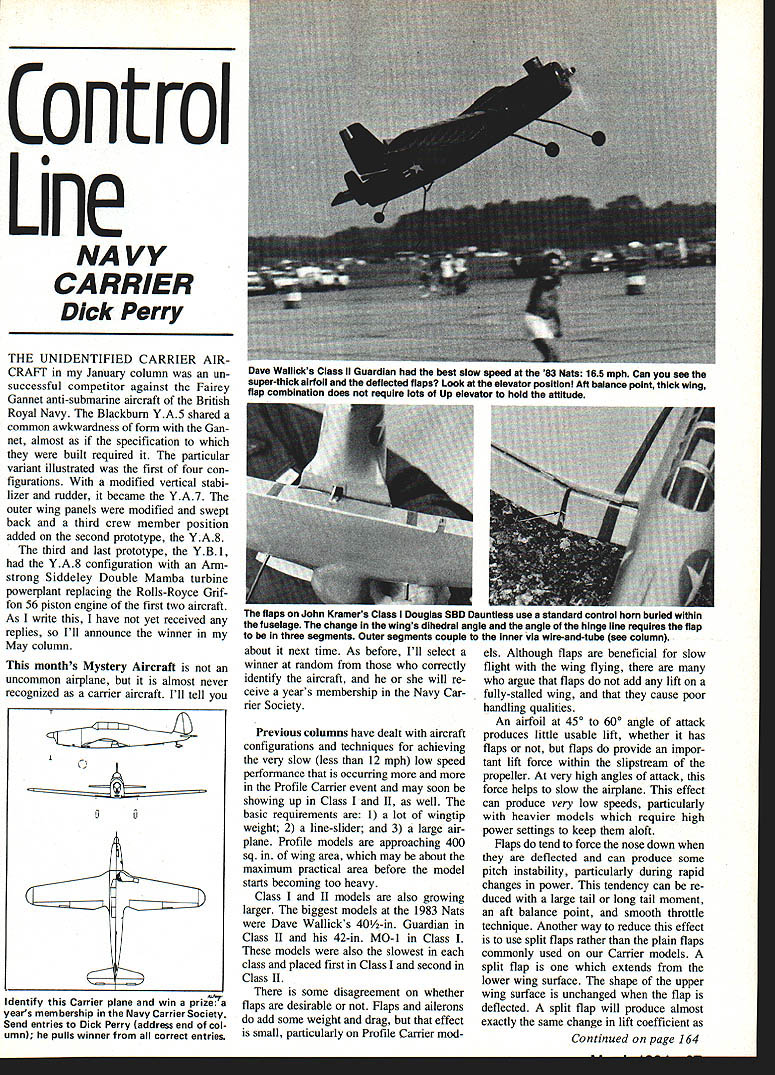
The flaps on John Kramer's Class I Douglas SBD Dauntless use a standard control horn buried within the fuselage. The change in the wing's dihedral angle and the angle of the hinge line requires the flap to be in three segments. The outer segments couple to the inner via a wire-and-tube arrangement.
Although flaps are beneficial for slow flight with the wing flying, there are many who argue that flaps do not add any lift on a fully stalled wing, and that they cause poor handling qualities. An airfoil at a 45° to 60° angle of attack produces little usable lift, whether it has flaps or not, but flaps do provide an important lift force within the propeller slipstream. At very high angles of attack, this force helps to slow the airplane. This effect can produce very low speeds, particularly with heavier models that require high power settings to keep them aloft.
Flaps do tend to force the nose down when they are deflected and can produce some pitch instability, particularly during rapid changes in power. This tendency can be reduced with a large tail or long tail moment, an aft balance point, and smooth throttle technique. Another way to reduce this effect is to use split flaps rather than the plain flaps commonly used on our carrier models. A split flap extends only from the lower wing surface; the shape of the upper wing surface is unchanged when the flap is deflected. A split flap will produce almost exactly the same change in lift coefficient as a plain flap, but the nose-down pitching moment will be about half that produced by a plain flap.
I have run tests comparing full-stall low-speed performance with and without flaps. What I have noticed is that models consistently fly 7–8 miles per hour slower in light winds when they have flaps. You can draw your own conclusions from your observations.
Putting flaps on an airplane is a straightforward task. Probably the most common way of operating flaps is to use a standard horn arrangement and a push/pull rod connected to an arm and tailhook. I've used a wide variety of hinges — tube-and-wire through the full range, commercial hinges, hinges made from iron-on Mylar covering — and one particularly convenient hinge is the one-piece polypropylene hinge from Full Command Systems (908 E. Rosewood, Spokane, WA 99208). Because there are no hinge pins and no sliding surfaces, you can't harm the hinge by inadvertently getting CA glue or epoxy paint in the hinge line. They are light and very strong — a good characteristic for flaps actuated by the tailhook.
Wings that do not have a straight hinge line must have divided flaps (the F4U Corsair had three flap segments per wing). An easy way to connect flap segments is shown in the accompanying photo: one segment contains a 1/16-inch OD brass or aluminum tube mounted near the trailing edge; the other flap segment has a .025-inch wire attached to it and extending across the break into the tube. The wire can bend or slide within the tube to allow for movement between the flap segments.
Richard L. Perry 7578 Vogels Way Springfield, VA 22153
Transcribed from original scans by AI. Minor OCR errors may remain.

