

Control Line: Navy Carrier
By Dick Perry
Rules cycle and advisory committees
The rules cycle is beginning again. Its first major event is the submission of proposed changes, which must be accomplished before September 1, 1984. Many proposals result from new ideas that have found local acceptance either as a common practice in running AMA events, or as a new event flown at local contests as an additional event. In many cases, these proposals are defeated on the initial ballot of the CLCB, not because they lack merit, but because there is no experience with the proposed change outside the area in which it originated and there is no real opportunity to discuss the change adequately in the short time before the initial ballot.
The two-year rules cycle and the advent of advisory committees in the various events have the potential to change this tendency. Submitting a change proposal early allows the advisory committee to discuss it and share ideas. Advisory committees can also serve as forums for seeking support for proposals.
If an advisory committee likes a suggested change and submits it as a committee proposal, it automatically passes the initial CLCB ballot.
As the new chairman of the Navy Carrier Advisory Committee (NCAC), I'd like to encourage anyone who plans to submit change proposals to send them to me within the next month or two. I will distribute the proposal and your comments to the NCAC so that we can discuss them thoroughly before the September 1 deadline. If the NCAC agrees with the proposal, I will submit it as an NCAC-supported change; if not, then perhaps we can suggest some alternatives to you. In any case, you may still submit the change as an individual proposal.
Mystery airplane
Richard K. Ng of San Antonio, TX, was selected as the winner of the January Mystery Plane contest. He and five others correctly identified the Blackburn Y.A.5 / Y.A.7. The other correct entrants were:
- John Urbas
- Marty Greenly
- Carlin Hulick
- Frank Beatty
- S. H. Warden
They share in the honors, if not the prize.
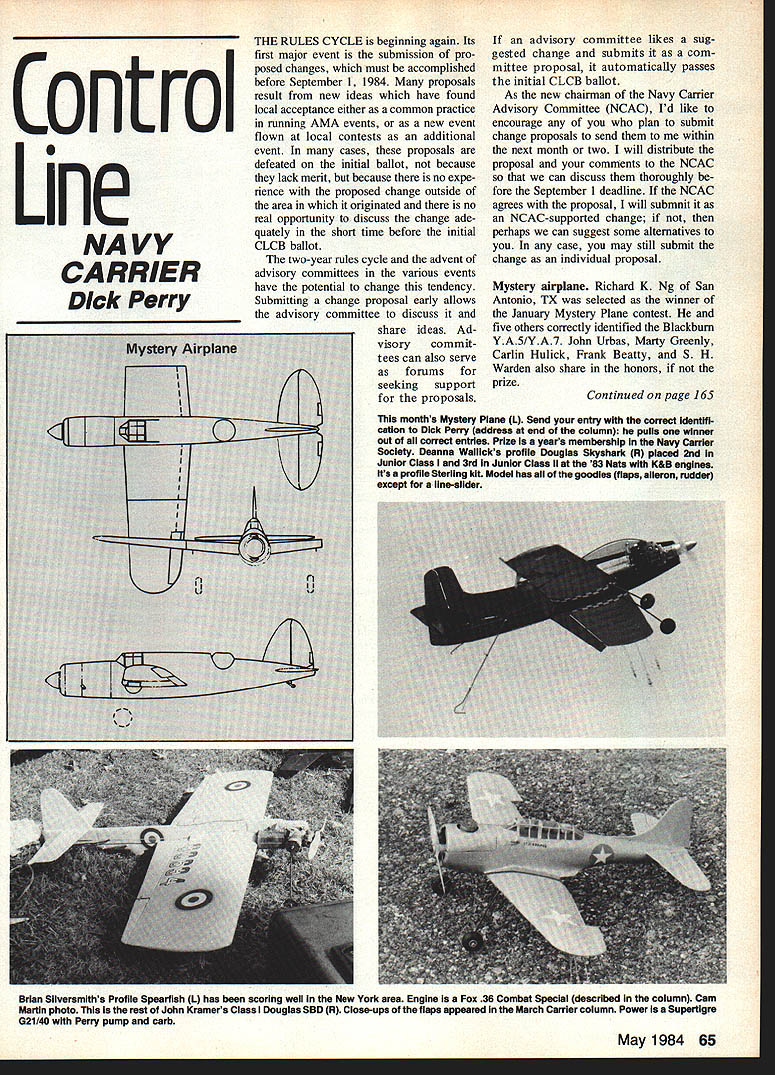
This month's Mystery Plane (left). Send your entry with the correct identification to Dick Perry (address at the end of the column); he pulls one winner out of all correct entries. Prize is a year's membership in the Navy Carrier Society.
Deanna Wallick's profile Douglas Skyshark (right) placed 2nd in Junior Class I and 3rd in Junior Class II at the 1983 Nats with K&B engines. It's a profile Sterling kit. The model has all of the goodies (flaps, aileron, rudder) except for a line-slider.
The March quiz didn't pose much of a challenge to anyone who read the "Competition News" (CN) section. A drawing of the Arado Ar-96 appeared on page 94, just before CN. I looked for a year-and-a-half for a good drawing of the Arado without success, and Carl Wheeley had one in his files all the time! A photo of the carrier version of the Ar-96 trainer appeared in the March 1976 issue of Der Flieger. The photo showed the aircraft, complete with tail hook, mounted on its catapult cradle.
Many fighter, dive bomber, and support aircraft were modified and tested for use on the German carrier Graf Zeppelin, which was never finished. A previous column contained a drawing of the Messerschmitt Bf-109T carrier fighter.
Kingfisher documentation
Robert Cory passed on additional proof of the OS2U Kingfisher's eligibility for our event. Combat Aircraft of WW II by Weal and Barker states that, "It was also flown off AMC class carriers in the South Atlantic and Indian Oceans." The same book also documents use of the Piper HE-1 (AE-1) ambulance version of the civilian J-5C for carrying patients between carriers and hospitals on shore. Robert plans to build one.
Fox .36 for Profile
C. T. (Tom) Schaefer, the 1983 Nats Open Profile Carrier Champion, passed along some tips on using Fox .36 Mk IV and Mk V engines in Profile Carrier. The carburetor for the new Mk V (single-ball-bearing RC .36) fits the Mk IV (last two-ball-bearing Combat Special) after the intake is cut down. Tom filed down the spray bar to increase carburetor intake area; that was the only modification on either engine.
Tom set up both engines without the spacer ring under the sleeve. Head clearance was adjusted to provide 0.44 to 0.45 cc chamber volume (deck height 0.185 in.). The crankshaft on the Mk V was polished except for the part that fits within the ball bearing. The Mk IV was fit by hand; the Mk V was run in on a bench and in an airplane after a thorough cleaning. Both appear to be very good engines and have exceeded 90 mph on the high speed. The Mk V is within 200–300 rpm of the Mk IV and is still improving.
One problem encountered by a few fliers is excessive wear of the aluminum bearing for the crankshaft at the extreme front end of the bearing. Larry Driskill has prevented this problem and arrested deterioration on one engine on which it had already started by extending the oil groove forward. A small file can be used for this purpose. The extension of the oil groove need not be very deep and should stop just short of the forward end of the bearing area. Extending the groove both from the front and the rear of the bearing can cause some leakage around the crankshaft.
The Fox engines are light, powerful, cheap, and available—a combination that is hard to beat.
Richard L. Perry 7578 Vogels Way Springfield, VA 22153
Transcribed from original scans by AI. Minor OCR errors may remain.

