

Control Line: Navy Carrier
Richard L. Perry
I'VE BEEN receiving quite a few letters and phone calls about the new scoring system for Navy Carrier. Some were questions on how the points would be computed; others were comments on the scoring system, itself. One modeler was concerned that Carrier would not survive until the scoring could be changed back to the old system in two years. Many others are happy to see some reduction in the emphasis on high speed in Carrier.
One pattern that emerged from the letters is that more people are going to be flying Carrier next year. The big reason for this seems to be a general feeling that since the new rules have reduced the emphasis on high speed, Carrier modelers can now compete effectively without going bankrupt buying super-hot engines.
The rule book is quite clear on the new scoring. The only thing that has really changed is the low speed score. Low speed points are now calculated by dividing the high speed by the low speed and multiplying by ten. The same result is obtained by dividing the low speed time (in seconds) by the high speed time and multiplying that result by ten. By using the latter method, the new system takes no longer to figure by hand than did the old method since it is not necessary to convert the low speed time into miles per hour.
An electronic pocket calculator makes score computation really easy. By using the formula,
179.928 ÷ Low Speed Time ------------------------ × 10 High Speed Time
the flight score (high speed points plus low speed points) can be computed in a matter of seconds. By substituting 180 for 179.928, accuracy will not suffer greatly and more time will be saved. This method should not be used for computing scores for national record purposes because it will occasionally give answers that are 1/10 point too high. The reason for this is that the high speed score is not rounded to the nearest 1/10 point before the low speed score is added.
If any of you have access to a programmable calculator, I have a program for the Texas Instrument calculators and hope to finish one for Hewlett-Packard soon. The program does all the necessary rounding and does not suffer from the problem mentioned above. It also computes scores using the 1975 rules for comparison purposes. If any of you want program sheets, send 25¢ to me to cover reproduction and mailing, and specify which brand of calculator you have.
Those of you who have tried to use a calculator outdoors have discovered that some calculator displays cannot be read in bright sunlight. I solved the problem with a technique used by Ace R/C in their transmitters (RC does have a few things to teach CL modelers). I use a rectangular tube about two inches long made from black construction paper and folded to just fit the calculator display. When the tube is taped over the display, it excludes the excess light and the display can be read by looking through the tube.
Some modelers felt that under the old rules, Navy Carrier had evolved into little more than a Proto Speed event with a landing requirement. While this analogy is a little extreme, it is true that the emphasis on high speed made that phase of the flight very important.
Roger Edwards (who holds the Class I and II records at the time of this writing — 339.9 and 342.0) published a comprehensive analysis of the new scoring system in the Duke City Dope Sheet of the Albuquerque Thunderbirds. Roger's article stressed the increased importance of low speed and landing points. He showed that when low speed is below about 23 mph in Profile or 27 mph in Class I and II, a 1 mph reduction in low speed is worth more than a 1 mph increase in high speed.
Although most people think in terms of mph when comparing scoring systems, I prefer to work with percentage changes because a one-mph change is a much larger change in low speed than it is in high speed. By observing contest scores, one can see that there is usually only about a 7 to 8 mph spread in low speeds while high speeds usually vary by around 25 mph. This demonstrates the ranges of speeds that we have to work with in making improvements and shows why I think percentage changes give a better picture of what is happening.
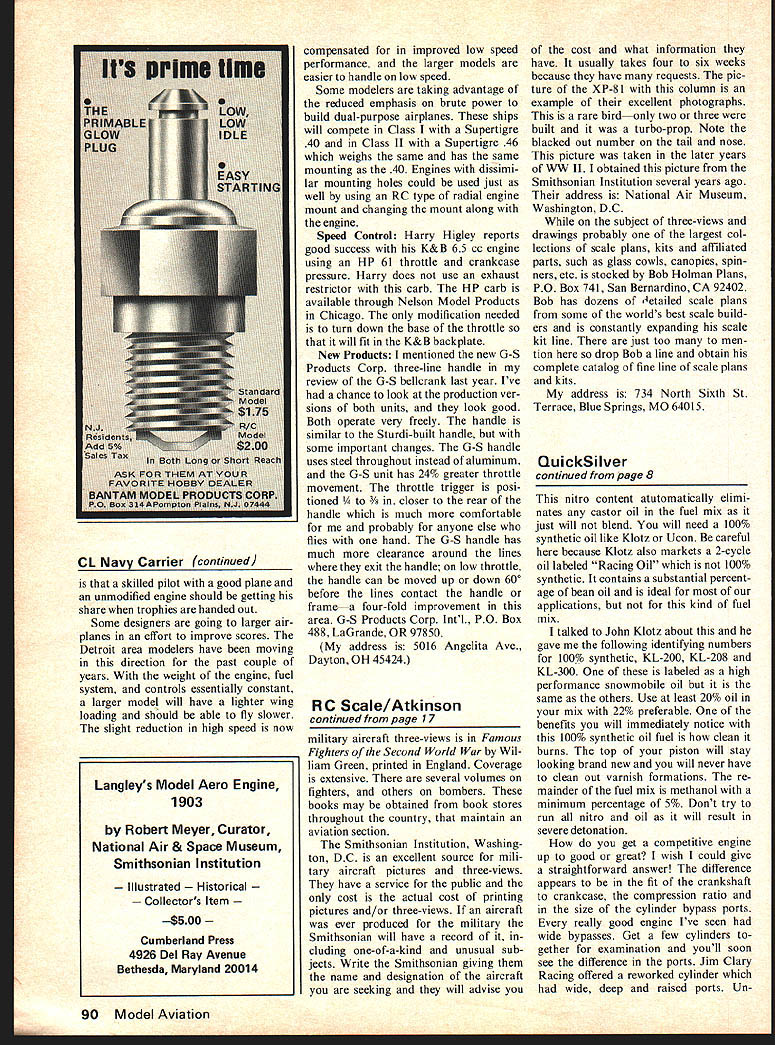
The graph shows the effect of a one percent change in high speed compared to a one percent change in low speed. The Score Ratio along the bottom of the graph shows the relative importance of high speed improvements to low speed improvements for both 1975 and 1976 rules. A Score Ratio of 5 (100 mph and 27 mph under 1975 rules) means that a percentage improvement in high speed is worth 5 times more than an equal percentage change in low speed. At the same speeds under the new rules, high speed is only 3.6 times more important than low speed.
A look at the graph shows two important changes. First, high speed no longer has any effect on the score ratio. Second, the effect of improving low speed has been reversed. Under the old rules, any improvement, either high or low speed, caused an increase in the relative importance of the high speed score. With the new rules, the importance of the high speed is constant regardless of the value of the high speed. As low speeds are improved under the new rules, the relative importance of high speed is reduced.
What this all means to many modelers is that a lighter, cheaper, more reliable RC-type engine and some practice to improve flying skills can be used effectively against the hot racing engines. While high speed is still relatively more important than low speed, a hot engine can no longer be counted on to compensate for a poor low speed or a missed landing. Flying skill and aircraft design and construction technique have increased in importance; and good, consistent performance will not go unrewarded.
The effect is most apparent in Profile Carrier. Modified engines are now legal in the Profile event, but it is in the Profile speed ranges — 65 to 90 mph and 15 to 22 mph — that the greatest reduction in high speed emphasis has occurred. The result is that a skilled pilot with a good plane and an unmodified engine should be getting his share when trophies are handed out. Some designers are going to larger airplanes in an effort to improve scores. The Detroit area modelers have been moving in this direction for the past couple of years. With the weight of the engine, fuel system, and controls essentially constant, a larger model will have a lighter wing loading and should be able to fly slower. The slight reduction in high speed is now compensated for in improved low speed performance, and the larger models are easier to handle on low speed.
Some modelers are taking advantage of the reduced emphasis on brute power to build dual-purpose airplanes. These ships will compete in Class I with a Super Tiger .46 and in Class II with a Super Tiger .46 which weighs the same and has the same mounting as the .40. Engines with dissimilar mounting holes could be used just as well by using an RC type of radial engine mount and changing the mount along with the engine.
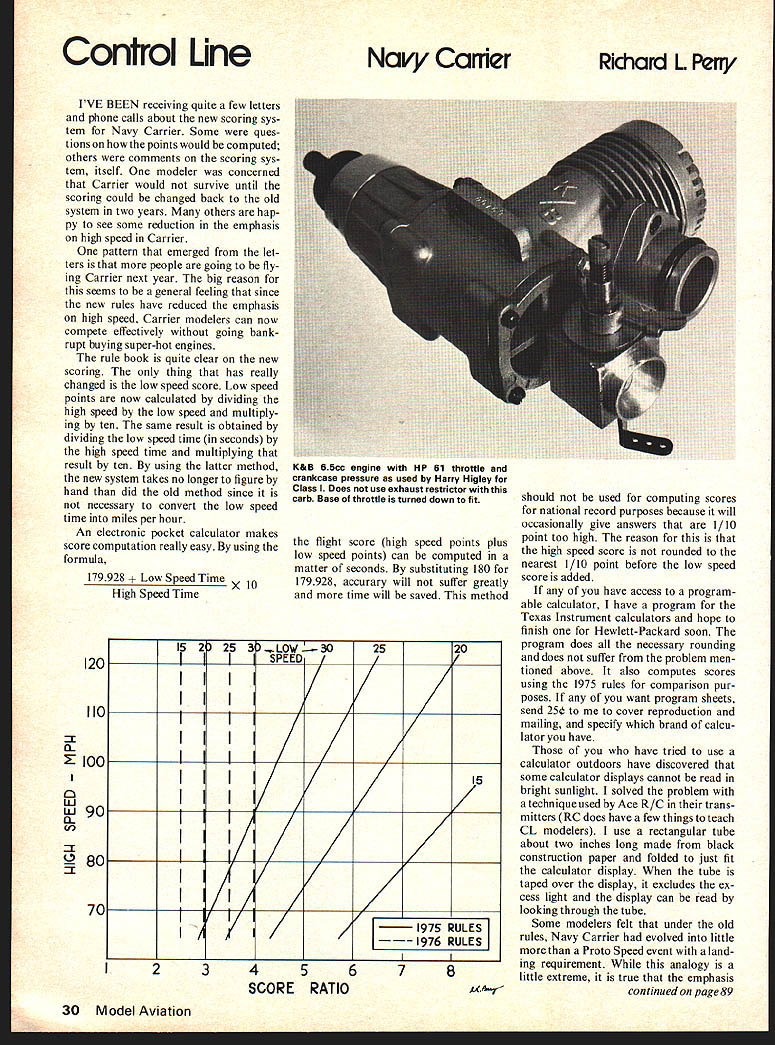
Speed Control: Harry Higley reports good success with his K&B 6.5 cc engine using an HP 61 throttle and crankcase pressure. Harry does not use an exhaust restrictor with this carb. The HP carb is available through Nelson Model Products in Chicago. The only modification needed is to turn down the base of the throttle so that it will fit in the K&B backplate.
New Products: I mentioned the new G-S Products Corp. three-line handle in my review of the G-S bellcrank last year. I've had a chance to look at the production versions of both units, and they look good. Both operate very freely. The handle is similar to the Sturdi-built handle, but with some important changes. The G-S handle uses steel throughout instead of aluminum, and the G-S unit has 24% greater throttle movement. The throttle trigger is positioned 1/4 to 3/8 in. closer to the rear of the handle which is much more comfortable for me and probably for anyone else who flies with one hand. The G-S handle has much more clearance around the lines where they exit the handle; on low throttle, the handle can be moved up or down 60° before the lines contact the handle or frame — a four-fold improvement in this area. G-S Products Corp., Int'l., P.O. Box 488, LaGrande, OR 97850.
(My address is: 5016 Angelita Ave., Dayton, OH 45424.)
Transcribed from original scans by AI. Minor OCR errors may remain.

