
Control Line: Navy Carrier
Author
Dick Perry
THE WINNER of the Mystery Plane contest for the May issue was Bob Colton. Bob was selected from the eight readers who correctly identified the Brewster XSB2A-1 Buccaneer. Bob sent along a copy of an article covering the full range of Brewster bombers as described in my last column. Bob has a slight advantage over most of us in identifying planes of the 1930s and 1940s—he taught aircraft identification in the military during World War II.
The good proportions of the Buccaneer haven't gone unnoticed. Tom Schaefer, a top Carrier competitor from New Jersey, has built and flown two. His accounts of them describe 350/365-point capability in Class I using an HP .40 on suction with a Perry carb.
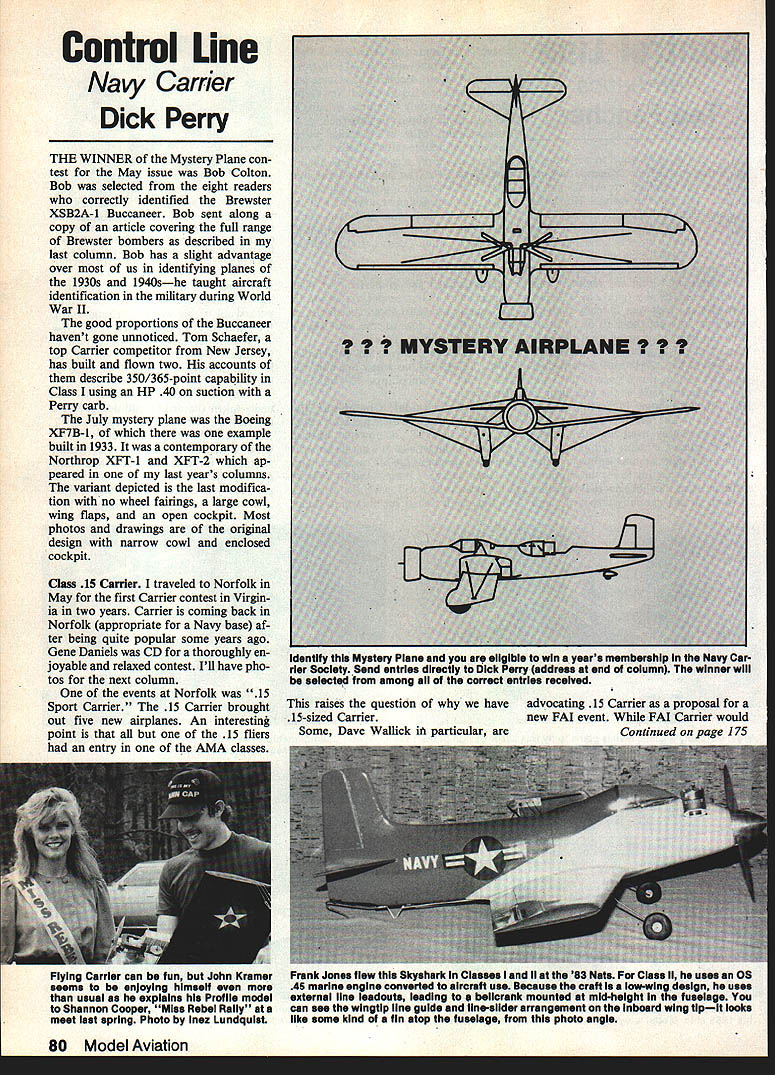
The July mystery plane was the Boeing XF7B-1, of which there was one example built in 1933. It was a contemporary of the Northrop XFT-1 and XFT-2 which appeared in one of my last year's columns. The variant depicted is the last modification with no wheel fairings, a large cowl, wing flaps, and an open cockpit. Most photos and drawings are of the original design with narrow cowl and enclosed cockpit.
Class .15 Carrier
I traveled to Norfolk in May for the first Carrier contest in Virginia in two years. Carrier is coming back in Norfolk (appropriate for a Navy base) after being quite popular some years ago. Gene Daniels was CD (Contest Director) for a thoroughly enjoyable and relaxed contest. I'll have photos for the next column.
One of the events at Norfolk was ".15 Sport Carrier." The .15 Carrier brought out five new airplanes. An interesting point is that all but one of the .15 fliers had an entry in one of the AMA classes.
This raises the question of why we have .15-sized Carrier. Some, Dave Wallick in particular, are advocating .15 Carrier as a proposal for a new FAI event. While FAI Carrier would be great, I question the need to create a new class when the Canadians and the British already have experience in Class I with a recognized FAI engine displacement limit of 66 cm3 for FAI Pylon. An FAI event based on Class I should be just as acceptable as a .15-sized class—probably more so because of established safety factors and experience in the event.
If .15 Carrier is to provide an easy event for beginners to use as a stepping-stone into the other Carrier events, then it doesn't seem to be working, since most people who fly .15 Carrier fly the AMA classes, too.
If the .15 class is intended as a low-cost, low-pressure, fun event for people who already enjoy the AMA events, then it is probably succeeding. As a local event with rules that vary from one area to the next, it will likely continue to fill that need.
The advantage of local events with local rules is that the rules can be tailored to fit the local situation. Pressure can be brought to bear whenever someone starts to take the event too seriously, or the rules can be changed as often as necessary to equalize competition or control cost.
Although there is some interest in adopting a .15 class of Carrier as a supplemental AMA event, I think that such an event should remain a local event only. If there is to be any standardization, it should probably be very general in nature (line length and diameter, engine size, etc.) to ensure safety without restricting local clubs from changing the rules as required to meet local needs. Such standardization would best come from the Navy Carrier Society, not the AMA.
Safety of large models
There has been some concern expressed about the safety of the large Class II ships that are becoming more popular. Most good .65 engines weigh over 20 ounces (some, like the Pico, are even heavier), and some fliers use a lot of wingtip weight (the max I've heard of so far is eight ounces). Under those conditions, it takes a bit of skill and careful planning to build a large Class II model under four pounds. The concern is generated when a flier puts 10, 12, or even 16 ounces of fuel on board, thereby producing a flying weight of nearly five pounds.
Heavy, high-performance Class II ships are not new; Terry Herron's four-pound Judy was faster 10 years ago than the majority of today's Class II models. While some care is required in constructing control systems and lines and in using proper line connectors, such as the Sullivan connectors tested at 110 pounds, there is no safety problem. Properly maintained lines have a good safety margin, and the pull test of 25 Gs (100 pounds max) exceeds the flight load of even a five-pound model at speeds up to 135 mph. The only concern should be that a proper pull test is used to confirm the integrity of the control system.
Three-view source
Cam Martin sent me a plans listing from Aviation News Plans Service, 226 High Street, Berkhamsted, Herts, England HP4 1AD which contains numerous aircraft plans useful for Carrier modeling. Highlights include:
- 21 Royal Navy aircraft plans
- 36 U.S. Navy aircraft plans
- Plans are in 1/72 scale and should be good for scale documentation or designing an original Carrier ship
I will duplicate the list for anyone interested. Please send 30¢ in stamps for postage and reproduction.
Until next time—stay safe and stay dry.
Richard L. Perry 7578 Vogels Way, Springfield, VA 22153.
Transcribed from original scans by AI. Minor OCR errors may remain.

