
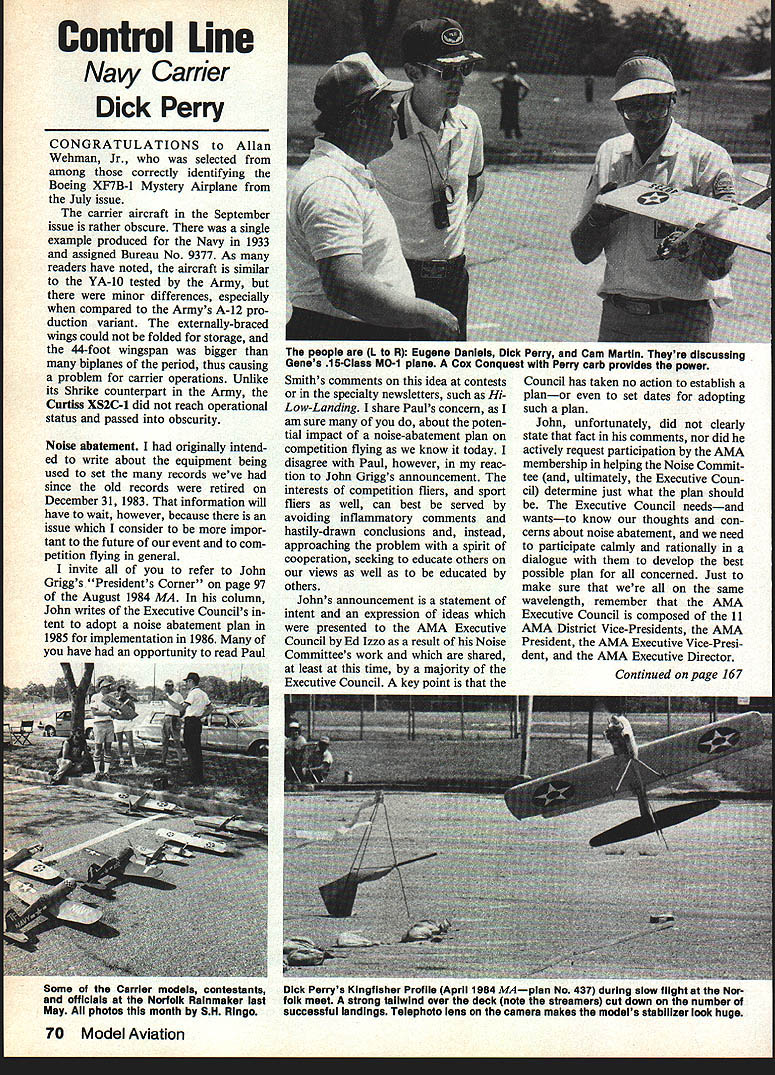
Control Line: Navy Carrier
By Dick Perry
Congratulations to Allan Wehman, Jr., who was selected from among those correctly identifying the Boeing XF7B-1 Mystery Airplane from the July issue.
The carrier aircraft
The carrier aircraft in the September issue is rather obscure. There was a single example produced for the Navy in 1933 and assigned Bureau No. 9377. As many readers have noted, the aircraft is similar to the YA-10 tested by the Army, but there were minor differences, especially when compared to the Army's A-12 production variant. The externally braced wings could not be folded for storage, and the 44-foot wingspan was bigger than many biplanes of the period, thus causing a problem for carrier operations. Unlike its Shrike counterpart in the Army, the Curtiss XS2C-1 did not reach operational status and passed into obscurity.
Noise abatement
I had originally intended to write about the equipment being used to set the many records we've had since the old records were retired on December 31, 1983. That information will have to wait, however, because there is an issue which I consider to be more important to the future of our event and to competition flying in general.
I invite all of you to refer to John Griggs' "President's Corner" on page 97 of the August 1984 MA. In his column, John writes of the Executive Council's intent to adopt a noise abatement plan in 1985 for implementation in 1986. Many of you have had an opportunity to read Paul Smith's comments on this idea at contests or in the specialty newsletters, such as Hi-Low-Landing. I share Paul's concern, as I am sure many of you do, about the potential impact of a noise-abatement plan on competition flying as we know it today. I disagree with Paul, however, in my reaction to John Griggs' announcement. The interests of competition fliers, and sport fliers as well, can best be served by avoiding inflammatory comments and hastily drawn conclusions and, instead, approaching the problem with a spirit of cooperation—seeking to educate others on our views as well as to be educated by others.
John's announcement is a statement of intent and an expression of ideas which were presented to the AMA Executive Council by Ed Izzo as a result of his Noise Committee's work and which are shared, at least at this time, by a majority of the Executive Council. A key point is that the Council has taken no action to establish a plan—or even to set dates for adopting such a plan.
John, unfortunately, did not clearly state that fact in his comments, nor did he actively request participation by the AMA membership in helping the Noise Committee (and, ultimately, the Executive Council) determine just what the plan should be. The Executive Council needs—and wants—to know our thoughts and concerns about noise abatement, and we need to participate calmly and rationally in a dialogue with them to develop the best possible plan for all concerned. Just to make sure that we're all on the same wavelength, remember that the AMA Executive Council is composed of the 11 AMA District Vice-Presidents, the AMA President, the AMA Executive Vice-President, and the AMA Executive Director.
What follows are some of my thoughts on noise and modeling.
Competition fliers are a minority of the AMA membership, and competition flying in actual sanctioned contests is a very small portion of the total modeling activity in the United States. Competition flying is, however, the primary driver for research and development and the reason we have the high-quality engines, radios, and other advanced equipment we enjoy today. The best way to encourage manufacturers to develop quieter, high-performance equipment is to create a demand for it among competition fliers. Demand has resulted in the muffled, tuned-pipe development for RC Pattern. CL Precision Aerobatics moved to muffled engines, voluntarily, even earlier.
Developing and producing new engines takes time and money, and short-notice (and often ill-conceived) rule changes have alienated manufacturers in the past. I fear that mandating noise standards in competition less than a year after establishing those standards (as suggested in John's comments) would be extremely detrimental. Equipment cannot be developed, tested, and produced that fast. Remaining competitive would require a continual update of equipment as improvements became available.
A much better alternative to mandatory competition noise standards in 1986 would be to promote a development period during which noise reduction measures would be allowed, and delay mandatory enforcement until at least 1988, and preferably 1990 or later. I emphasized the word "allowed," because many events (CL Speed, Carrier, Racing; FF Power; RC Pylon) have rules which restrict the use of mufflers or tuned pipes. If we must allow the use of mufflers (or tuned pipes) in order to encourage development, then we should do so.
The measurement problem is no small thing. The old "A" weighting network used on many meters gives results which do not correlate well with human perception, and many low-frequency noises are underweighted. Octave-band analyzers and "C" weighting may be more appropriate. In addition, the proper test procedure must be developed—engine rpm, propeller used, engine position, background noise, and the location of the microphone must all be standardized. The measurement should be made at pilot hearing height at 25 feet from the flight line with the airplane in the configuration used for flight.
Education is important. Modelers and the general public must be educated on proper engine operation, tuning, and the benefits of noise reduction. We can promote courteous operation, better starting procedures, and better listening tours. The problem is solvable but will take time, money, and common sense.
If we have noise regulations in competition flying, I would prefer to set standards, drop the exhaust restrictions which now exist, and allow competitors and manufacturers to develop competitive, low-noise systems over the course of a few years. This way, existing equipment would not be made immediately obsolete, and a gradual transition could occur. It might even happen voluntarily!
The standards themselves deserve considerable attention. Noise-level standards, as in FAI RC Pattern, seem to me to be extremely difficult to enforce accurately without a great deal of expense, and accuracy is essential for regulating the performance events. What of the individual? We would each need access to sound-level-measuring equipment, and it would need to be accurately calibrated.
A much more easily enforced standard would be one similar to that which exists in FAI RC Pylon, in which an exhaust system must have an expansion chamber of at least a certain volume and an outlet of no more than a specified area. That should reduce engine noise, but will do nothing to reduce the noise from the propeller.
The data produced by the AMA Noise Committee (and published on page 118 of the July 1983 MA) points to propeller noise as a major contributor to total noise on a competition model. It would be almost impossible to meet FAI Pattern noise restrictions (100 dB at one meter) with any existing performance-event model (Speed, Carrier, Racing, Combat, FF Power, RC Pylon) without a complete change of equipment.
Mandated, revolutionary change is contrary to AMA's own guidelines for competition rules, and acceptance would be resisted by modelers. Evolutionary change, however, has been the accepted pattern for years of competition flying. Once again, noise level standards, unless they are much less restrictive than the FAI Pattern standard, do not seem an acceptable alternative, while equipment specifications could be tolerated, if a gradual transition were allowed.
Recommendations
Finally, any plan to reduce noise in modeling should include the following concepts:
- It should actively involve manufacturers.
- It should apply equally to sport and competition flying.
- It should follow all procedures and schedules of the AMA Contest Board for any regulations which will affect competition flying.
- It should include a campaign to get noise regulations into FAI events. (We cannot enforce U.S. noise rules on FAI events in this country and remain competitive in world competition.)
- It should address the concerns of the AMA membership as its highest priority.
The last point is the most important, in my opinion. If you do not participate in the process, you cannot complain about the results. Write or talk to Ed Izzo (District I VP) and your own VP, and let them know what you think.
Richard L. Perry 7578 Vogels Way Springfield, VA 22153
Transcribed from original scans by AI. Minor OCR errors may remain.

