
Control Line: Navy Carrier
Dick Perry
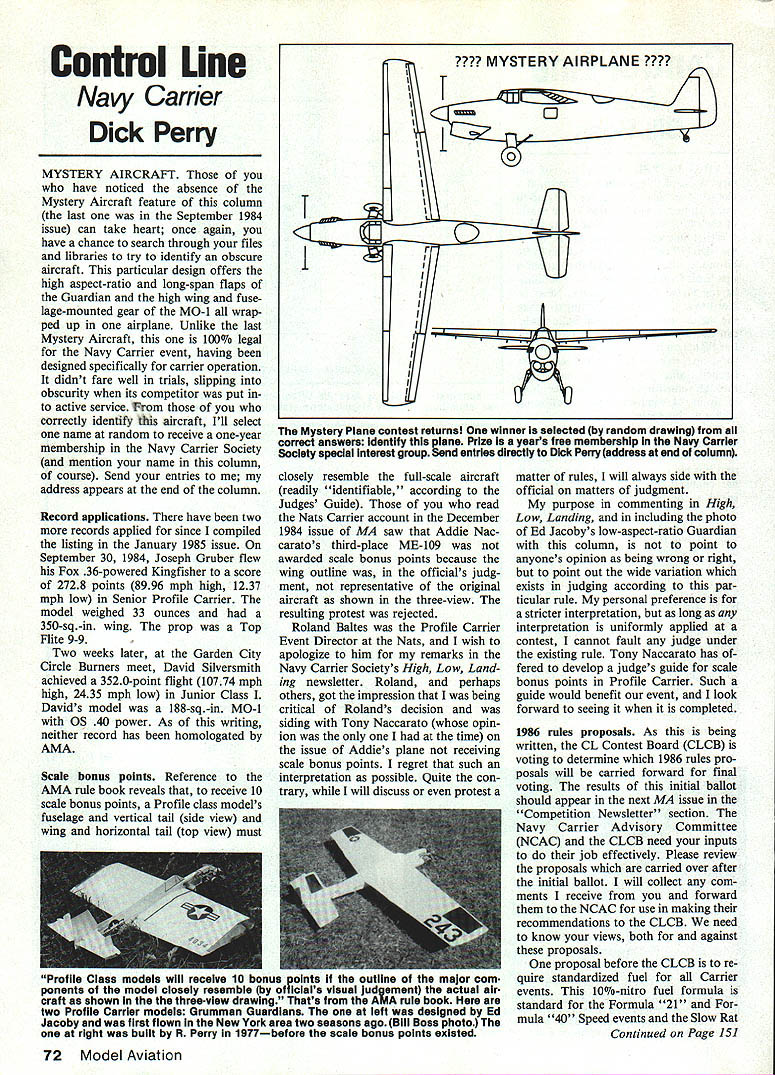
Mystery Aircraft
Those of you who noticed the absence of the Mystery Aircraft feature (the last one ran in the September 1984 issue) can take heart — it returns. Once again you have a chance to search your files and libraries to identify an obscure aircraft. This particular design combines the high aspect-ratio, long-span flaps of the Guardian with the high wing and fuselage-mounted gear of the MO-1. Unlike the last Mystery Aircraft, this one is 100% legal for the Navy Carrier event — it was designed specifically for carrier operation. It did not fare well in trials and slipped into obscurity when its competitor was put into active service.
From those who correctly identify this aircraft I will select one name at random to receive a one-year membership in the Navy Carrier Society (and I’ll mention the winner in this column). Send entries to me; my address appears at the end of the column.
Record applications
Two more record applications have been filed since the listing in the January 1985 issue:
- September 30, 1984 — Joseph Gruber flew a Fox .36–powered Kingfisher to a score of 272.8 points (89.96 mph high, 12.37 mph low) in Senior Profile Carrier. The model weighed 33 ounces and had a 350‑sq‑in wing. The prop was a Top Flite 9‑9.
- Mid‑October 1984 (Garden City Circle Burners meet) — David Silversmith achieved a 352.0‑point flight (107.74 mph high, 24.35 mph low) in Junior Class I. David’s model was a 188‑sq‑in MO‑1 with .05‑.40 power.
As of this writing, neither record has been homologated by the AMA.
Scale bonus points
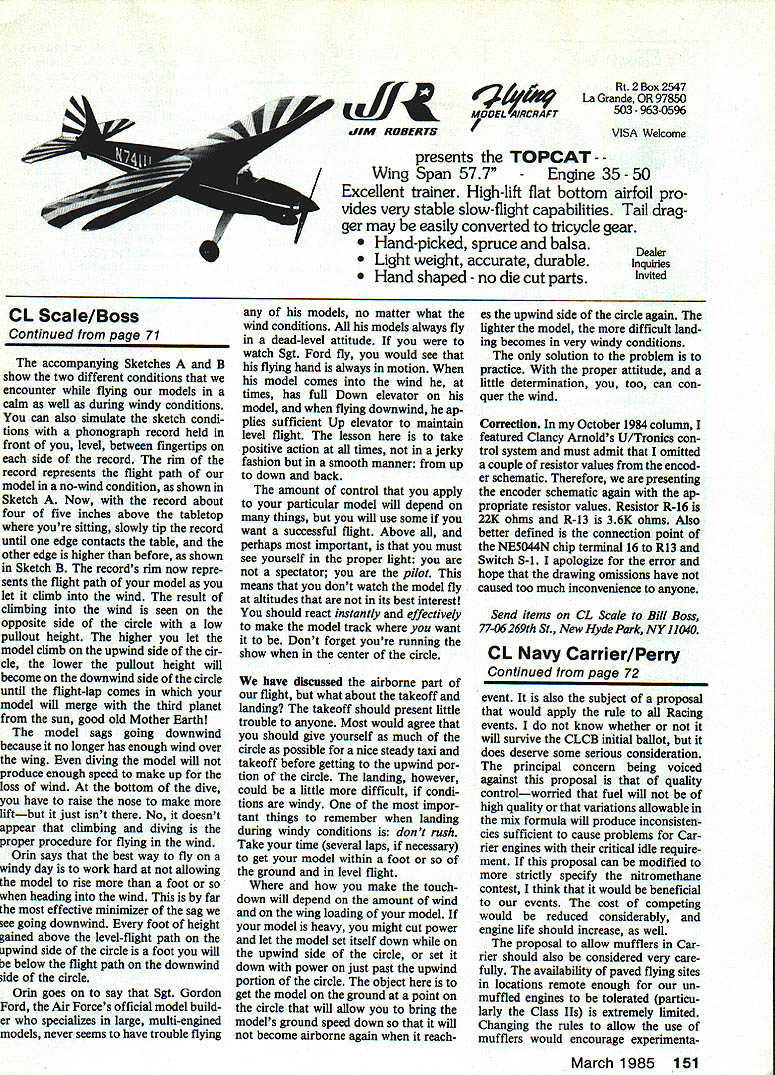
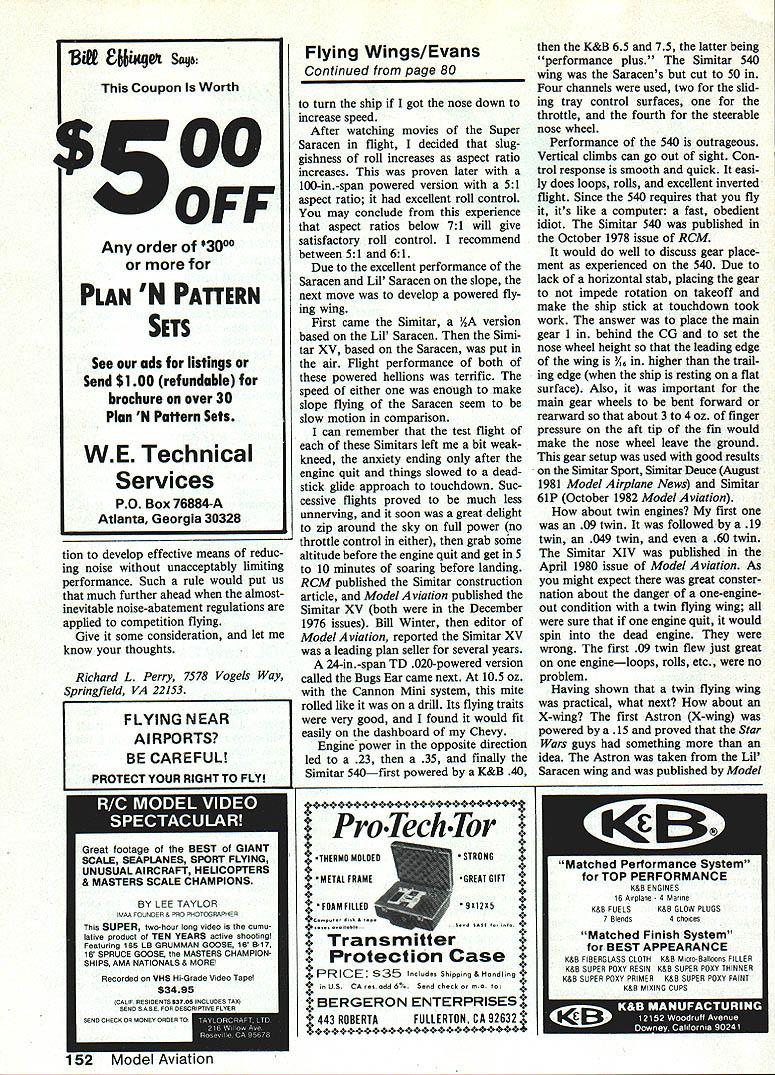
Reference to the AMA rule book shows that to receive the 10 scale bonus points, a Profile class model’s fuselage and vertical tail (side view) and wing and horizontal tail (top view) must closely resemble the full‑scale aircraft (the Judges’ Guide calls this "readily identifiable"). At the Nats Carrier event (see the December 1984 issue of MA) Addie Naccarato’s third‑place ME‑109 was denied scale bonus points because the wing outline, in the official’s judgment, did not represent the original aircraft as shown in the three‑view. The resulting protest was rejected.
Tony Naccarato has offered to develop a Judges’ Guide for awarding scale bonus points in Profile Carrier. Such a guide would benefit the event, and I look forward to seeing it when completed.
Apology and judging philosophy
I wish to apologize to Roland Baltes, Profile Carrier Event Director at the Nats, for remarks in the Navy Carrier Society’s High, Low, Landing newsletter that may have given the impression I was critical of Roland’s decision or was siding with Tony Naccarato. I regret that such an interpretation was possible.
To be clear: while I will discuss or even protest matters of rules, I will always side with the official on matters of judgment. My purpose in commenting (and in including the photo of Ed Jacoby’s low‑aspect‑ratio Guardian with this column) is not to mark anyone’s opinion right or wrong but to point out the wide variation that exists in judging under this rule. My personal preference is for a stricter interpretation, but as long as any interpretation is applied uniformly at a contest I cannot fault a judge under the existing rule.
1986 rules proposals
As this is written, the CL Contest Board (CLCB) is voting to determine which 1986 rules proposals will be carried forward for final voting. The results of this initial ballot should appear in the next MA issue in the Competition Newsletter section. The Navy Carrier Advisory Committee (NCAC) and the CLCB need your input to do their job effectively. Please review the proposals that are carried over after the initial ballot; I will collect any comments I receive and forward them to the NCAC for use in making recommendations to the CLCB. We need to know your views, both for and against the proposals.
One proposal before the CLCB is to require standardized fuel for all Carrier events — a 10% nitro fuel formula (the standard for Formula 21 and Formula 40 Speed events and the Slow Rat event). Points to consider:
- Pros: reduced cost of competing, increased engine life, improved reliability if quality is controlled.
- Cons: quality control concerns — variations in mix or fuel quality could produce inconsistent results and might affect Carrier engines’ critical idle requirements.
If this proposal can be modified to more strictly specify the nitromethane content, I think it would be beneficial to our events.
The proposal to allow mufflers in Carrier should also be considered very carefully. The availability of paved flying sites remote enough for muffled engines to be tolerated (particularly the Class II's) is extremely limited. Changing the rules to allow mufflers would encourage experimentation with muffler systems and could shift the balance of performance and accessibility; because of site and noise restrictions, the change could have unintended consequences. Those tradeoffs deserve careful discussion before any rule change is adopted.
Transcribed from original scans by AI. Minor OCR errors may remain.

