
Control Line: Navy Carrier
Byline
Dick Perry
Mystery Aircraft
The high-wing, high-aspect-ratio carrier aircraft in the March issue was the Supermarine Type 322, which carried the nickname "Dumbo." It was built to specification S.24/37 as a carrier-based torpedo-bomber/reconnaissance aircraft. It had a unique, variable-incidence wing which allowed the wing to reach the very high angles of attack possible with full-span leading-edge slats while keeping the fuselage relatively level for good pilot visibility during approach and landing. Because Supermarine was also busy with the Spitfire at the time, the Type 322 was considered a rather low priority and did not fly until 1943.
The other aircraft built to that specification was the Fairey Barracuda, which served with the Royal Navy's Fleet Air Arm through the latter part of World War II and into the early 1950s.
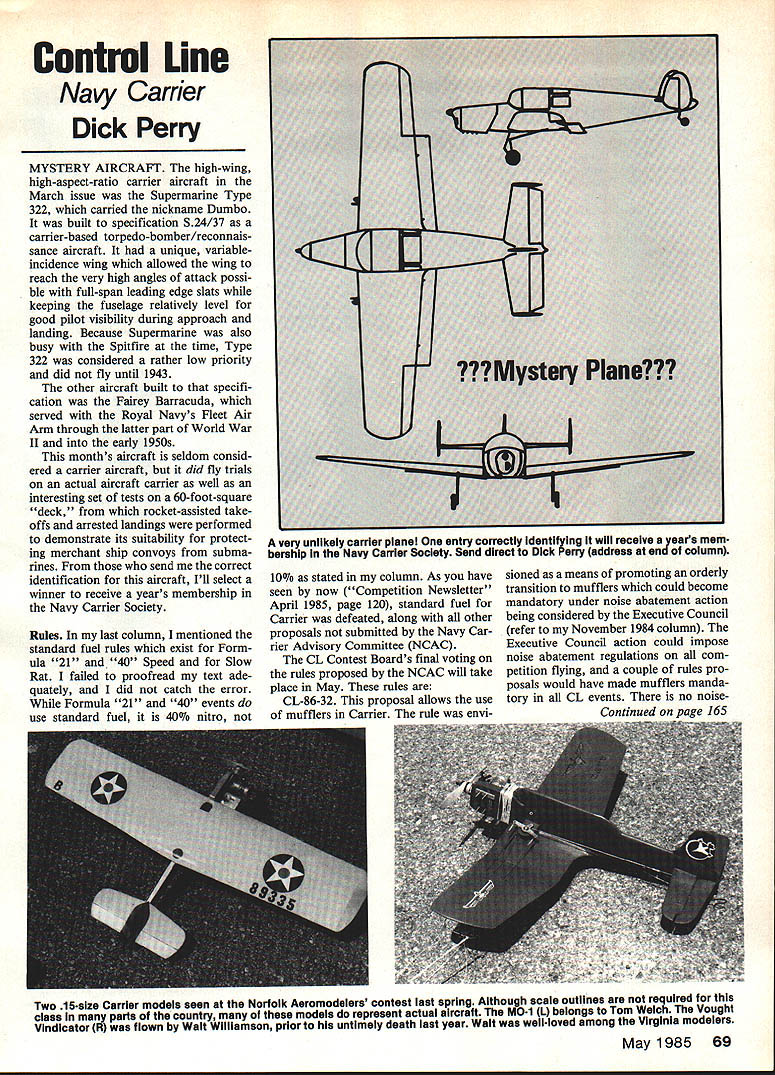
This month's aircraft is seldom considered a carrier aircraft, but it did fly trials on an actual aircraft carrier as well as an interesting set of tests on a 60-foot-square "deck," from which rocket-assisted takeoffs and arrested landings were performed to demonstrate its suitability for protecting merchant ship convoys from submarines. From those who send me the correct identification for this aircraft, I'll select a winner to receive a year's membership in the Navy Carrier Society.
Rules
In my last column, I mentioned the standard fuel rules which exist for Formula "21" and "40" Speed and for Slow Rat. I failed to proofread my text adequately and did not catch the error. While Formula "21" and "40" events do use standard fuel, it is 40% nitro, not 10% as stated in my column. As you have seen by now ("Competition Newsletter," April 1985, page 120), standard fuel for Carrier was defeated, along with all other proposals not submitted by the Navy Carrier Advisory Committee (NCAC).
The CL Contest Board (CLCB)'s final voting on the rules proposed by the NCAC will take place in May. These rules are:
- CL-86-32: This proposal allows the use of mufflers in Carrier. The rule was envisioned as a means of promoting an orderly transition to mufflers which could become mandatory under noise-abatement action being considered by the Executive Council (refer to my November 1984 column). The Executive Council action could impose noise-abatement regulations on all competition flying, and a couple of rules proposals would have made mufflers mandatory in all CL events. There is no noise-abatement program yet from the Executive Council, and the muffler rules were deferred on the initial Contest Board ballot.
- CL-86-33: This proposal would exempt CL Navy Carrier from noise-abatement regulations. It was proposed, when Executive Council action was expected to be applied to competition events in 1986, in order to allow a more gradual transition and avoid making all existing equipment obsolete immediately.
- CL-86-35: This proposal would preserve the scale outlines of Carrier aircraft, in the event that CL-86-32 passes, by requiring pipes and mufflers to be either external to the model or enclosed within it.
- CL-86-34: This proposal specifies that Carrier models are to weigh a maximum of four pounds in flight configuration but without fuel. This corresponds to universally accepted practice for all other CL events. CL-86-34 is likely to receive a favorable recommendation from the NCAC; the outcome of the other proposals is uncertain until after the NCAC has further discussed the proposals and voted. Much of the original reason for the muffler-related proposals seems to have been diminished by the defeat of the muffler rules by the CLCB.
New records
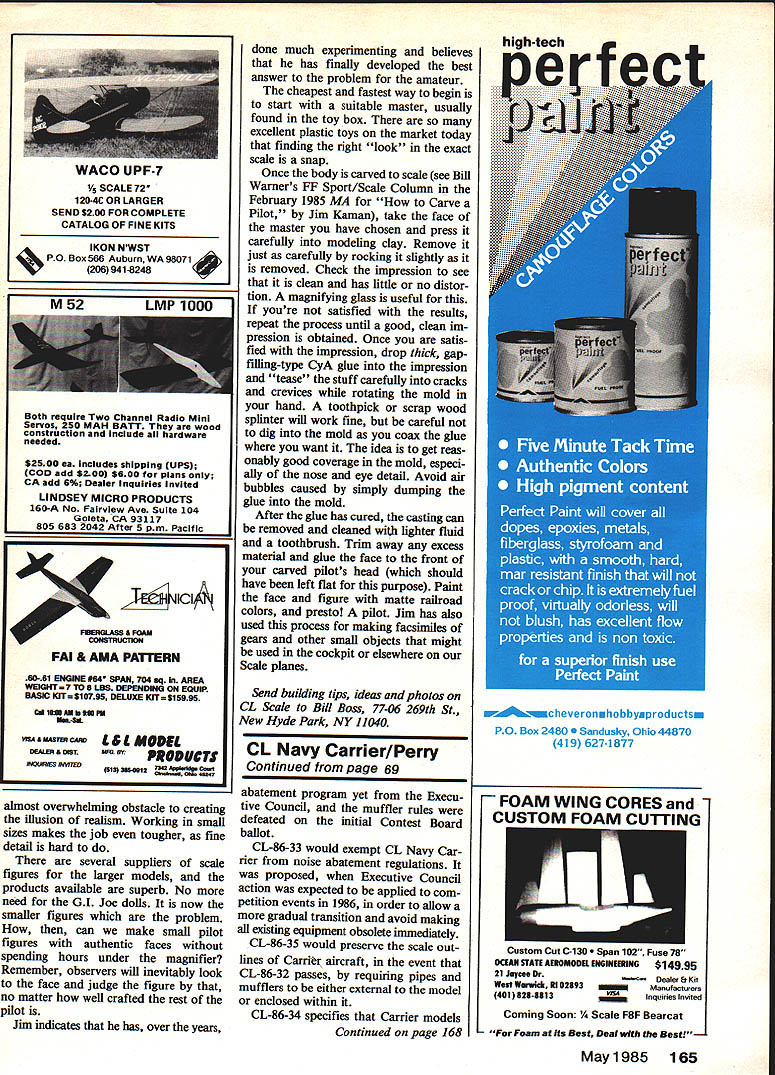
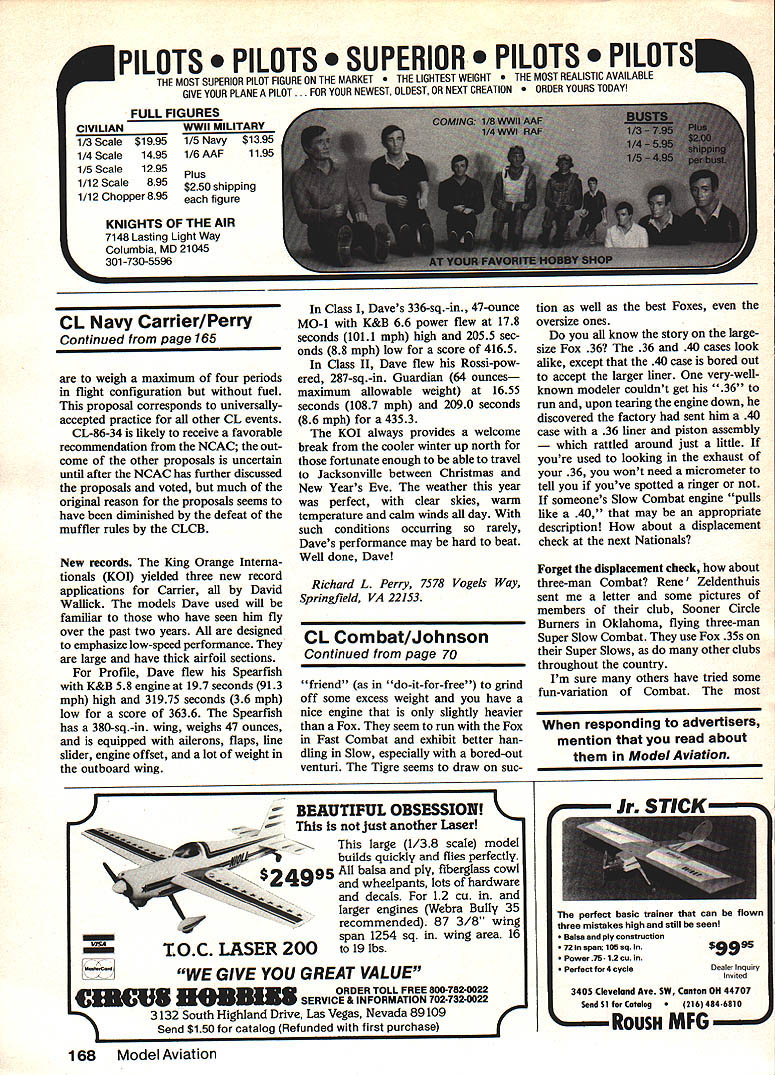
The King Orange Internationals (KOI) yielded three new record applications for Carrier, all by David Wallick. The models Dave used will be familiar to those who have seen him fly over the past two years. All are designed to emphasize low-speed performance. They are large and have thick airfoil sections.
- Profile: Dave flew his Spearfish with a K&B .5 engine at 19.7 seconds (91.3 mph) high and 319.75 seconds (3.6 mph) low for a score of 363.6. The Spearfish has a 380 sq.-in. wing, weighs 47 ounces, and is equipped with ailerons, flaps, line slider, engine offset, and a lot of weight in the outboard wing.
- Class I: Dave's 336 sq.-in., 47-ounce MO-1 with K&B 6.6 power flew at 17.8 seconds (101.1 mph) high and 205.5 seconds (8.8 mph) low, for a score of 416.5.
- Class II: Dave flew his Rossi-powered, 287 sq.-in. Guardian (64 ounces — maximum allowable weight) at 16.5 seconds (108.7 mph) high and 209.0 seconds (8.6 mph) low for a score of 435.3.
The KOI always provides a welcome break from the cooler winter up north for those fortunate enough to travel to Jacksonville between Christmas and New Year's Eve. The weather this year was perfect, with clear skies, warm temperatures, and calm winds all day. With such conditions occurring so rarely, Dave's performance may be hard to beat. Well done, Dave!
Richard L. Perry 7578 Vogels Way Springfield, VA 22153.
Transcribed from original scans by AI. Minor OCR errors may remain.

