
Control Line: Navy Carrier
By Dick Perry
OOPS!
In the last column I mistakenly listed the .15-sized MO-1 as belonging to Tom Welsh. My apologies to Jim Welsh, the true owner.
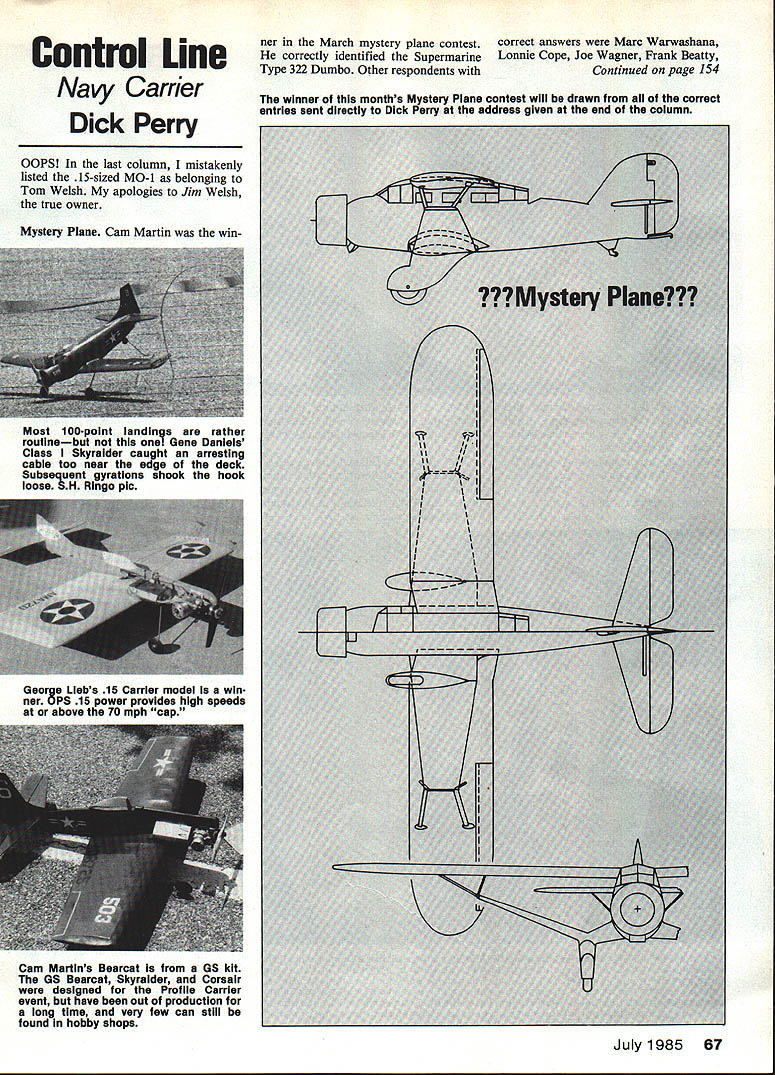
Mystery Plane
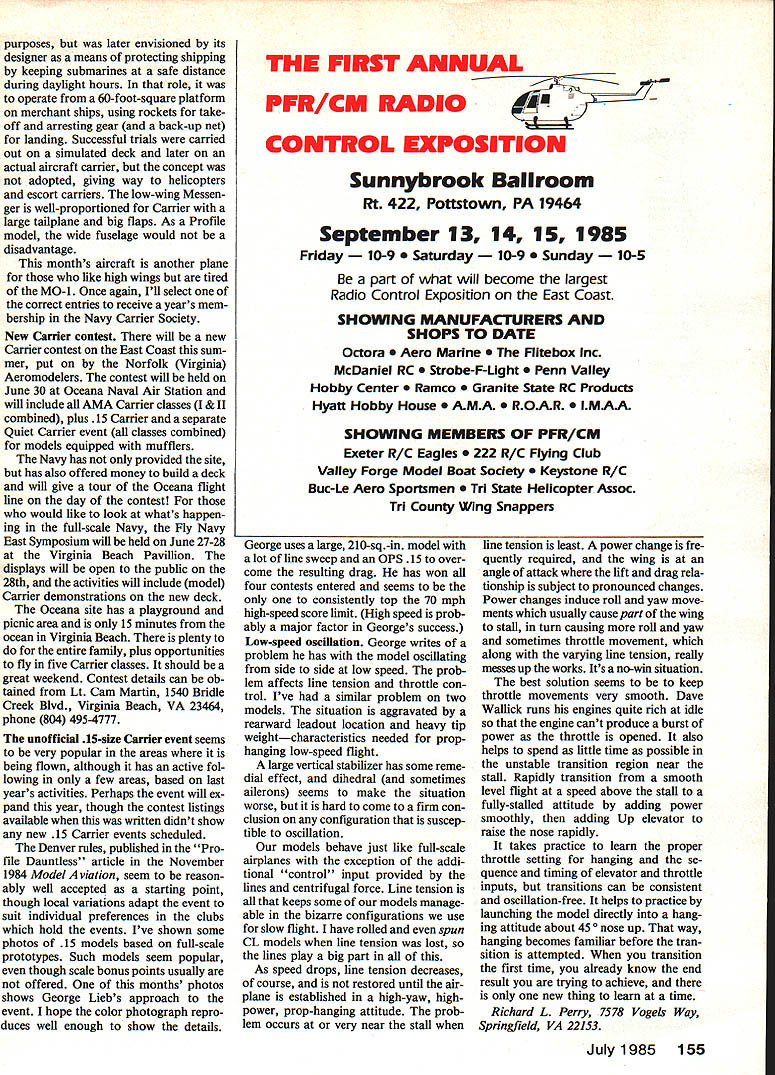
Cam Martin was the winner in the March mystery plane contest. He correctly identified the Supermarine Type 322 Dumbo. Other respondents with correct answers were Marc Warwashana, Lonnie Cope, Joe Wagner, and Frank Beatty.
The winner of this month's Mystery Plane contest will be drawn from all correct entries sent directly to Dick Perry at the address given at the end of the column.
Engine-size proposal
Although it has a slight disadvantage, this proposal would obsolete the .36 as far as competition use goes. Availability, lighter weight, and less power (for slowing down the models) are usually cited as reasons for such a change. Any engine/model changes really affect fewer than a hundred national and regional competitors, so no need to worry. Local flyers can run whatever they want (as long as two of you can agree).
Henry Nelson engines — assembly and testing
I talked with Jed Kusik the other day before he left for his new job working with Henry Nelson. Henry's engine business has really taken off. Don't wait until a week before the Nationals or Team Trials to order your engines! Even though they have orders for hundreds from overseas and other people around the world, Henry won't sneer at your two-engine order. He will put it in line with the rest, Jed said.
Jed has spent most of his time doing work on engines that had been sent in for repair, so that backlog should be cleared long before you read this. He is also assembling and testing every unit. They must meet a very high standard before they are shipped; units that don't perform are closely scrutinized to find out why. Jed said that positioning of the liner in the case is very critical. Even a tiny amount of misalignment causes a large drop in power. If you're into engine disassembly at every opportunity, be careful about liner positioning.
Head clearance is another major factor. Most people run the head down tighter until they start popping plugs and then back it off a few thousandths. Overcompressing seems to be one of the major problems with engines that don't run up to par.
Before you complain about any engine, be sure to test-run it on a very strong test bench and see how it performs. Loose mounts (or ones that distort the case when tightened) will kill the performance of any engine, regardless of the care taken in manufacture. You can take it from several people at the World Championships that they saw their engines pick up a couple of thousand rpm when run on Henry's test bench.
Props
Besides the usual 140 mph models to report on, another useful item is the Zinger 8x6 prop, which many of you think is too small for a Fast or Slow Combat model. It works great in the turns with a full streamer, and that's really the measure of any good prop. These props are widely available and cheaper than a lot of the others on the market. Remember: test your props using a full competition streamer both in level flight and through a series of maneuvers.
MACA Top Twenty for 1984
- Larry Driskill ..........................................195
- Tom Fluker ..............................................191
- Richard Stubblefield .................................164
- Paul Smith ..............................................121
- Chris Gay ................................................120
- Steve Kott ...............................................114
- Pete Athans ............................................99
- Jerry Sabin ..............................................93
- Don Cranfil .............................................72
- Bud Bodzioch ..........................................66
- Al Jorgensen ...........................................61
- Gary Byerely ..........................................55
- Joe McKenzie .........................................55
- Phil Cartier .............................................54
- Bill Lajack .............................................50
- Ron Malcolm ............................................47
- Jeff Johnson ............................................46
- John Salvin III .........................................45
- Ed Brzys ................................................43
- Don Holbrook ..........................................33
Contacts and names
- Charlie Johnson, 3716 Ingraham St., San Diego, CA 92109.
- Bob Heywood, Monty Greenly, and Bernard Klein.
May mystery aircraft
The May mystery aircraft was the Miles M.38 Messenger. An unlikely carrier aircraft, it was originally designed for other purposes, but was later envisioned by its designer as a means of protecting shipping by keeping submarines at a safe distance during daylight hours. In that role it was to operate from a 60-foot-square platform on merchant ships, using rockets for takeoff and arresting gear (and a back-up net) for landing. Successful trials were carried out on a simulated deck and later on an actual aircraft carrier, but the concept was not adopted, giving way to helicopters and escort carriers.
The low-wing Messenger is well proportioned for Carrier with a large tailplane and big flaps. As a profile model, the wide fuselage would not be a disadvantage.
This month's aircraft is another plane for those who like high wings but are tired of the MO-1. Once again, I'll select one of the correct entries to receive a year's membership in the Navy Carrier Society.
New Carrier contest (East Coast)
There will be a new Carrier contest on the East Coast this summer, put on by the Norfolk (Virginia) Aeromodelers.
- When: June 30
- Where: Oceana Naval Air Station
- Classes: All AMA Carrier classes (I & II combined), plus .15 Carrier and a separate Quiet Carrier event (all classes combined) for models equipped with mufflers.
- Notes: The Navy has provided the site, offered money to build a deck, and will give a tour of the Oceana flight line on the day of the contest. For those who want to see full-scale Navy activity, the Fly Navy East Symposium will be held June 27–28 at the Virginia Beach Pavilion. The displays will be open to the public on the 28th, and activities will include model Carrier demonstrations on the new deck. Oceana has a playground and picnic area and is only 15 minutes from the ocean in Virginia Beach.
Contest details: Lt. Cam Martin, 1540 Bridle Creek Blvd., Virginia Beach, VA 23464, phone (804) 495-4777.
.15-size Carrier event
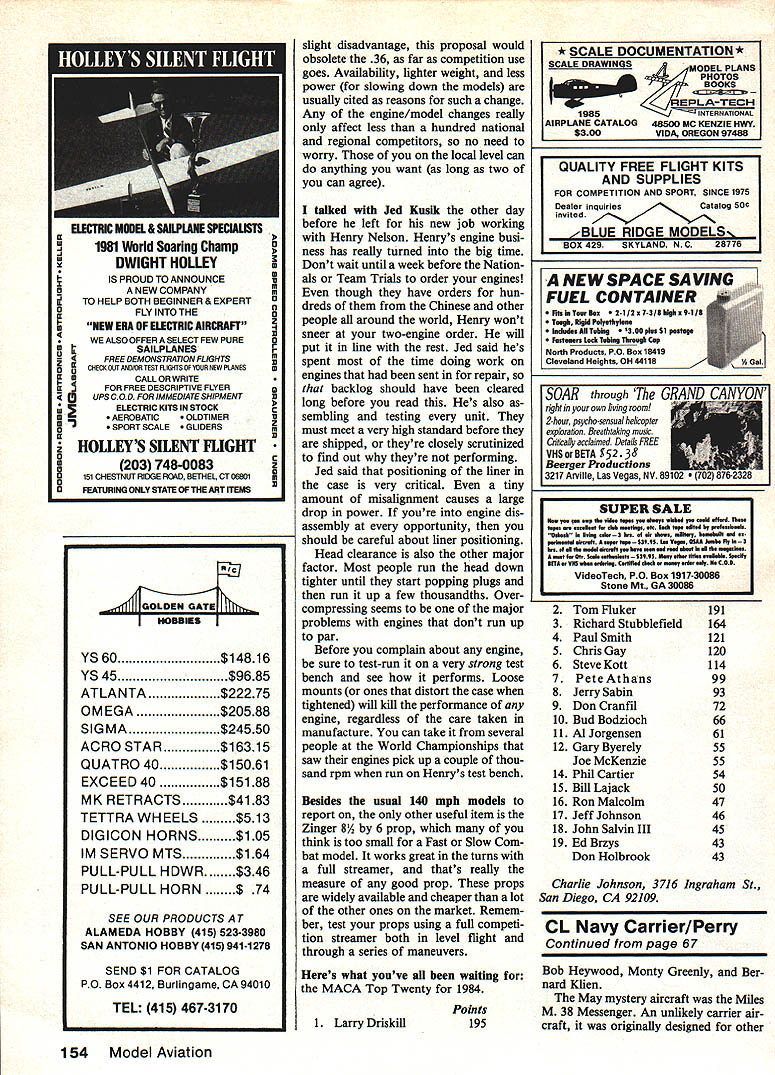
The unofficial .15-size Carrier event seems very popular where it is flown, although it has an active following in only a few areas based on last year's activities. Perhaps the event will expand this year, though the contest listings available when this was written didn't show any new .15 Carrier events scheduled.
The Denver rules, published in the "Profile Dauntless" issue in the November 1984 Model Aviation, seem to be reasonably well accepted as a starting point, though local variations adapt the event to suit individual club preferences. I'm shown some photos of .15 models based on full-scale prototypes. Such models seem popular, even though scale bonus points usually are not offered.
One of this month's photos shows George Lieb's approach to the event. George uses a large, 210-sq.-in. model with a lot of line sweep and an OS .15 to overcome the resulting drag. He has won all four contests entered and seems to be the only one to consistently top the 70 mph high-speed score limit. High speed is probably a major factor in George's success.
Low-speed oscillation
George writes of a problem he has with his model oscillating from side to side at low speed. The problem affects line tension and throttle control. I've had a similar problem on two models. The situation is aggravated by a rearward leadout location and heavy tip weight—characteristics needed for proper low-speed flight.
A large forward stabilizer has some remedial effect; dihedral (and sometimes ailerons) seems to make the situation worse. It's hard to reach a firm conclusion on any configuration that is susceptible to oscillation.
Our models behave like full-scale airplanes with the exception of the additional "control" input provided by the lines and centrifugal force. Line tension is all that keeps some of our models manageable in the bizarre configurations we use for slow flight. I have flown and even spun CL models when line tension was lost, so the lines play a big part in all of this.
As speed drops, line tension decreases and is not restored until the airplane is established in a high-yaw, high-power, prop-hanging attitude. The problem occurs at or very near the stall when line tension is least. A power change is frequently required, and the wing is at an angle of attack where the lift and drag relationship is subject to pronounced changes. Power changes induce roll and yaw movements which usually cause part of the wing to stall, in turn causing more roll and yaw and sometimes throttle movement; along with the varying line tension, this really messes up the works. It's a no-win situation.
The best solution seems to be to keep throttle movements very smooth. Dave Wallick runs his engines quite rich at idle so the engine can't produce a burst of power as the throttle is opened. It also helps to spend as little time as possible in the unstable transition region near the stall. Rapidly transition from a smooth level flight at a speed above the stall to a fully stalled attitude by adding power smoothly, then adding up elevator or raising the nose rapidly.
It takes practice to learn the proper throttle setting for high speed and the sequence and timing of elevator and throttle inputs, but transitions can be consistent and oscillation-free. Practice by launching the model directly into a hanging attitude about 45° nose up so hanging becomes familiar before the transition is attempted. When you transition the first time, you already know the end result you are trying to achieve, and there is only one new thing to learn at a time.
Richard L. Perry 7578 Vogels Way, Springfield, VA 22153.
Transcribed from original scans by AI. Minor OCR errors may remain.

