
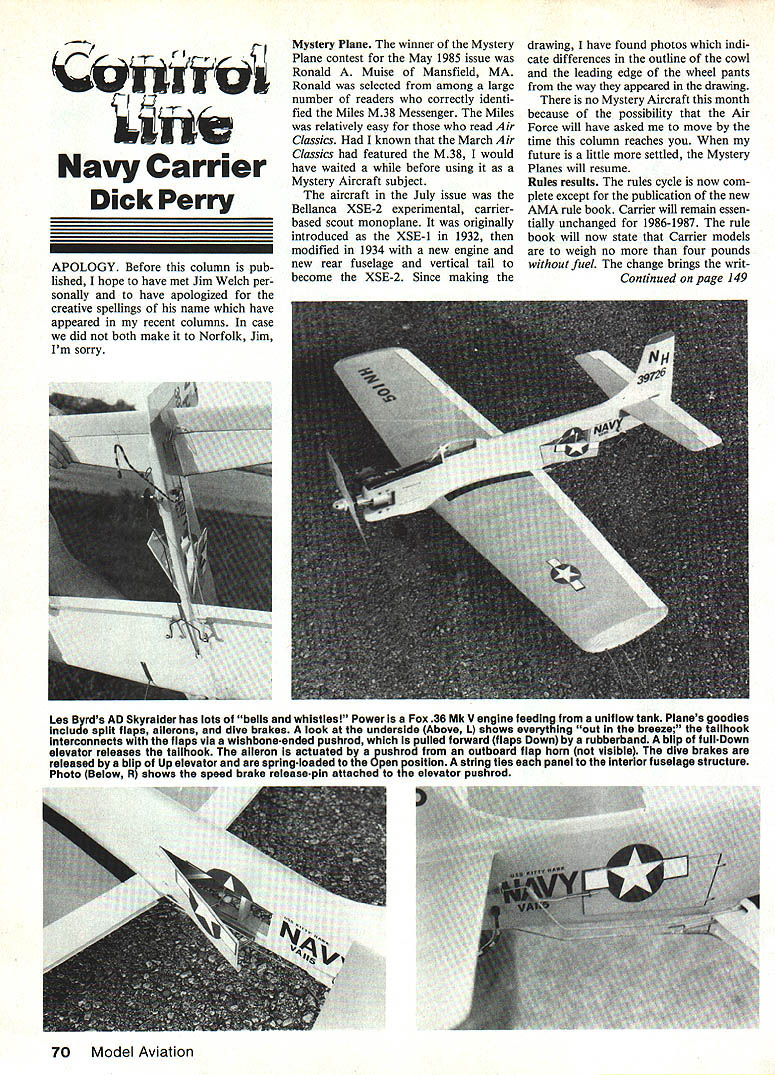
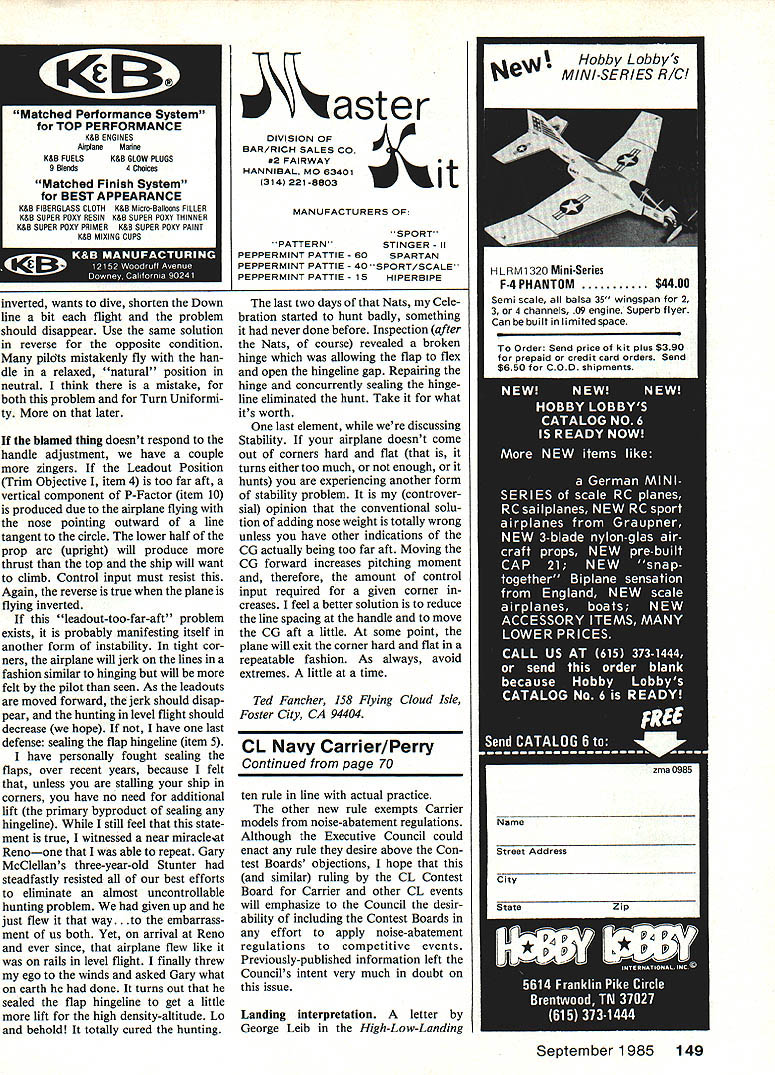
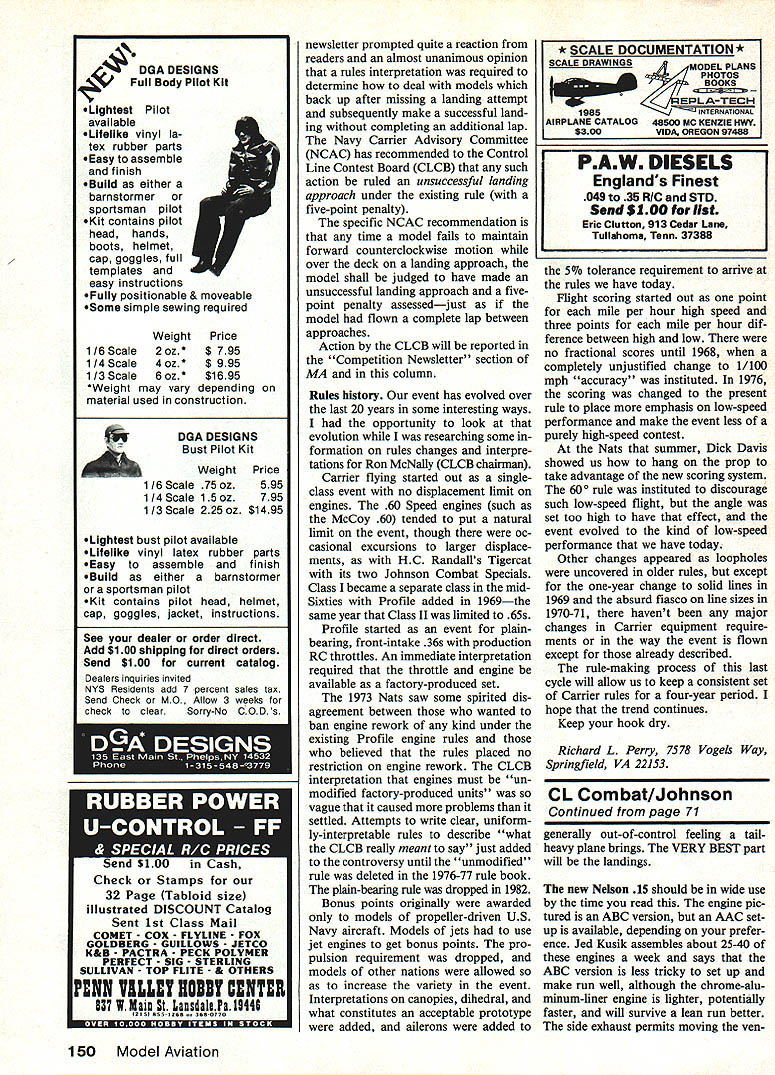
Control Line: Navy Carrier
Dick Perry
Apology
Before this column is published, I hope to have met Jim Welch personally and to have apologized for the creative spellings of his name which have appeared in my recent columns. In case we did not both make it to Norfolk, Jim, I'm sorry.
Mystery Plane
The winner of the Mystery Plane contest for the May 1985 issue was Ronald A. Muise of Mansfield, MA. Ronald was selected from among a large number of readers who correctly identified the Miles M.38 Messenger. The Miles was relatively easy for those who read Air Classics. Had I known that the March Air Classics had featured the M.38, I would have waited a while before using it as a Mystery Aircraft subject.
The aircraft in the July issue was the Bellanca XSE-2 experimental, carrier-based scout monoplane. It was originally introduced as the XSE-1 in 1932, then modified in 1934 with a new engine and new rear fuselage and vertical tail to become the XSE-2. Since making the drawing, I have found photos which indicate differences in the outline of the cowl and the leading edge of the wheel pants from the way they appeared in the drawing.
There is no Mystery Aircraft this month because of the possibility that the Air Force will have asked me to move by the time this column reaches you. When my future is a little more settled, the Mystery Planes will resume.
Rules results
The rules cycle is now complete except for the publication of the new AMA rule book. Carrier will remain essentially unchanged for 1986–1987. The rule book will now state that Carrier models are to weigh no more than four pounds without fuel, to bring the rule in line with actual practice.
The other new rule exempts Carrier models from noise-abatement regulations. Although the Executive Council could enact any rule they desire above the Contest Boards' objections, I hope that this (and similar) ruling by the CL Contest Board for Carrier and other CL events will emphasize to the Council the desirability of including the Contest Boards in any effort to apply noise-abatement regulations to competitive events. Previously published information left the Council's intent very much in doubt on this issue.
Landing interpretation
A letter by George Leib in the High-Low-Landing newsletter prompted quite a reaction from readers and an almost unanimous opinion that a rules interpretation was required to determine how to deal with models which back up after missing a landing attempt and subsequently make a successful landing without completing an additional lap. The Navy Carrier Advisory Committee (NCAC) has recommended to the Control Line Contest Board (CLCB) that any such action be ruled an unsuccessful landing approach under the existing rule (with a five-point penalty).
The specific NCAC recommendation is that any time a model fails to maintain forward counterclockwise motion while over the deck on a landing approach, the model shall be judged to have made an unsuccessful landing approach and a five-point penalty assessed—just as if the model had flown a complete lap between approaches.
Action by the CLCB will be reported in the "Competition Newsletter" section of MA and in this column.
Rules history
Our event has evolved over the last 20 years in some interesting ways. I had the opportunity to look at that evolution while I was researching some information on rules changes and interpretations for Ron McNally (CLCB chairman).
Carrier flying started out as a single-class event with no displacement limit on engines. The .60-speed engines (such as the McCoy .60) tended to put a natural limit on the event, though there were occasional excursions to larger displacements, as with H. C. Randall's Tigercat with its two Johnson Combat Specials. Class I became a separate class in the mid-'60s, with Profile added in 1969—the same year that Class II was limited to .65s.
Profile started as an event for plain-bearing, front-intake .36s with production RC throttles. An immediate interpretation required that the throttle and engine be available as a factory-produced set.
The 1973 Nats saw some spirited disagreement between those who wanted to ban engine rework of any kind under the existing Profile engine rules and those who believed that the rules placed no restriction on engine rework. The CLCB interpretation that engines must be "unmodified factory-produced units" was so vague that it caused more problems than it settled. Attempts to write clear, uniform, easy-to-interpret rules to describe "what the CLCB really meant to say" just added to the controversy until the "unmodified" rule was deleted in the 1976–77 rule book. The plain-bearing rule was dropped in 1982.
Bonus points originally were awarded only to models of propeller-driven U.S. Navy aircraft. Models of jets had to use jet engines to get bonus points. The propulsion requirement was dropped, and models of other nations were allowed so as to increase the variety in the event.
Interpretations on canopies, dihedral, and what constitutes an acceptable prototype were added, and ailerons were added to the five-percent tolerance requirement to arrive at the rules we have today.
Flight scoring started out as one point for each mile per hour high speed and three points for each mile per hour difference between high and low. There were no fractional scores until 1968, when a completely unjustified change to 1/100 mph "accuracy" was instituted. In 1976, the scoring was changed to the present rule to place more emphasis on low-speed performance and make the event less of a purely high-speed contest.
At the Nats that summer, Dick Davis showed us how to hang on the prop to take advantage of the extra scoring. The 60° rule was instituted to discourage such low-speed flight, but the angle was set so high that the effect was lost and the event evolved to the kind of low-speed performance that we have today.
Other changes appeared as loopholes were uncovered in older rules, but except for the one-year change to solid lines in 1969 and the absurd fiasco on line sizes in 1970–71, there haven't been any major changes in Carrier equipment requirements or in the way the event is flown except for those already described.
The rule-making process of this last cycle will allow us to keep a consistent set of Carrier rules for a four-year period. I hope that the trend continues.
Keep your hock dry.
Richard L. Perry 7578 Vogels Way, Springfield, VA 22153.
Transcribed from original scans by AI. Minor OCR errors may remain.

