
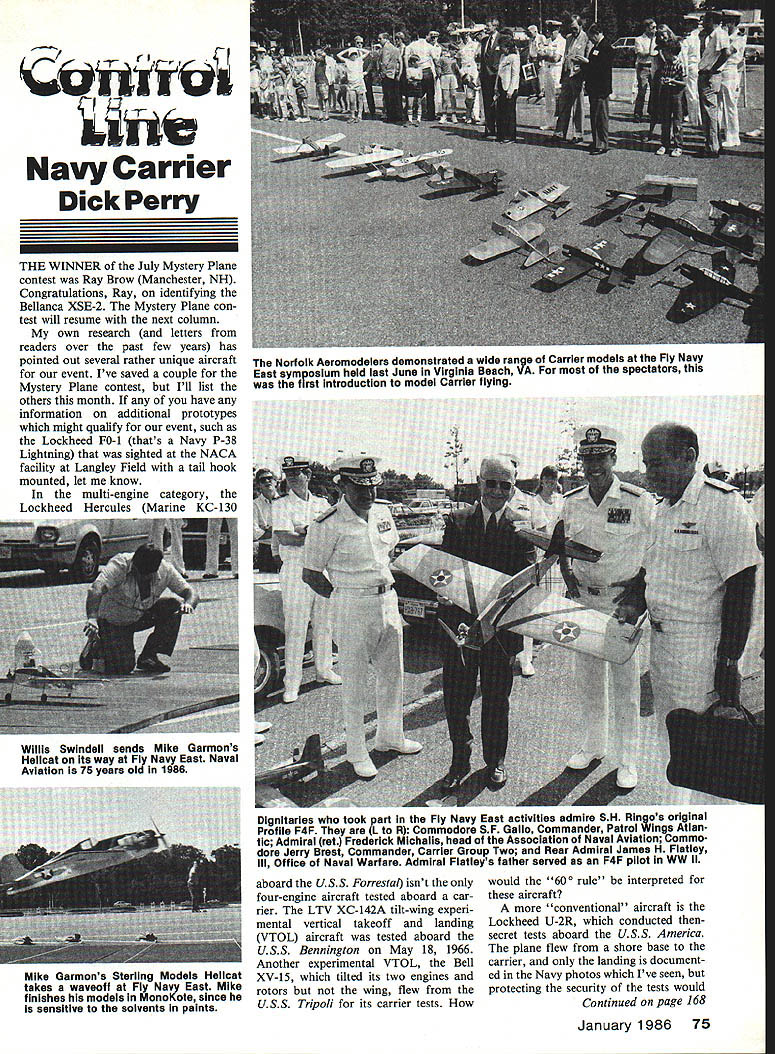
Control Line: Navy Carrier
Dick Perry
The winner of the July Mystery Plane contest was Ray Brow (Manchester, NH). Congratulations, Ray, on identifying the Bellanca XSE-2. The Mystery Plane contest will resume with the next column.
My own research (and letters from readers over the past few years) has turned up several rather unique aircraft that might qualify for our event. I've saved a couple for the Mystery Plane contest, but I'll list the others here. If any of you have information on additional prototypes—such as the Lockheed FO-1 (a Navy P-38 Lightning) sighted at the NACA facility at Langley Field with a tail hook mounted—please let me know.
Unusual carrier tests and prototypes
- In the multi-engine category, the Lockheed Hercules (Marine KC-130 aboard the U.S.S. Forrestal) isn't the only four-engine aircraft tested aboard a carrier.
- The LTV XC-142A tilt-wing experimental VTOL was tested aboard the U.S.S. Bennington on May 18, 1966.
- The Bell XV-15 (tilt-rotor) flew from the U.S.S. Tripoli for carrier tests.
- A more "conventional" example is the Lockheed U-2R, which conducted then-secret tests aboard the U.S.S. America. The plane flew from a shore base to the carrier, and only the landing is documented in the Navy photos I've seen, but protecting the security of the tests would have been difficult if the U-2 had remained aboard after the landing and been removed by crane after America returned to port.
- For those preferring Army Air Forces aircraft (such as the P-39 and P-51), there is a twin-engine option: although Doolittle's raiders didn't land their B-25s on a carrier, the Navy tested a modified Marine PBJ-1H (AAF equivalent B-25J) with a tail hook and catapult gear aboard the U.S.S. Shangri-La in 1944.
How the "60" rule would be interpreted for tilt-wing and tilt-rotor aircraft is an interesting question for contest classification.
Kits and Carrier modeling
There has never been an abundance of kits available for the Class I and II Carrier events. With the phaseout of the Sterling Guardian kit, the shortage is particularly acute. An alternative has been found, however: at least two carrier modelers have converted the Royal Products XA Radio Control Sport Scale kits for use as Class I/II Carrier models. Cam Martin flew his F4U Corsair at the Nats using an OS .40 FSR for Class I and an OS .45 FSR for Class II. The kit line also includes a Zero and a P-51.
#### Cam Martin's modifications
Cam's modifications adapt the kit to a larger engine, provide for the bellcrank mount and tail hook, and increase strength in critical areas.
- Fuselage: The kit fuselage consists of plywood ring formers with 1/8-in.-square balsa stringers and 1/16-in. sheet covering. Cam replaced the balsa stringers with bass (spruce would also work) and added additional stringers to approximately double the original number. He also added a stringer or two in the area used for holding the model during a pull test. The 1/16-in. sheeting has developed some cracks aft of the cowl; Cam suggests fiberglass reinforcement for that area.
- Engine and radio mount: The kit has a 1/8-in. plywood box for mounting the engine and radio equipment. Engine bearers were added to the inside of this box for an inverted engine installation. The fuel tank fits on top of the motor mounts; the bellcrank hooks below them with the lead-outs routed above the wing to the line-slider near the tip. Cam used a nylon nose gear block for the tail hook mount and added plywood to both sides of one fuselage former so the hook could be bolted in.
- Wing: The wing was modified similarly to the fuselage, with bass replacing the 1/8-in. balsa spars and 1/16-in. vertical-grain webbing added between the spars. The wing was mounted permanently to the fuselage, rather than remaining removable as in the kit.
- Tail surfaces: Tail surfaces are 1/16-in. sheet balsa and are adequate as long as the balsa is hard enough. One might consider increasing the thickness or using a carbon tape overlay to increase rigidity. The 1/8-in. dowel elevator-joiner should be replaced with a wire joiner, as is standard control-line practice.
The end result of these efforts is a Class I or small-engine Class II model with about 230 square inches of wing area and a weight of about 24 ounces. If the Corsair is any indication, Royal has been very careful with scale dimensions in this series of kits. The only detectable deviations in the Corsair are in the thickness of the tail surfaces, where sheet balsa was used to simplify construction.
That's it for this time. Keep your hook.
Richard L. Perry 7578 Vogels Way Springfield, VA 22153
Transcribed from original scans by AI. Minor OCR errors may remain.

