
Control Line: Navy Carrier
Dick Perry
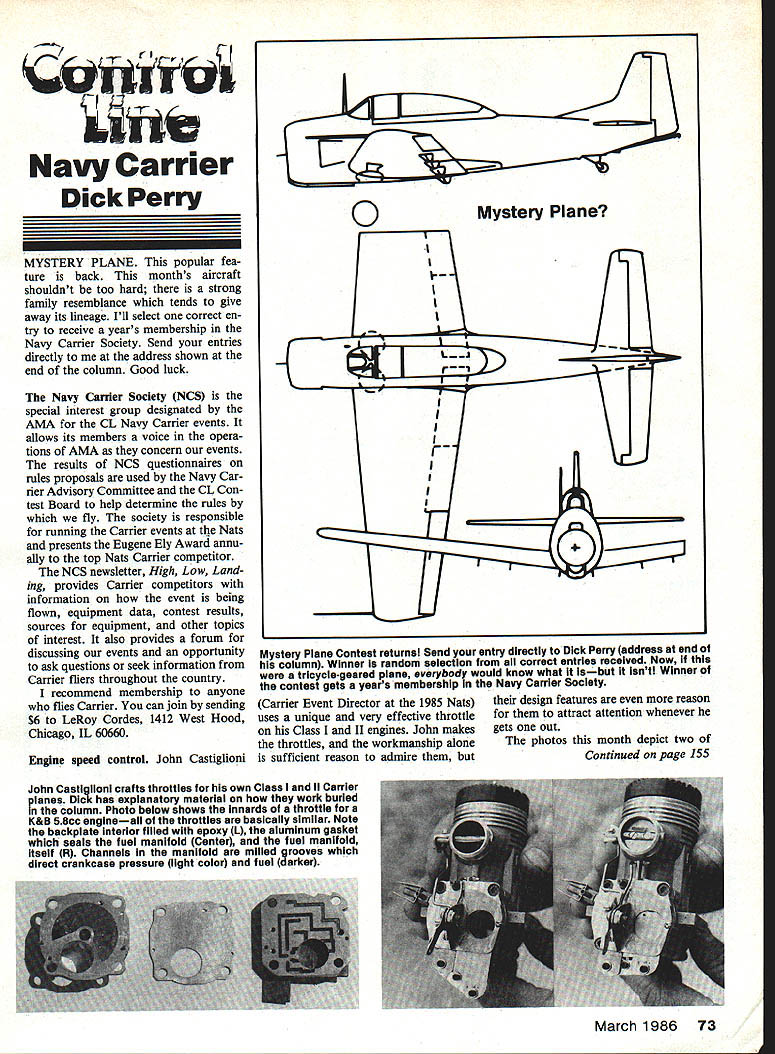
Mystery Plane
This popular feature is back. This month's aircraft shouldn't be too hard; there is a strong family resemblance which tends to give away its lineage. I'll select one correct entry to receive a year's membership in the Navy Carrier Society. Send your entries directly to me at the address shown at the end of the column. Good luck.
Mystery Plane Contest returns! Winner is a random selection from all correct entries received. Now, if this were a tricycle-geared plane, everybody would know what it is — but it isn't! The winner of the contest gets a year's membership in the Navy Carrier Society.
Navy Carrier Society
The Navy Carrier Society (NCS) is the special interest group designated by the AMA for the CL Navy Carrier events. It allows its members a voice in the operations of AMA as they concern our events. The results of NCS questionnaires on rules proposals are used by the Navy Carrier Advisory Committee and the CL Contest Board to help determine the rules by which we fly. The society is responsible for running the Carrier events at the Nats and presents the Eugene Ely Award annually to the top Nats Carrier competitor.
The NCS newsletter, High, Low, Landing, provides Carrier competitors with information on how the event is being flown, equipment data, contest results, sources for equipment, and other topics of interest. It also provides a forum for discussing our events and an opportunity to ask questions or seek information from Carrier fliers throughout the country.
I recommend membership to anyone who flies Carrier. You can join by sending $6 to:
- LeRoy Cordes, 1412 West Hood, Chicago, IL 60660
Engine speed control
John Castiglioni (Carrier Event Director at the 1985 Nats) uses a unique and very effective throttle on his Class I and II engines. John makes the throttles, and the workmanship alone is sufficient reason to admire them, but their design features are even more reason for them to attract attention whenever he gets one out. The photos this month depict two of his throttles. A photo shows the innards of a throttle for a K&B 5.8 cc engine — all of the throttles are basically similar. Note the backplate interior filled with epoxy (left), the aluminum gasket which seals the fuel manifold (center), and the fuel manifold itself (right). Channels in the manifold are milled grooves which direct crankcase pressure (light color) and fuel (darker).
John's throttles are works of art. They are all different in some detail — the result of continuing evolution in the design. I have neither the knowledge nor the column space to provide detailed fabrication specifications (this is not a construction article); instead, I will describe the mechanics of these throttles so that anyone with the inclination, imagination, and equipment can attempt their own. John does not make these throttles for sale (the price would be too high); they are, for him, an enjoyable part of the sport and more a labor of love.
John started making his throttles as a means of both shortening the length of his rear-intake engines and providing a larger-diameter intake to improve performance. A side benefit is the significantly improved fuel economy, which results from better control of fuel mixture at intermediate throttle settings.
The slide valve which controls the air intake is a piece of thin brass sheet that is a loose fit between the fuel manifold block (1/4 in. aluminum) and the rear cover plate of the throttle. A brass rod passes vertically through the fuel manifold block and performs a variety of functions. It operates the slide valve by means of a lever at the bottom of the throttle. It progressively closes off the multiple fuel jets as the throttle is closed, thus providing effective fuel metering throughout the range of engine speeds. It also vents the crankcase pressure line (which passes through the fuel manifold block on its way to the fuel tank) when the throttle is near the closed position, because the crankcase pressure at that point in the speed envelope is too low and too variable for consistent operation on pressure alone.
The fuel manifold block contains milled channels which direct the fuel from the bore of the metering rod to the air intake. This particular manifold is a five-jet configuration for a .65 engine in which the channels are cut about 0.004 in. deep. The width and depth of the channels control the amount of fuel which can pass through, thus providing mixture control at intermediate speeds. The primary needle valve fits into a threaded hole in the side of the manifold and feeds fuel to the bore of the metering rod. The final (idle) fuel channel also includes a needle valve for precise setting of idle mixture. Any of the fuel channels could contain a needle valve, if the builder desired that feature.
The other two parts in the photograph are the engine backplate and the plate which separates the backplate from the milled channels on the face of the fuel manifold block. The backplate has been filled with epoxy and milled flat. The backplate mounting screws provide the necessary pressure to hold the throttle together and seal the fuel passages.
Richard L. Perry 7578 Vogels Way Springfield, VA 22153
Transcribed from original scans by AI. Minor OCR errors may remain.

