
Control Line: Navy Carrier
Dick Perry
North American XSN2J-1 and the T-28 Trojan
The North American XSN2J-1 (company designator NA-142) was evaluated by the U.S. Navy as an intermediate trainer intended for carrier training and other activities. The Navy owned two examples. As most new service aircraft were being purchased with tricycle landing gear, the Navy asked North American to produce a tricycle-gear derivative of the XSN2J-1; this derivative became the T-28 Trojan, which served long and well.
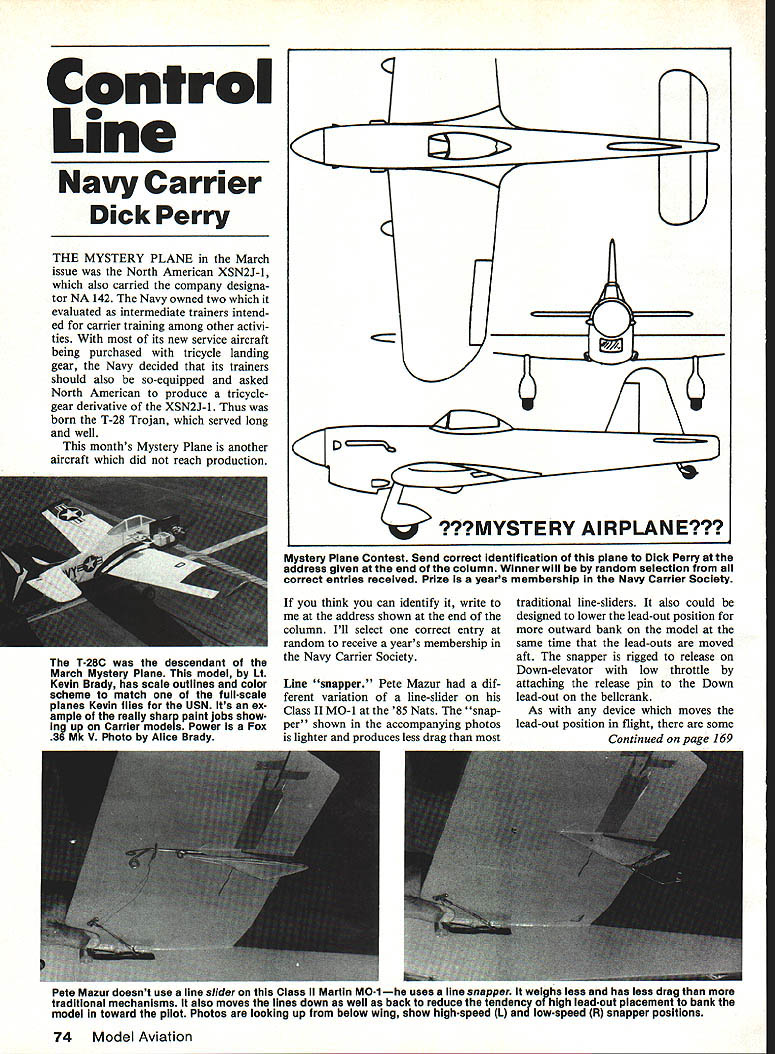
This month's Mystery Plane is another aircraft that did not reach production.
Mystery Plane Contest
- Send the correct identification of this plane to Dick Perry at the address given at the end of the column.
- One correct entry will be chosen at random from all correct entries received.
- Prize: one year's membership in the Navy Carrier Society.
If you think you can identify the plane, write to the address shown at the end of the column. I will select one correct entry at random to receive the prize.
Richard L. Perry 7578 Vogels Way Springfield, VA 22153
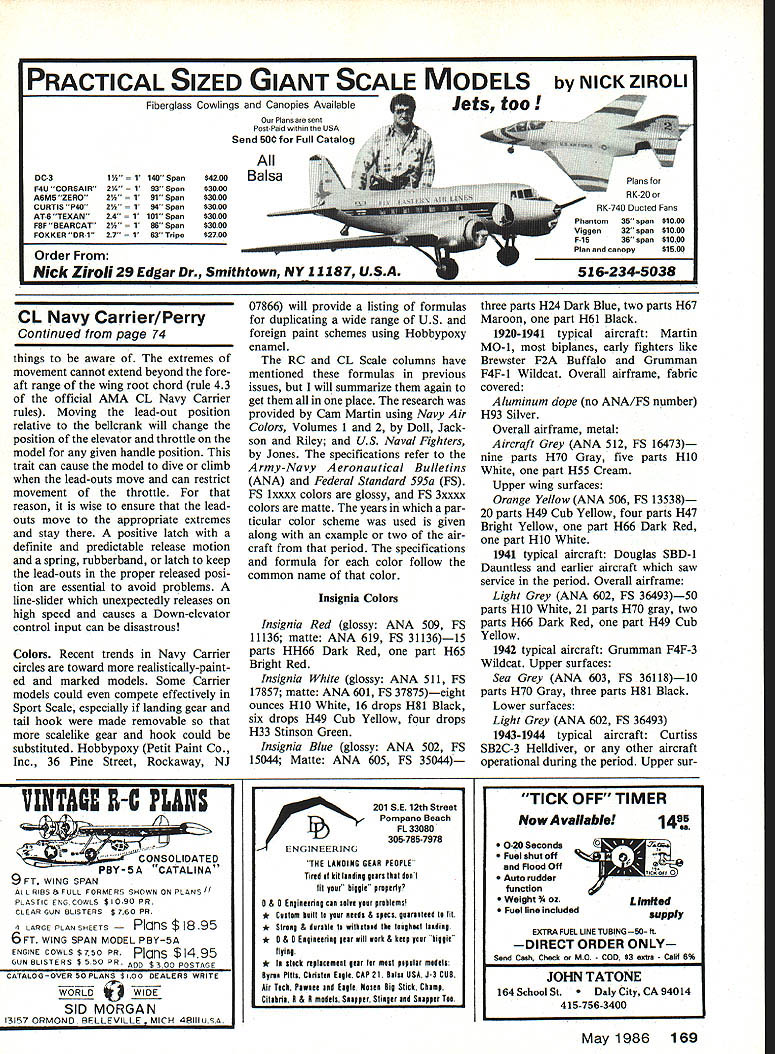
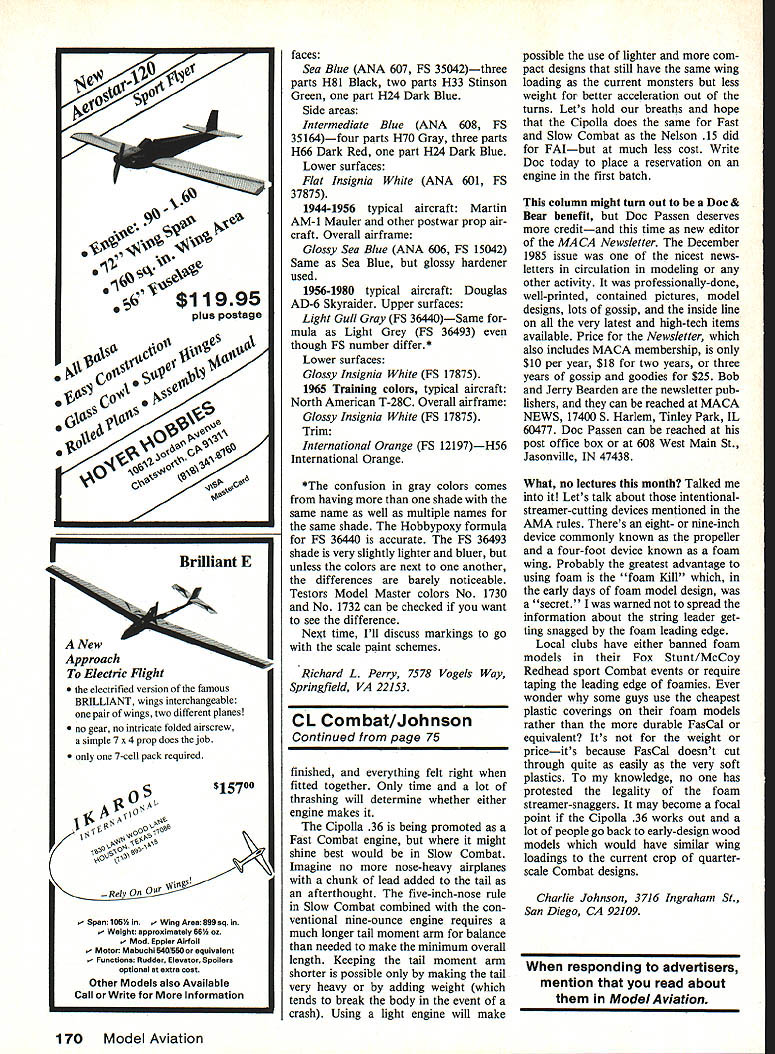
Line "snapper"
Pete Mazur used a different variation of a line-slider on his Class II MO-1 at the 1985 Nats. The "snapper" shown in the accompanying photos is lighter and produces less drag than most traditional line-sliders. It can be designed to lower the lead-out position for more outward bank on the model while simultaneously moving the lead-outs aft. The snapper is rigged to release on down-elevator with low throttle by attaching the release pin to the down lead-out on the bellcrank.
Notes and cautions:
- As with any device that moves the lead-out position in flight, movement must not extend beyond the fore-aft range of the wing root chord (see Rule 43 of the official AMA CL Navy Carrier rules).
- Moving the lead-out position relative to the bellcrank will change the elevator/throttle relationship for a given handle position; this can cause the model to dive or climb.
- Lead-outs moved aft can restrict throttle movement. Make sure the lead-outs move within appropriate extremes.
- Use a positive, predictable latch (spring or rubber-band latch) so release motion is definite. Proper release position is essential to avoid problems.
- A line-slider unexpectedly releasing at high speed causes a down-elevator control input and can be disastrous.
Colors
Recent trends in Navy Carrier circles favor realistically painted and marked models. Some Carrier models could compete effectively in Sport Scale if landing gear and tail hook are made removable (a scale-like gear or hook could be substituted). Hobbypoxy Petit Paint Co., Inc., 36 Pine Street, Rockaway, NJ 07866, will provide a listing of formulas duplicating a wide range of U.S. and foreign paint schemes using Hobbypoxy enamel.
For research, Cam Martin consulted:
- Navy Air Colors Volumes 1 & 2
- Doll, Jackson, Riley, US Naval Fighters, Jones
- Specifications: Army-Navy Aeronautical Bulletins and ANA Federal Standard 595A
Insignia Colors
- Insignia Red — glossy ANA 509, FS 11136; matte ANA 619, FS 31136
Recipe: 1½ parts HH66 Dark Red, 1 part H65 Bright Red.
- Insignia White — glossy ANA 511, FS 17857; matte ANA 601, FS 37875
Recipe: 8 oz H10 White, 16 drops H81 Black, 6 drops H49 Cub Yellow, 4 drops H33 Stinson Green.
- Insignia Blue — glossy ANA 502, FS 15044; matte ANA 605, FS 35044
Recipe: 3 parts H24 Dark Blue, 2 parts H67 Maroon, 1 part H61 Black.
Typical Airframe Finishes
- Overall, fabric-covered (typical for Martin MO-1, most biplanes, early fighters like Brewster F2A Buffalo and Grumman F4F-1 Wildcat): Aluminum dope (no ANA/FS number) — H93 Silver.
- Overall, metal airframe: Aircraft Gray (ANA 512, FS 16473) — 9 parts H70 Gray, 5 parts H10 White, 1 part H55 Cream.
- Upper wing surfaces (early types): Orange Yellow (ANA 506, FS 13538) — 20 parts H49 Cub Yellow, 4 parts H47 Bright Yellow, 1 part H66 Dark Red, 1 part H10 White.
Period Examples and Notes
- 1941 typical aircraft (e.g., Douglas SBD-1 Dauntless and earlier types):
Overall airframe — Light Gray (ANA 602, FS 36493): 50 parts H10 White, 21 parts H70 Gray, 2 parts H49 Cub Yellow, 1 part H66 Dark Red.
- 1942 typical aircraft (e.g., Grumman F4F-3 Wildcat):
Upper surfaces — Sea Gray (ANA 603, FS 36118): 10 parts H70 Gray, 3 parts H81 Black.
- 1943–44 typical aircraft (e.g., Curtiss SB2C-3 Helldiver):
Upper surfaces — Light Gray (ANA 602, FS 36493). Lower surfaces — White (ANA 601, FS 37875).
Transcribed from original scans by AI. Minor OCR errors may remain.

