
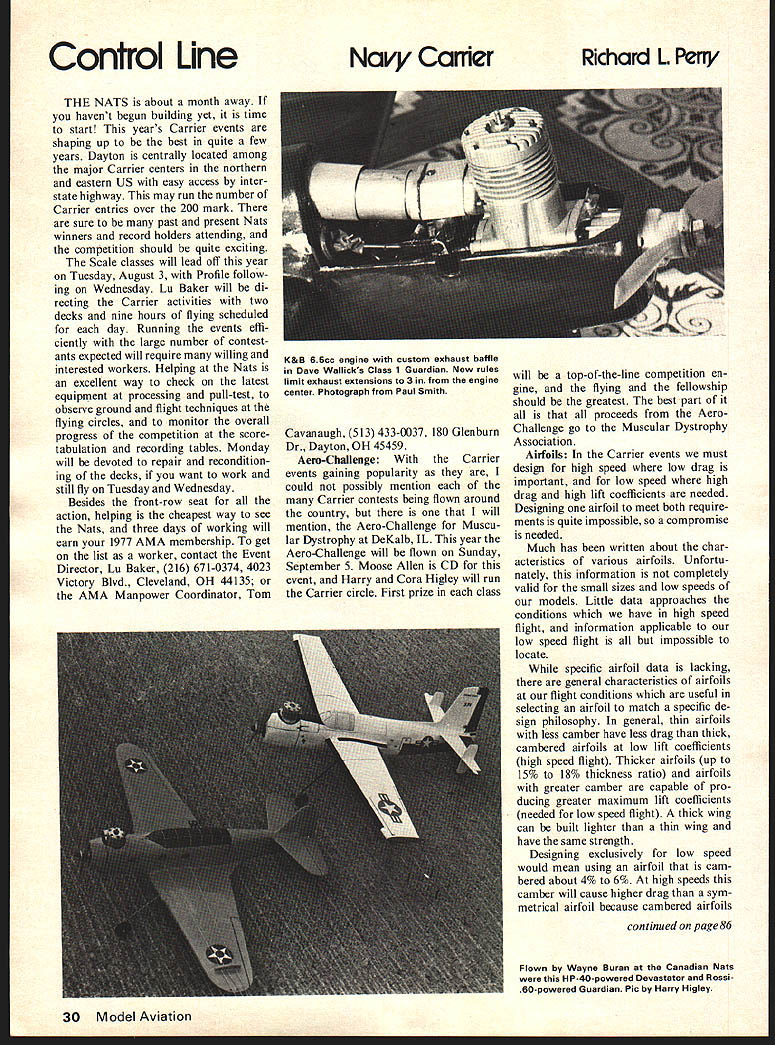

Control Line: Navy Carrier
THE NATS is about a month away. If you haven't begun building yet, it is time to start! This year's Carrier events are shaping up to be the best in quite a few years. Dayton is centrally located among the major Carrier centers in the northern and eastern US with easy access by interstate highway. This may run the number of Carrier entries over the 200 mark. There are sure to be many past and present Nats winners and record holders attending, and the competition should be quite exciting.
The Scale classes will lead off this year on Tuesday, August 3, with Profile following on Wednesday. Lu Baker will be directing the Carrier activities with two decks and nine hours of flying scheduled for each day. Running the events efficiently with the large number of contestants expected will require many willing and interested workers. Helping at the Nats is an excellent way to check on the latest equipment at processing and pull-test, to observe ground and flight techniques at the flying circles, and to monitor the overall progress of the competition at the score tabulation and recording tables. Monday will be devoted to repair and reconditioning of the decks, if you want to work and still fly on Tuesday and Wednesday.
Besides the front-row seat for all the action, helping is the cheapest way to see the Nats, and three days of working will earn your 1977 AMA membership. To get on the list as a worker, contact the Event Director, Lu Baker, (216) 671-0374, 4023 Victory Blvd., Cleveland, OH 44135; or the AMA Manpower Coordinator, Tom Cavanaugh, (513) 433-0037, 180 Glenburn Dr., Dayton, OH 45459.
Aero-Challenge: With the Carrier events gaining popularity as they are, I could not possibly mention each of the many Carrier contests being flown around the country, but there is one that I will mention, the Aero-Challenge for Muscular Dystrophy at DeKalb, IL. This year the Aero-Challenge will be flown on Sunday, September 5. Moose Allen is CD for this event, and Harry and Cora Higley will run the Carrier circle. First prize in each class will be a top-of-the-line competition engine, and the flying and the fellowship should be the greatest. The best part of it all is that all proceeds from the Aero-Challenge go to the Muscular Dystrophy Association.
Airfoils: In Carrier events we must design for high speed where low drag is important, and for low speed where high drag and high lift coefficients are needed. Designing one airfoil to meet both requirements is quite impossible, so a compromise is needed.
Much has been written about the characteristics of various airfoils. Unfortunately, this information is not completely valid for the small sizes and low speeds of our models. Little data approaches the conditions which we have in high speed flight, and information applicable to our low speed flight is all but impossible to locate.
While specific airfoil data is lacking, there are general characteristics of airfoils at our flight conditions which are useful in selecting an airfoil to match a specific design philosophy. In general, thin airfoils with less camber have less drag than thick, cambered airfoils at low lift coefficients (high speed flight). Thicker airfoils (up to 15% to 18% thickness ratio) and airfoils with greater camber are capable of producing greater maximum lift coefficients (needed for low speed flight). A thick wing can be built lighter than a thin wing and have the same strength.
Designing exclusively for low speed would mean using an airfoil that is cambered about 4% to 6%. At high speeds this camber will cause higher drag than a symmetrical airfoil because cambered airfoils
Control Line: Navy Carrier
produce their minimum drag at relatively high lift coefficients (around 0.5 for our example) compared to the low lift coefficients (less than 0.1) needed by a typical Carrier model at high speed. Designing for low speed would mean using an airfoil of 15% to 18% thickness if flaps were to be used.
Flaps can be used to increase available lift coefficients while keeping camber low during high speed flight. At the speeds and sizes used for Carrier, flaps are most beneficial on very thick airfoils (20% or greater), so even flaps can't be used to best advantage without quite increasing drag at higher speeds. An airfoil with flaps will, however, provide greater lift and drag under the same conditions than the same airfoil without flaps. I will discuss flaps in more detail in the next column.
My idea of the best compromise for a Carrier airfoil consists of about 10% to 12% thickness with a camber of about 1%. This airfoil can operate near its minimum-drag lift coefficient at high speed, yet it has some camber and enough thickness to provide reasonable lift coefficients at low speeds. This airfoil is also thick enough to be built light and to benefit from the use of flaps.
Using the four-digit designation system developed by the NACA (forerunner of NASA), the NACA 1310 airfoil fits my requirements for an airfoil of 1% camber (first digit), and 10% thickness (last two digits). The second digit indicates the point of maximum camber — in this case, 30% — and should be a 3 or 4 for model applications. An airfoil such as the NACA 6315 would provide good low speed performance without flaps, while the NACA 0006 (symmetrical with 6% thickness) would be optimum for a Profile airplane designed to emphasize high speed.
An airfoil built to NACA coordinates is about the best that can be had for a given camber and thickness, but any airfoil of reasonable shape will come close to NACA airfoils in efficiency. Three things are important. The airfoil surfaces must be free of abrupt changes in contour; the point of maximum thickness should be about 30% of the chord; and the leading edge should be rounded. The last point is important. A sharp leading edge is useful at supersonic speeds, but at our speeds about all it will do is reduce maximum lift coefficient and cause increased drag in high speed flight at any lift coefficient outside a very narrow range. For a source of NACA airfoils, read the next section.
Products and Services: Whenever I find out about new services or sources of equipment of interest to Carrier modelers, I will pass the information on in this column. I am not trying to sell any of the products or services. I just want to keep all Carrier modelers aware of the sources available to us. When I receive products for evaluation, I will give a complete description and the results of any tests I make. I will not make any claims for a product unless I have personally checked them, and all opinions will be my own. I will include addresses where you can write (include a stamped envelope) for price and availability information.
I received a couple of letters and samples after my column on pressure fuel systems for Carrier. William (Moose) Allen, 418 Fairmont Dr., DeKalb, IL 60115, offered a good bladder at a very reasonable price (20c plus postage).
George Mattel, G-T-M Products, 404 Franklin Rd., Hamden, CT 06517, offers bladders, pacifiers, fuel syringes, and other specialty items. George sent along a sample of the 8-oz. fuel bulb he sells. This bulb is the only one I have used that can handle the pressure required to fill a bladder without leaking or blowing apart. I even stood on the full bulb and could not get it to leak! The capacity allows one-shot filling with
Control Line: Navy Carrier
The NATS are about a month away. If you haven't begun building yet, it's time to start. This year's Carrier events are shaping up to be the best in quite a few years. Dayton, centrally located among major Carrier centers in the northern and eastern U.S. and with easy access to interstate highways, may push the number of Carrier entries over the 200 mark. I'm sure past and present Nats winners and record holders attending the competition should make it quite exciting.
Scale classes will lead off the year Tuesday, August 3. Profile follows Wednesday. Lu Baker will be directing Carrier activities. Two decks, nine hours flying scheduled per day.
Running the events efficiently, with the large number of contestants expected, will require willing, interested workers. Helping at the Nats is an excellent way to check the latest equipment, process pull-tests, observe ground flight techniques, flying circles, and monitor the overall progress of the competition. Score tabulation and recording tables will need assistance. Monday will be devoted to repair and reconditioning of decks. If you want to work and still fly, Tuesday and Wednesday are available.
Besides the front-row seat action, helping is the cheapest way to see the Nats. Three days of working will earn a 1977 AMA membership. To get a list of workers, contact Event Director Lu Baker, 216-671-0374, 4023 Victory Blvd., Cleveland, OH 44135. AMA Manpower Coordinator Tom "Navy" Cavanaugh, 513-433-0037, 180 Glenburn Dr., Dayton, OH 45459.
Aero-Challenge: With Carrier events gaining popularity, I could possibly mention Carrier contests being flown around the country. I'll mention the Aero-Challenge for Muscular Dystrophy at DeKalb, IL. This year the Aero-Challenge will be flown Sunday, September 5. Moose Allen is CD of the event; Harry Higley will run the Carrier circle. First prize in the class is a top-of-the-line competition engine. The best part is that proceeds from the Aero-Challenge go to the Muscular Dystrophy Association.
Airfoils: In Carrier events you must design for high speed and low drag where important, and for low speed and high lift coefficients where needed. Designing an airfoil to meet both requirements is quite impossible; a compromise is needed. Much has been written about the characteristics of various airfoils. Unfortunately, that information is completely invalid for the small sizes and low speeds of our models. Little data approaches the conditions we have; high-speed flight information applicable to low-speed flight is impossible to locate. Specific airfoil data is lacking; general characteristics of airfoils and flight conditions are useful in selecting an airfoil to match a specific design philosophy. In general, thin airfoils with less camber have less drag. Thicker, cambered airfoils with up to 15%–18% thickness ratio and greater camber are capable of producing the greater maximum lift coefficients needed for low-speed flight. A thick wing can be built lighter than a thin wing of the same strength. Designing exclusively for low speed would mean using an airfoil cambered about 4%–6%; at high speeds that camber will cause higher drag than a symmetrical airfoil because cambered airfoils
Transcribed from original scans by AI. Minor OCR errors may remain.

