
Control Line: Navy Carrier
Dick Perry
Opportunity Knocks
Our United States Navy is celebrating the 75th Anniversary of Naval Aviation beginning in May and continuing throughout the year. This could be an excellent opportunity to provide carrier flight demonstrations at Navy air shows and base open houses to let others know about our hobby and, particularly, about CL Navy Carrier flying. A good place to inquire about 75th anniversary activities would be the Public Affairs office at your nearest Navy base or Naval Air Station.
The official logo is printed in Navy blue and gold, and Navy PA offices might be able to provide one to adorn your club carrier deck. Another possible benefit is obtaining a site for a carrier contest. The SLOW Club holds its annual contest at Anacostia Naval Air Station in Washington, DC, even without a carrier event. This could be a good time to ask about using a Navy facility near you.
Mystery Plane Contest
The Mystery Plane in the May issue was the Miles M.20. It was originally designed as a land-based fighter; one prototype was built using many components from the Miles Master trainer to hasten design and assembly, fixed landing gear to reduce weight and complexity, wood construction to save weight and strategic materials, and eight .303-caliber machine guns to get its job done.
When the Royal Navy issued specification N.1/41 for a naval fighter, Miles added catapult points and a tail hook to a second prototype and turned it over for service testing. The Royal Navy elected to continue with the practice of modifying Hurricanes and Spitfires for naval service, and the M.20 passed into obscurity. It was resurrected in the early Seventies when Ted Kraver flew one in Arizona carrier circles as a Class I model. He also built a Class II M.20 with a 44-inch span for the 1977 Nats.
The winner of the March contest was Lt. Cam Martin (Virginia Beach, VA). There were very few correct answers for the XSN2J; many people were misled by the Fairchild look-alike.
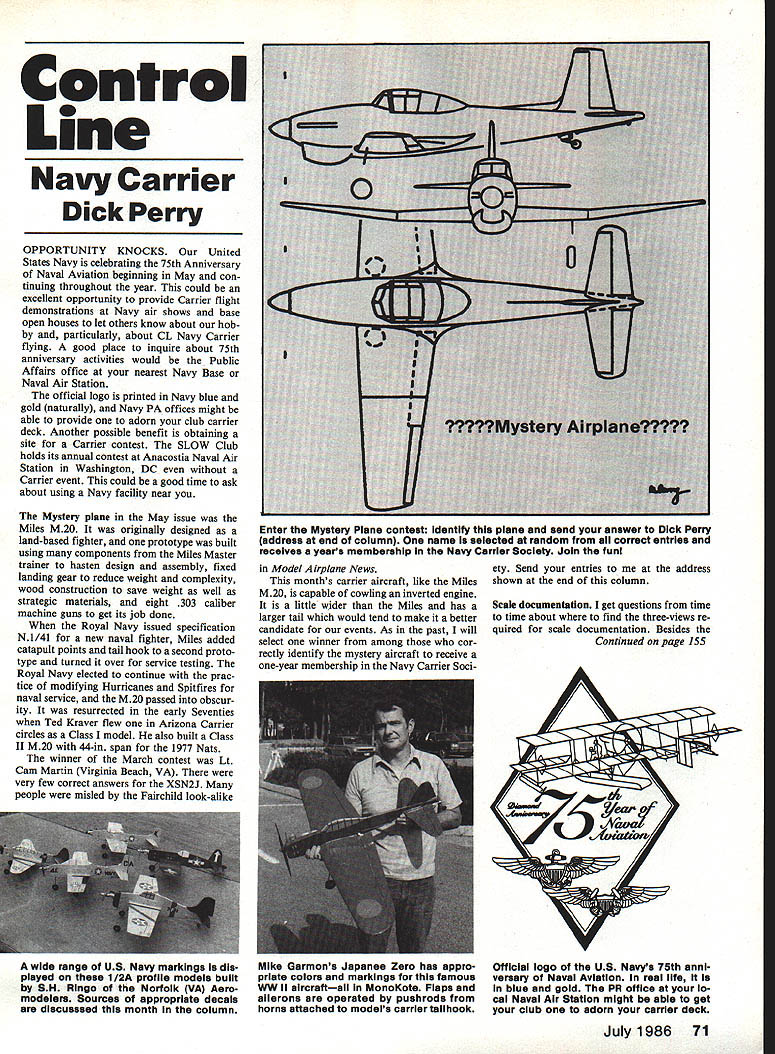
Enter the Mystery Plane contest: identify the plane and send your answer to Dick Perry (address at the end of this column). One name is selected at random from all correct entries and receives a one-year membership in the Navy Carrier Society. Join the fun!
This column appears in Model Airplane News.
This month's carrier aircraft, like the Miles M.20, is capable of cowling an inverted engine. It is a little wider than the Miles and has a larger tail, which would tend to make it a better candidate for our events. As in the past, I will select one winner from among those who correctly identify the mystery aircraft to receive a one-year membership in the Navy Carrier Society. Send your entries to me at the address shown at the end of this column.
Scale documentation
I get questions from time to time about where to find the three-views required for scale documentation. Besides the ones which appear as Mystery Planes in this column, there are numerous magazines that specialize in detailed histories of aircraft. The Reader's Guide to Periodical Literature in your local library should have information on whether one of these has had a recent article on your favorite aircraft.
There are also some excellent books which include three-views of most operational carrier aircraft and a few experimental types. Putnam aeronautical books has both general references which list all major aircraft of a country or service and books covering specific manufacturers. The latter usually include details of experimental aircraft and many variants of the same design.
Other useful titles for carrier documentation include:
- U.S. Navy Aircraft Since 1911
- Japanese Aircraft of the Pacific War
- British Naval Aircraft Since 1912
Two good references on U.S. fighter aircraft are:
- U.S. Naval Fighters by Lloyd S. Jones
- U.S. Navy & Marine Corps Fighters 1918–1962 by Robertson and Matt
These titles are currently available through bookstores or mail-order houses that advertise in aviation publications (including Model Aviation). There are also many books about specific aircraft which are too numerous to mention here.
Another excellent source of three-views is Scale Model Research (418-B E. Oceanfront, Newport Beach, CA 92661), whose product line was described in Bill Boss' "CL Scale" column in the March issue of MA.
Markings
Continuing with the theme of well-finished carrier models, which I began in the last column with a discussion of paint schemes and color formulas, I like to turn this month to the subject of markings. I wrote on the subject in one of my earliest columns, and I won't go into the same detail on what markings are appropriate for which time periods in the history of the U.S. Navy. A photo of any subject aircraft should be quite sufficient to provide appropriate marking information, and the references listed earlier in the column are also useful.
Getting the appropriate markings without having to make them is likely to present the greatest problem, particularly since the manufacturers of decals seem reluctant to fill in large gaps. The larger companies produce a pretty good selection, at least in the ones I frequent. There are also notable exceptions. Sig Manufacturing Co. (401-7 Front Street, Montezuma, IA 50171) has pre-WWII "Army" stars (which are, of course, identical to Navy markings of the same period) in a variety of sizes. Film covering or paint can provide the rudder bars without much difficulty. They also have the post-war U.S. stars and bars as well as French roundels complete with anchor overlay for naval markings, but size selection is limited.
For smaller Class I or .15 carrier models, the Paul K. Guillow Company (Box 229, Wakefield, MA 01880) sells decals (and plans and canopies, too) for their 3/4-inch scale models. Available subjects include:
- Spitfire and Mosquito (British)
- Zero (Japanese)
- Bf 109 and Ju-87 Stuka (German)
- P-39 Airacobra (early WWII U.S. without red circle)
- SBD Dauntless (pre-WWII U.S. with red circle)
- F4U Corsair, P-51 Mustang, and F6F Wildcat (WWII and early post-war U.S. without red bar)
Plans for Roland Bates' 1/4-inch scale Class I Dauntless are still available as plan No. 8772 from Model Builder (898 West Sixteenth St., Newport Beach, CA 92663); the Guillow plastic parts and markings are the same size.
Richard L. Perry 7578 Vogels Way Springfield, VA 22153
Transcribed from original scans by AI. Minor OCR errors may remain.

