
Control Line: Navy Carrier
Dick Perry
Introduction
The series on basics of Navy Carrier modeling continues this month. April's column discussed three-line control systems from the handle to the bellcrank. This month, the discussion of control systems starts with the bellcrank and goes forward to the engine.
Bellcranks (L-R Products)
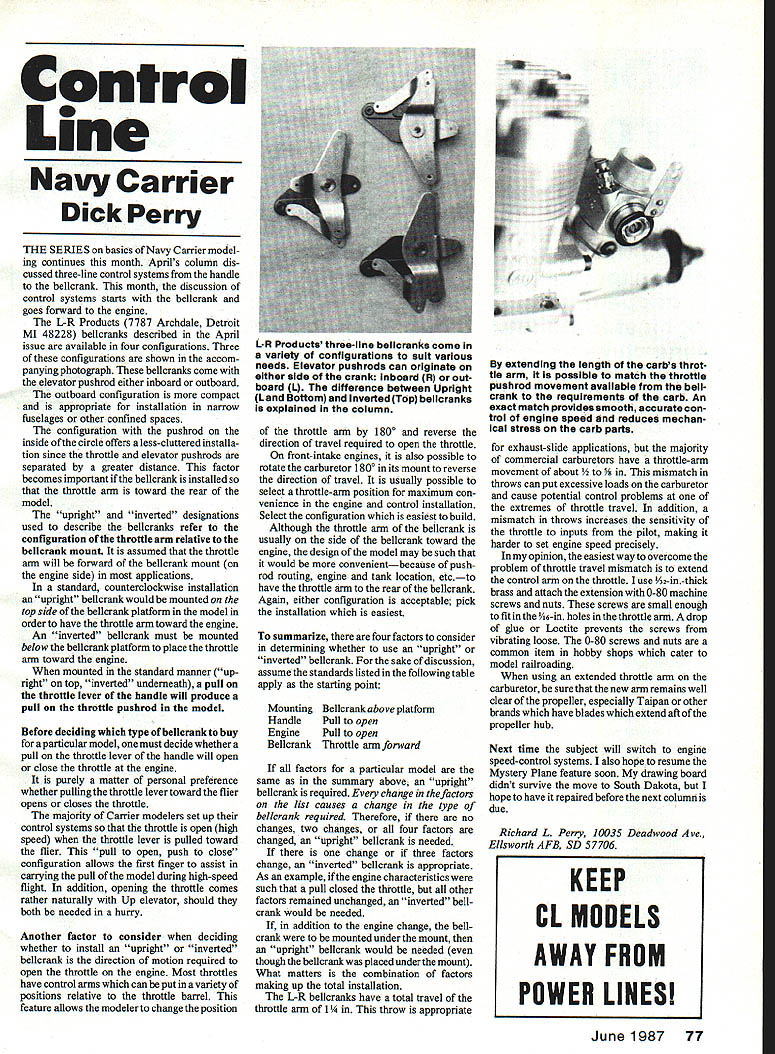
The L-R Products (7787 Archdale, Detroit, MI 48228) bellcranks described in the April issue are available in four configurations. Three of these configurations are shown in the accompanying photograph.
These bellcranks come with the elevator pushrod either inboard (I) or outboard (O). The outboard configuration is more compact and appropriate for installation in narrow fuselages or other confined spaces. The configuration with the pushrod on the inside of the circle offers a less-cluttered installation since the throttle and elevator pushrods are separated by a greater distance. This factor becomes important if the bellcrank is installed so that the throttle arm is toward the rear of the model.
"Upright" vs. "Inverted"
The "upright" and "inverted" designations used to describe the bellcranks refer to the configuration of the throttle arm relative to the bellcrank mount. It is assumed that the throttle arm will be forward of the bellcrank mount (on the engine side) in most applications.
- In a standard, counterclockwise installation an "upright" bellcrank would be mounted on the top side of the bellcrank platform in the model in order to have the throttle arm toward the engine.
- An "inverted" bellcrank must be mounted below the bellcrank platform to place the throttle arm toward the engine.
When mounted in the standard manner ("upright" on top, "inverted" underneath), a pull on the throttle lever of the handle will produce a pull on the throttle pushrod in the model.
Deciding handle/throttle direction
Before deciding which type of bellcrank to buy for a particular model, one must decide whether a pull on the throttle lever of the handle will open or close the throttle at the engine. It is purely a matter of personal preference whether pulling the throttle lever toward the flier opens or closes the throttle at the engine.
The majority of Carrier modelers set up their control systems so that the throttle is open (high speed) when the throttle lever is pulled toward the flier. This "pull to open, push to close" configuration allows the first finger to assist in carrying the model during high-speed flight. In addition, opening the throttle comes rather naturally with up elevator, should both be needed quickly.
Another factor to consider when deciding whether to install an "upright" or "inverted" bellcrank is the direction of motion required to open the throttle on the engine. Most throttles have control arms which can be put in a variety of positions relative to the throttle barrel. This feature allows the modeler to change the position of the throttle arm by 180° and reverse the direction of travel required to open the throttle.
On front-intake engines, it is also possible to rotate the carburetor 180° in its mount to reverse the direction of travel. It is usually possible to select a throttle-arm position for maximum convenience in the engine and control installation.
Select the configuration which is easiest to build. Although the throttle arm of the bellcrank is usually on the side of the bellcrank toward the engine, the design of the model may be such that it would be more convenient—because of pushrod routing, engine and tank location, etc.—to have the throttle arm to the rear of the bellcrank. Again, either configuration is acceptable; pick the installation which is easiest.
Choosing upright or inverted — a simple rule
To summarize, there are four factors to consider in determining whether to use an "upright" or "inverted" bellcrank. For the sake of discussion, assume the standards listed below apply as the starting point:
- Mounting — bellcrank above platform
- Handle — pull to open
- Engine — pull to open
- Bellcrank — throttle arm forward
If all factors for a particular model are the same as above, an "upright" bellcrank is required. Every change in the factors on the list causes a change in the type of bellcrank required. Therefore:
- If there are 0, 2, or 4 changes from the baseline, an "upright" bellcrank is needed.
- If there is 1 or 3 changes from the baseline, an "inverted" bellcrank is appropriate.
As an example, if the engine characteristics were such that a pull closed the throttle, but all other factors remained unchanged, an "inverted" bellcrank would be needed. If, in addition to the engine change, the bellcrank were mounted under the platform, then an "upright" bellcrank would be needed (even though the bellcrank was placed under the mount). What matters is the combination of factors making up the total installation.
Throttle travel and extension
The L-R bellcranks have a total travel of the throttle arm of 1/4 in. This travel is appropriate for exhaust-slide applications, but the majority of commercial carburetors have a throttle-arm movement of about 5/16 to 3/8 in. This mismatch in throws can put excessive loads on the carburetor and cause potential control problems at one of the extremes of throttle travel. In addition, a mismatch in throws increases the sensitivity of the throttle to inputs from the pilot, making it harder to set engine speed precisely.
In my opinion, the easiest way to overcome the problem of throttle travel mismatch is to extend the control arm on the throttle. Use 5/32-in.-thick brass and attach the extension with 0-80 machine screws and nuts. These screws are small enough to fit the 5/32-in. holes in the throttle arm. A drop of Loctite prevents the screws from vibrating loose. The 0-80 screws and nuts are a common item in hobby shops which cater to model railroading.
When using an extended throttle arm on the carburetor, be sure that the new arm remains well clear of the propeller, especially Taipan or other brands which have blades that extend aft of the propeller hub.
Looking ahead
Next time the subject will switch to engine speed-control systems. I also hope to resume the Mystery Plane feature soon. My drawing board didn't survive the move to South Dakota, but I hope to have it repaired before the next column is due.
Richard L. Perry 10035 Deadwood Ave., Ellsworth AFB, SD 57706
Transcribed from original scans by AI. Minor OCR errors may remain.

