
Control Line: Navy Carrier
Dick Perry
PROFILE KITS
Although there have generally been more kits available for Profile Carrier than for Scale classes, there have been no kits designed specifically for Profile Carrier since the GS kits a few years back. Sterling's Hellcat, though not originally designed for Carrier competition, can be adapted easily. Two other long-out-of-production Sterling kits are also well suited:
- P-51 Mustang — qualifies for bonus points with configuration changes.
- Yak-9 — with minor modifications can become a Bell Airabonita.
These models are small compared to other .35-sized profile models such as the Ringmaster and are only slightly larger than the 300 sq in minimum wing area for Profile Carrier. They build into light models and have sheet-balsa trailing edges that can be converted to flaps very easily.
GS kits and older Sterling kits are harder to find because they have been out of production longer (and some are legal for Old-Time Stunt). Fortunately, replicas of the P-51 and Yak-9 Sterling kits have been produced and are available from:
J & J Sales 709 Crescent Sunnyside, WA 98944
Exhaust deflector
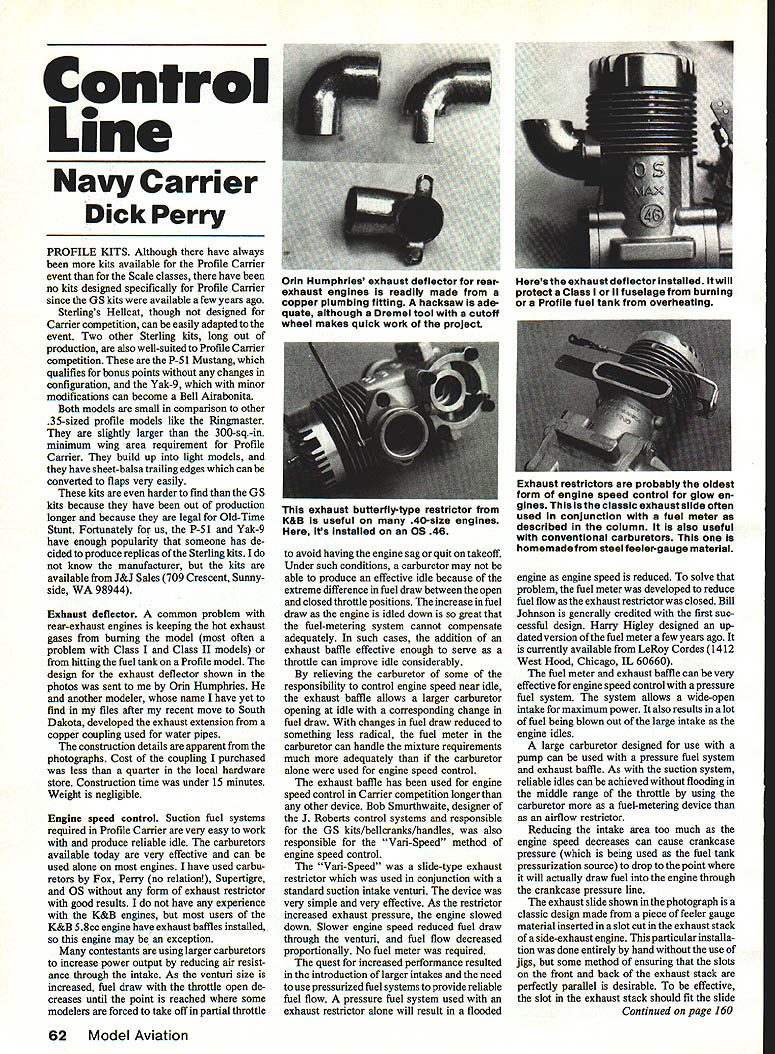
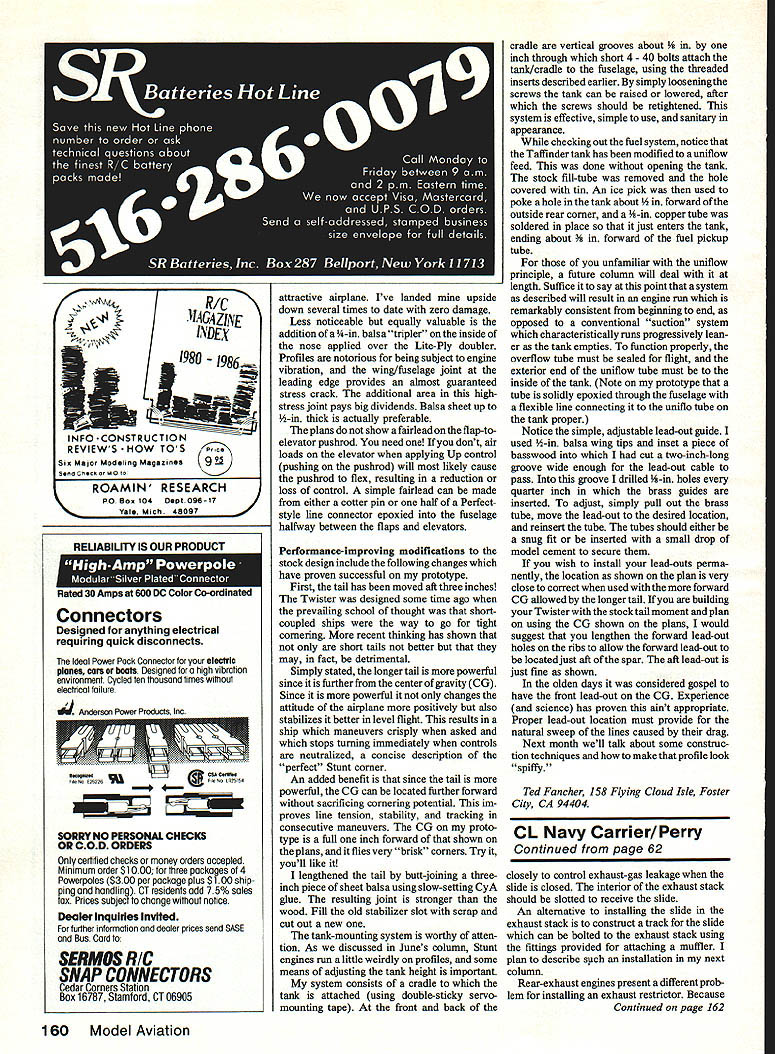
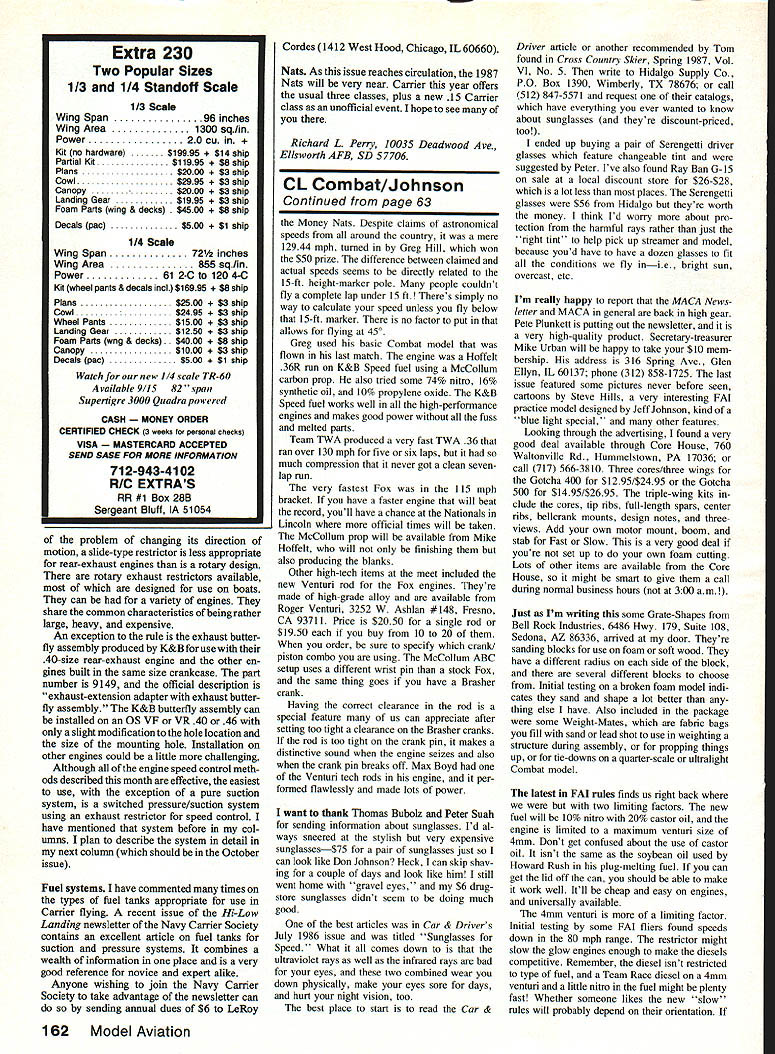
A common problem with rear-exhaust engines is keeping the hot exhaust gases from burning the model or hitting the fuel tank (most often a problem with Class I and Class II models and Profile models). Orin Humphries sent photos of a Profile-model exhaust deflector design; another modeler developed an exhaust extension using a copper coupling commonly used for water pipes. Construction details are apparent in the photographs.
- Cost: coupling can be purchased for less than $0.25 at a local hardware store.
- Construction time: under 15 minutes.
- Weight: negligible.
Engine speed control
Suction fuel systems are required for Profile Carrier and are generally easy to tune for a reliable idle. Modern carburetors are effective and often sufficient alone. Carburetors I have used successfully include:
- Fox
- Perry (no relation)
- Supertigre
- OS
K&B engines may be an exception: many K&B .58 cc engines come with exhaust baffles installed at the factory.
Contestants often use larger carburetors to reduce intake air resistance and increase top-end power. As venturi size increases, fuel draw at wide-open throttle decreases until some fliers must take off at partial throttle to avoid engine sag or quitting on takeoff. Under those conditions the carburetor alone may not produce an effective idle because the difference in fuel draw between open and closed throttle becomes too extreme for the fuel-metering system to compensate.
An effective exhaust baffle can act as a throttle and improve idle by relieving the carburetor of some engine-speed control near idle. With an exhaust baffle the carburetor can have a larger opening at idle while the corresponding change in fuel draw is reduced to a range the carburetor’s fuel-metering system can handle.
Historically, exhaust-baffle control has been used in Carrier competition longer than other devices. Bob Smurthwaite — designer of the J. Roberts control systems (responsible for GS kits, bellcranks and handles) — also designed the Vari-Speed method of engine speed control. Vari-Speed is a slide-type exhaust restrictor used with a standard suction-intake venturi. It is simple and effective: closing the restrictor increases exhaust back pressure, slowing the engine; slower speed reduces venturi fuel draw proportionally, so no fuel meter is required.
The push for more performance and larger intakes led to the use of pressurized fuel systems for reliable fuel flow. A pressure system used with an exhaust restrictor alone will flood the engine as the restrictor is closed. To solve that, fuel meters were developed to reduce fuel flow as the exhaust restrictor is closed. Bill Johnson is generally credited with the first successful design; Harry Higley later produced an updated version. The Higley design is (or was) available from:
LeRoy Cordes 1412 West Hood Chicago, IL 60660
A fuel meter combined with an exhaust baffle can be very effective with a pressure fuel system and allows wide-open intake for maximum power. However, large intakes and pressure systems can throw a lot of fuel out of the intake at idle. You can reduce that by:
- fitting a small vent or bleed at the base of the intake, or
- using an air-bleeder to supply a small amount of air at idle to slightly lean the mixture.
Use caution with large carburetors on pressure systems: reducing the intake area too much at idle or trying to control idle solely by restricting the intake can increase crankcase pressure, upset the mixture, or cause other fuel-feed problems. The best approach is usually a properly designed exhaust baffle or a fuel-metering device matched to the carburetor in use.
Transcribed from original scans by AI. Minor OCR errors may remain.

