
Control Line: Navy Carrier
Dick Perry 10034 Deadwood Ave. Ellsworth AFB, SD 57706
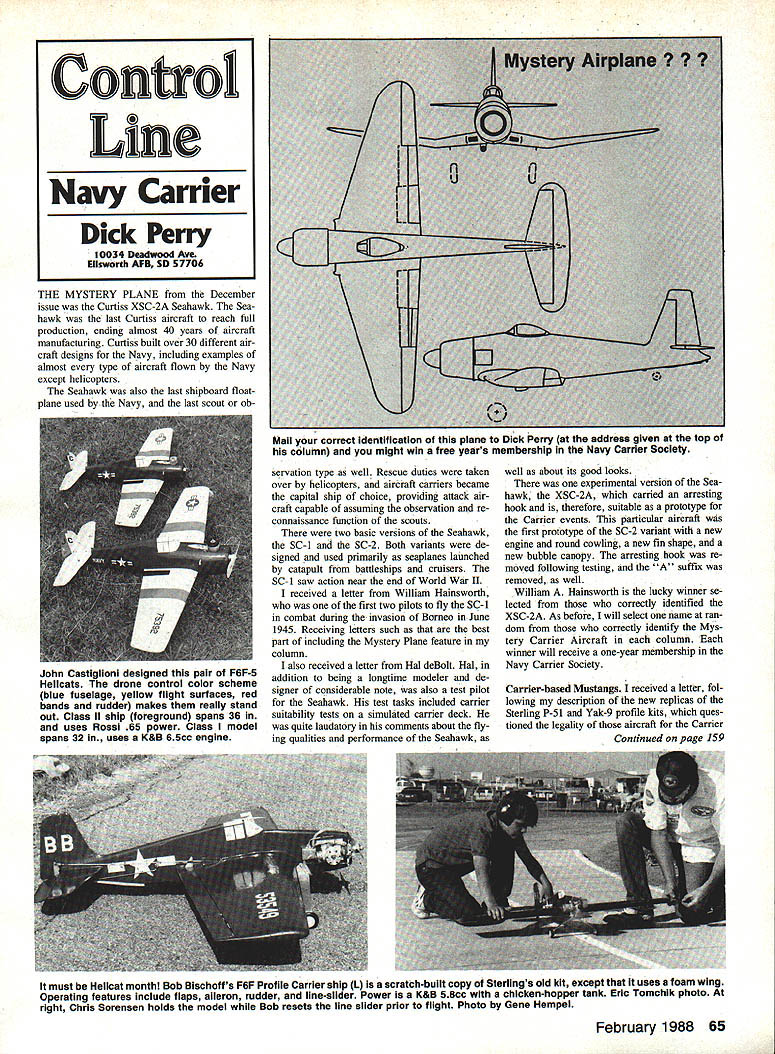
The Mystery Plane
The Mystery Plane from the December issue was the Curtiss XSC-2A Seahawk. The Seahawk was the last Curtiss aircraft to reach full production, ending almost 40 years of aircraft manufacturing. Curtiss built over 30 different aircraft designs for the Navy, including examples of almost every type of aircraft flown by the Navy except helicopters.
The Seahawk was also the last shipboard floatplane used by the Navy, and the last scout/observation type as well. Rescue duties were taken over by helicopters, and aircraft carriers became the capital ship of choice, providing attack aircraft capable of assuming the observation and reconnaissance functions of the scouts.
There were two basic versions of the Seahawk, the SC-1 and the SC-2. Both variants were designed and used primarily as seaplanes launched by catapult from battleships and cruisers. The SC-1 saw action near the end of World War II. I received a letter from William Hainsworth, who was one of the first two pilots to fly the SC-1 in combat during the invasion of Borneo in June 1945. Receiving letters such as that is the best part of including the Mystery Plane feature in my column.
I also received a letter from Hal deBolt. Hal, in addition to being a longtime modeler and designer of considerable note, was also a test pilot for the Seahawk. His test tasks included carrier-suitability tests on a simulated carrier deck. He was quite laudatory in his comments about the flying qualities, performance, and good looks of the Seahawk.
There was one experimental version of the Seahawk, the XSC-2A, which carried an arresting hook and is, therefore, suitable as a prototype for the Carrier events. This aircraft was the first prototype of the SC-2 variant with a new engine and round cowling, a new fin shape, and a new bubble canopy. The arresting hook was removed following testing, and the "A" suffix was dropped.
William A. Hainsworth is the lucky winner selected from those who correctly identified the XSC-2A. As before, I select one name at random from those who correctly identify the Mystery Carrier Aircraft in each column. Each winner receives a one-year membership in the Navy Carrier Society.
CL Navy Carrier / Perry
Continued from page 65
Yak-9 and Airacobra
The Yak-9, of course, did not see any carrier action or testing, since the Soviet Union had no aircraft carriers until the 1970s. The Yak outlines, however, are quite similar to those of the Bell Airacobra, and the Yak can be easily modified to resemble the two Bell aircraft.
Before someone else writes: the P-39 Airacobra is also legal for Carrier flying, having been tested for that purpose by the British Royal Navy.
P-51 Mustang
The P-51 Mustang was also tested for carrier suitability by the U.S. Navy. The Navy operated a number of Mustangs at various times, including:
- P-51A
- P-51B
- P-51C
- P-51D
- P-51H
All but the B and C models saw actual carrier suitability testing. The P-51B and P-51H were not fitted with arresting gear but did perform simulated takeoffs and landings at the Ship Experimental Unit at Mains Field, PA. The P-51D was equipped with an arresting hook and landed and took off from the aircraft carrier Shangri-La in November 1944.
G-S Kits
The possibility that the G-S kits would be reissued, which I mentioned in an earlier column, has become a reality. Thanks to the efforts of Carl Martin, there has been sufficient interest shown in all three models (F8F Bearcat, F4U Corsair, and AD Skyraider) for Bob Smurthwaite to produce a limited number of these kits.
Price: $36 each ($42 for the Corsair) plus $2 shipping. Order from: Bob Smurthwaite, P.O. Box 2947, La Grande, OR 97850. Phone: (503) 963-0596.
Exhaust deflector
One final correction on the origin of the plumbing-fitting exhaust deflector described in the August issue: the original idea belonged to Orin Humphries. His efforts involved soldering the elbow to a mount, but the solder joint failed readily because of the heat of the exhaust gas. The idea for the integral mount, as shown in the photographs and described in the column, belongs to Stan Johnson. Both Stan and Orin have been using the latest design with much success.
Navy Carrier Advisory Committee
As chairman of the Navy Carrier Advisory Committee, I try to keep members on the committee who can represent the areas in which Carrier events are regularly flown. Ron Haase has represented Florida in the past, but recently he has been inactive in our events and has asked that he be replaced on the committee.
Since I have not flown in the Southeast recently and do not have address information readily available for Carrier modelers in that area, I am taking this opportunity to ask for volunteers. If you are an active Carrier modeler in the Southeastern states and are interested in serving on the Navy Carrier Advisory Committee, please write to me and tell me of your Carrier activities. I will be happy to consider you for possible membership on the committee.
Transcribed from original scans by AI. Minor OCR errors may remain.

