
Control Line: Navy Carrier
Dick Perry 10035 Deadwood Ave. Ellsworth AFB, SD 57706
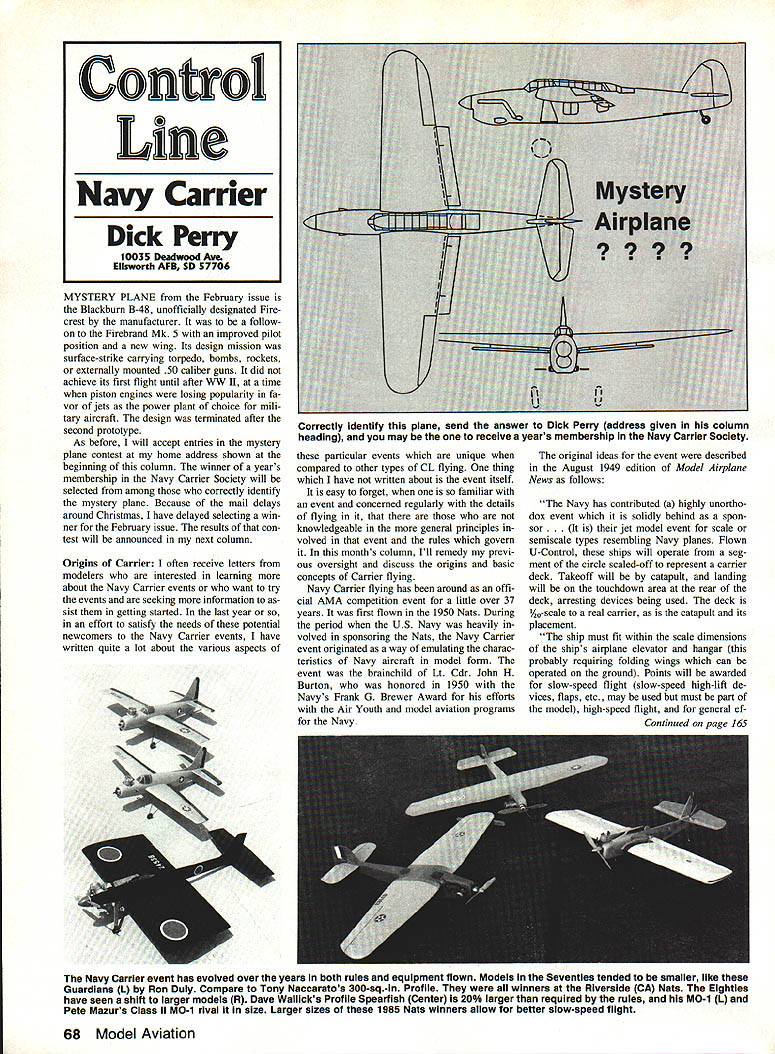
MYSTERY PLANE from the February issue is the Blackburn B-48, unofficially designated Firecrest by the manufacturer. It was to be a follow-on to the Firebrand Mk. 5 with an improved pilot position and a new wing. Its design mission was surface-strike, carrying torpedo, bombs, rockets, or externally mounted .50-caliber guns. It did not achieve its first flight until after WWII, at a time when piston engines were losing popularity in favor of jets as the power plant of choice for military aircraft. The design was terminated after the second prototype.
As before, I will accept entries in the mystery plane contest at my home address shown at the beginning of this column. The winner of a year's membership in the Navy Carrier Society will be selected among those who correctly identify the mystery plane. Because of the mail delays around Christmas, I have delayed selecting a winner for the February issue. The results of that contest will be announced in my next column.
Origins of Carrier
I often receive letters from modelers who are interested in learning more about the Navy Carrier events or who want to try the events and are seeking more information to assist them in getting started. In the last year or so, in an effort to satisfy the needs of these potential newcomers to the Navy Carrier events, I have written quite a lot about the various aspects of these particular events which are unique when compared to other types of CL flying. One thing which I have not written about is the event itself.
It is easy to forget, when one is so familiar with an event and concerned regularly with the details of flying in it, that there are those who are not knowledgeable in the more general principles involved in that event and the rules which govern it. In this month's column, I'll remedy my previous oversight and discuss the origins and basic concepts of Carrier flying.
Navy Carrier flying has been around as an official AMA competition event for a little over 37 years. It was first flown in the 1950 Nats. During the period when the U.S. Navy was heavily involved in sponsoring the Nats, the Navy Carrier event originated as a way of emulating the characteristics of Navy aircraft in model form. The event was the brainchild of Lt. Cdr. John H. Burton, who was honored in 1950 with the Navy's Frank G. Brewer Award for his efforts with the Air Youth and model aviation programs for the Navy.
The original ideas for the event were described in the August 1949 edition of Model Airplane News as follows:
"The Navy has contributed (a) highly unorthodox event which it is solidly behind as a sponsor. (It is) the most novel event for scale or semiscale types resembling Navy planes. Flown U-Control, these ships will operate from a segment of the circle scaled-off to represent a carrier deck. Takeoff will be by catapult, and landing will be on the touchdown area at the rear of the deck, arresting devices being used on the rear deck. The deck is to scale to a real carrier, as is the catapult and placement.
The ship must fit within the scale dimensions of the ship's airplane elevator and hangar (this probably requiring folding wings which can be operated on the ground). Points will be awarded for slow-speed flight (slow-speed high-lift devices, flaps, etc., may be used but must be part of the model), high-speed flight, and for general efficiency."
The first deck was manufactured in the Naval Gun Factory and was used in the 1950 Nats at Dallas Naval Air Station (NAS), TX. By direction of the Secretary of the Navy, it was officially commissioned the U.S.S. Smallfry and given the designation CVM-1 (Aircraft Carrier, Miniature) at Los Alamitos NAS, CA at the 1952 Nats.
Since its beginning, the event has changed considerably in equipment and rules, but the basic tenet remains the same. Models of real naval carrier-based aircraft are flown from a simulated carrier deck and must demonstrate the characteristics which are required of full-scale carrier aircraft: high speed, slow flight, and precision arrested landing. Scoring is a combination of these three flight regimes with bonus points added (and on an all-or-nothing basis) for scale appearance.
Flying consists of:
- Takeoff from the forward portion of the deck (about 24 ft. long).
- High-speed flight of seven laps.
- Slowing the model and signaling for the low-speed portion (seven laps).
- Arrested landing on the aft portion of the deck (about 20 ft. long) where arresting ropes tied to sandbags are used to stop the models.
There are now three classes of competition:
- Profile Carrier: for profile-fuselage models with at least 300 sq. in. of wing area and front-mounted .35 engines using suction fuel systems. A nominal bonus of 10 points is offered for models which represent actual carrier aircraft.
- Class I: engines up to and including .40 cu. in. displacement.
- Class II: engines up to and including .65 cu. in. displacement.
The complete rules for Navy Carrier flying are found in the AMA rule book. The new book has been available since December. The current rules are little changed from last year.
I enjoy the Carrier events because they are challenging ones which are a balance of equipment and flying skill. Judging is done on the basis of an evaluation by stopwatch with little room for subjectivity. The event can be flown by individuals (a practiced team is not required), and a contestant can usually set his own schedule at a contest, rather than being tied to a rigid schedule of heats or rounds. I hope that those of you who decide to try Carrier flying find it to be as enjoyable as I have.
CL Navy Carrier / Perry
One simple arrangement for making flap operation independent of throttle control uses a fourth-line operated down-limit switch (DL-SW) lever arm. The DL-SW closes the motor-operating circuit through the DL-SW and the upper limit switch (UP-SW) until the gearbox arm operates the UP-SW lever arm, opening the circuit and stopping the motor. The next pull on the fourth line starts the system all over again until the DL-SW stops the flaps once again in the down position and turns on the landing light.
Please note that the sketch I provided is not to scale; the intent is to demonstrate a way of making flap operation independent of throttle control. While no details were given regarding the type of gearbox and the drive-arm speed, a very low drive-arm speed of about one rpm (or less) would be desirable to give the flaps a realistic-looking operating speed.
An electric motor gear drive described in my April 1986 column would do nicely for this operation. Motor and gearbox units may also be found in some abandoned motorized toys. The output arm, connecting pushrods, and connection to flap(s) must be made to fit the individual installation.
If any of you have other ideas on how to independently control flaps or the operation of any other feature of a model, why not share it with your fellow scale modelers? I am running low on column material and would welcome ideas or photos of new projects.
Please send all correspondence — especially photos relating to CL Scale — to me at the address given at the very top of this column.
Transcribed from original scans by AI. Minor OCR errors may remain.

