

Control Line: Navy Carrier
Dick Perry 10035 Deadwood Ave Ellsworth AFB, SD 57706
This month's topics
Discussions in this month's column feature advantages of control systems other than the usual three-line system, the use of models which do not qualify for bonus points, and the usual Mystery Plane contest.
Mystery Plane (April)
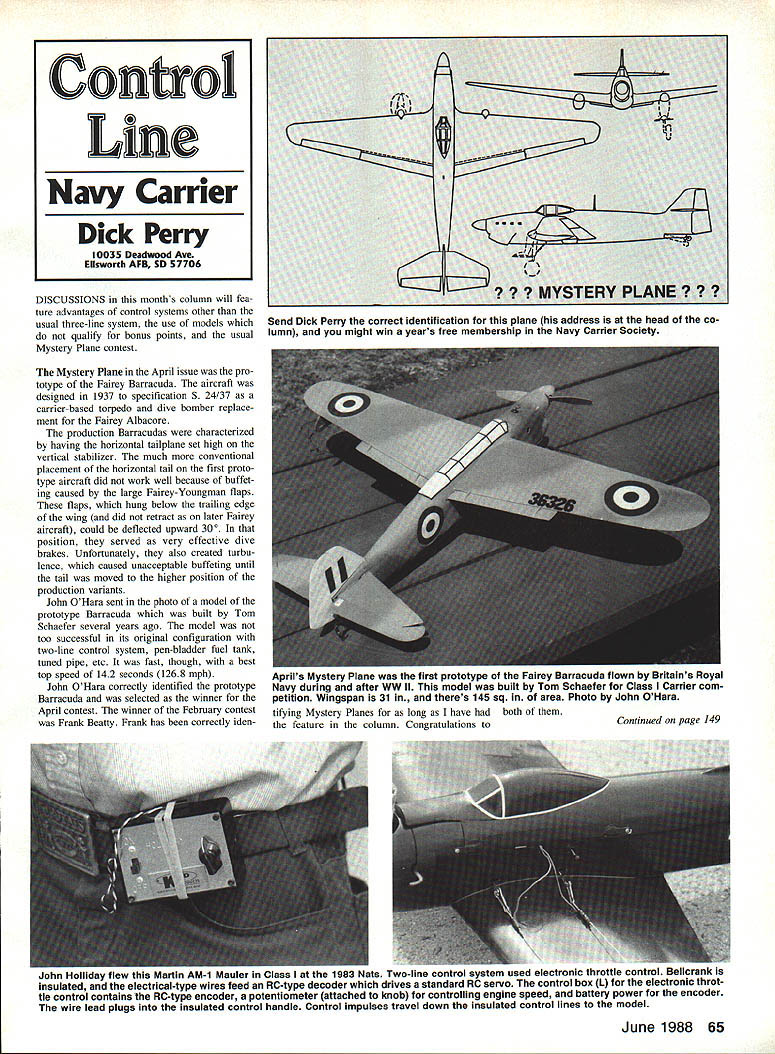
The Mystery Plane in the April issue was the prototype of the Fairey Barracuda. The aircraft was designed in 1937 to specification S.24/37 as a carrier-based torpedo and dive bomber replacement for the Fairey Albacore.
Production Barracudas were characterized by having the horizontal tailplane set high on the vertical stabilizer. The much more conventional placement of the horizontal tail on the first prototype did not work well because of buffeting caused by the large Fairey-Youngman flaps. These flaps, which hung below the trailing edge of the wing (and did not retract as on later Fairey aircraft), could be deflected upward 30°. In that position they served as very effective dive brakes. Unfortunately, they also created turbulence, which caused unacceptable buffeting until the tail was moved to the higher position of the production variants.
John O'Hara sent a photo of a model of the prototype Barracuda built by Tom Schaefer several years ago. The model was not too successful in its original configuration with a two-line control system, pen-bladder fuel tank, tuned pipe, etc. It was fast, though, with a best top speed of 14.2 seconds (126.8 mph).
John O'Hara correctly identified the prototype Barracuda and was selected as the winner for the April contest. The winner of the February contest was Frank Beatty. Frank has been correctly identifying Mystery Planes for as long as I have had the feature in the column. Congratulations to both of them.
CL Navy Carrier
As usual, I will select a winner from those who correctly identify this month's Mystery Plane. Each month's winner receives a year's membership in the Navy Carrier Society.
Nontraditional control systems
Bill Boss' "CL Scale" column has had a number of articles about electric or electronic control systems for CL models. The January issue provided a particularly good summary as well as addresses for inquiring about purchasing other electronic control systems. Such systems allow two lines to provide control of multiple functions — a definite advantage for scale models with many operating features. There would seem to be potential advantage in Carrier flying as well, because of reduced line drag with two lines instead of three.
I've looked at the advantages to be gained from using fewer than three lines in Carrier, and simplicity is not one of them. Neither is cost. Three-line systems are easy, simple, proven, and available. Two-line systems tend not to be. An electronic control system also has a slight weight penalty on the model caused by the necessary battery pack, decoder, and servo. What, then, is the advantage? The potential advantage comes from increasing performance by reducing line drag.
The analysis I performed relied on a number of assumptions to simplify the process. Most of the analysis isn't critical to the discussion, but I'll discuss them with any engineer types who are curious. A significant assumption is the amount of drag caused by the lines when compared to the drag of the model itself. I am not aware of any definitive study to evaluate the drag of a three-line control system and a typical Carrier model. The model is a significant variable in the equation, and the wide range of designs makes it difficult to make any definitive assumptions. Studies performed some years ago indicate that line drag of a three-line system probably accounts for over two-thirds of total drag. On many models the number is probably higher. That may be hard for some of you to believe, but it is substantiated by earlier studies and by analysis based on model performance.
The Navy Carrier rules mandate the use of three-line control systems in the Profile event, so this discussion is limited to Class I and II models. Line-size options in the classes are:
- Class I: three .015-in. dia. lines, two .020-in. lines, or one .026-in. dia. line.
- Class II: three .018-in. dia. lines, two .024-in. lines, or one .033-in. dia. line.
A quick look at the cross-sectional area of the lines gives an idea of drag differences. Including Reynolds-number effects caused by the changing sizes results in numbers which approximate:
- ~15% reduction in line drag by going to two lines, and
- ~45% reduction by going to a single line.
If line drag is reduced 15% and line drag accounts for two-thirds of total drag, then for a given speed total drag reduction would be about 10%. A 10% reduction in drag doesn't produce a 10% increase in speed, however. Drag changes as the square of speed, but that still isn't the whole answer unless the model is powered by a constant-thrust engine. Because our models' piston engines are essentially constant-power machines, performance increases are related to the cube of speed.
(POWER = DRAG × VELOCITY)
The bottom line is that changing from three lines to two will result in an increase in top speed of roughly 2% to 4% depending on the model. That results in an increase in score of about 2% to 4% as well — from roughly two points (for a mid–high-grade model capable of about 320 points with a three-line control system) up to about eight points (for an average model capable of a 380-point flight).
The real advantage comes from using a monoline system. Monoline has the potential to increase scores by 20 points or more, assuming that low-speed performance can be maintained. Unfortunately (or fortunately, depending on your point of view), throttle control with a monoline system presents some significant technological hurdles, and low-speed flight is not likely to be as slow or as reliable as with normal three-line control.
Is it worth it? You'll have to make your own decision.
Non-Scale models
I've received some letters about comments I made some months ago about Yak-9 and P-51 profile kits and their suitability for Carrier competition. These letters have made me want to discuss the issue again. While the Yak-9 prototype doesn't qualify as a carrier-based aircraft, there is nothing in the rules which prohibits its use in Carrier competition. The Yak-9 becomes a good Bell Airabonita with a little modification, and that is the way I would recommend using it.
The prototype restrictions (actual carrier takeoffs and landings or designation as a carrier aircraft) apply only to the bonus-points section of the rules. Any model meeting the basic specifications of the event can be used in competition regardless of whether or not it represents a qualifying prototype aircraft — it may not receive bonus points, however. Although the 10-point bonus in Class I and Class II is significant, many models have been flown effectively in Profile Carrier without the 10 scale bonus points.
Transcribed from original scans by AI. Minor OCR errors may remain.

