
Control Line: Navy Carrier
Dick Perry 10035 Deadwood Ave. Ellsworth AFB, SD 57706
Abstract
This month's column includes discussions of:
- Carrier at the Nats
- An easy way to make a Barracuda for .15 Carrier
- Rules change procedures
- The Mystery Plane feature
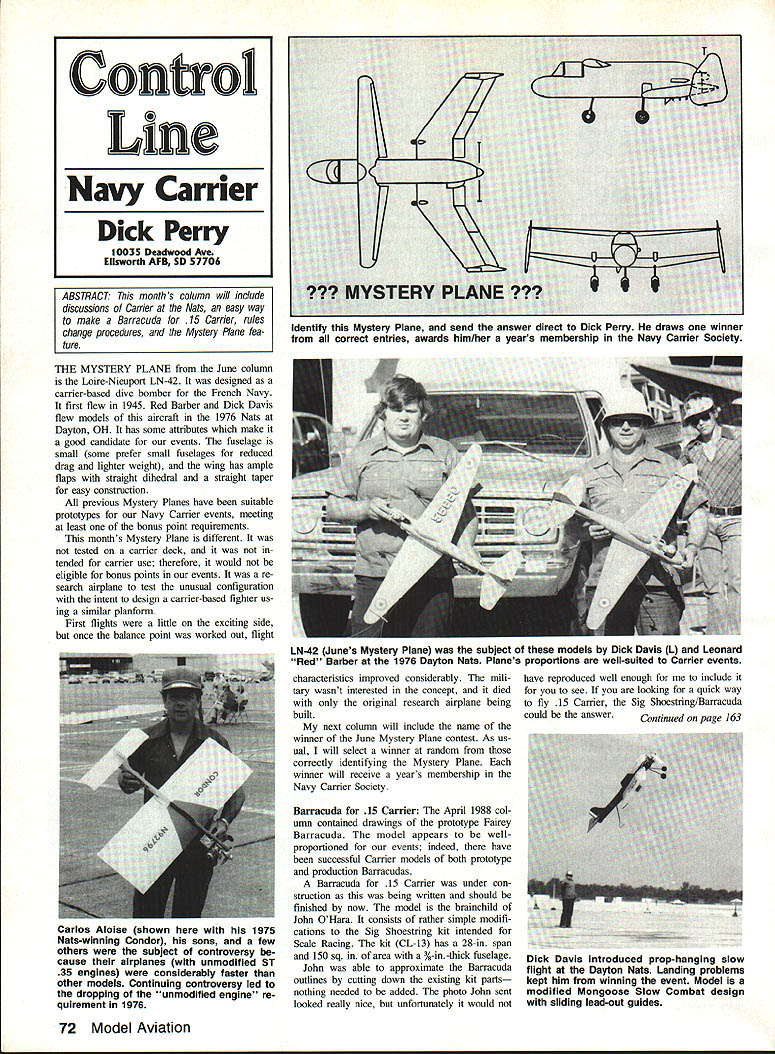
Identify the Mystery Plane and send your answer directly to Dick Perry. A winner will be drawn from the correct entries and awarded one year's membership in the Navy Carrier Society.
The Mystery Plane
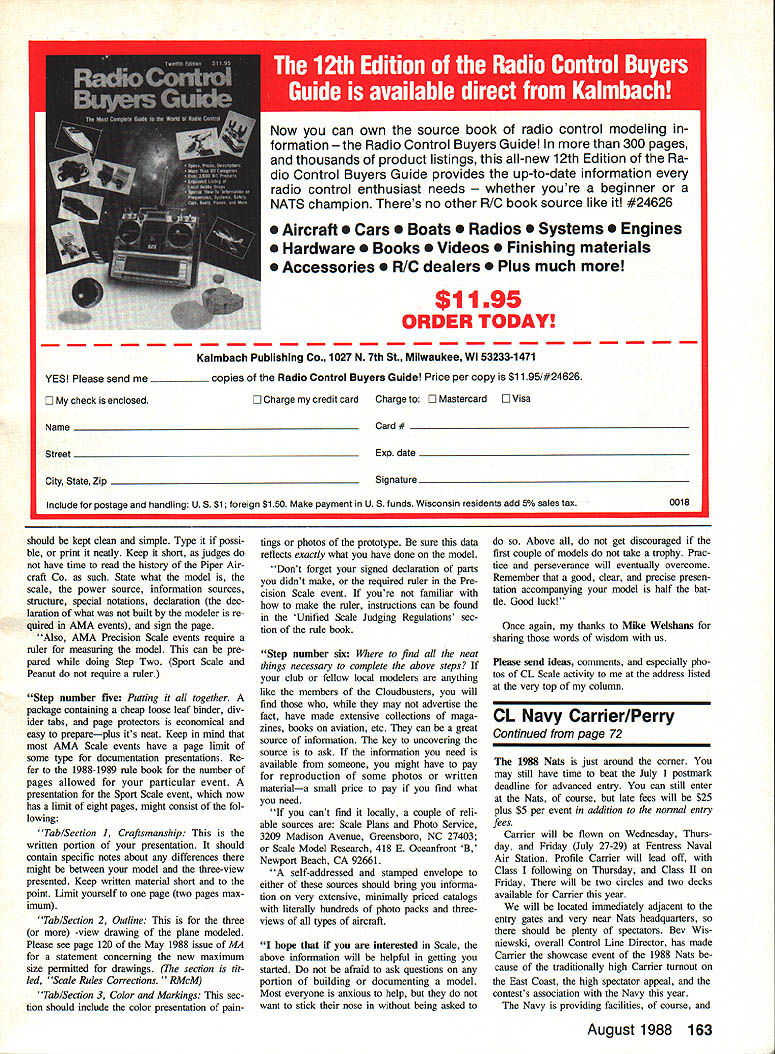
June's Mystery Plane was the Loire-Nieuport LN-42. Designed as a carrier-based dive bomber for the French Navy, it first flew in 1945. Red Barber and Dick Davis flew models of this aircraft at the 1976 Nats in Dayton, OH. It has attributes that make it a good candidate for Carrier events: a small fuselage (preferred by some for reduced drag and lighter weight) and a wing with ample flaps, straight dihedral, and straight taper—features that simplify construction.
All previous Mystery Planes have been suitable prototypes for our Navy Carrier events, meeting at least one bonus-point requirement.
This month's Mystery Plane is different. It was not tested on a carrier deck and was not intended for carrier use; therefore it would not be eligible for bonus points in our events. It was a research airplane used to test an unusual configuration with the intent of designing a carrier-based fighter using a similar planform. First flights were a little exciting, but once the balance point was worked out, flight characteristics improved considerably. The military wasn't interested in the concept, and the project ended with only the original research airplane built.
The name of the winner of the June Mystery Plane contest will be included in next month's column. As usual, a winner will be selected at random from the correct entries and will receive one year's membership in the Navy Carrier Society.
Barracuda for .15 Carrier
The April 1988 column contained drawings of the prototype Fairey Barracuda. The model appears well proportioned for our events; there have been successful Carrier models of both prototype and production Barracudas.
A Barracuda for .15 Carrier was under construction as this column was written and should be finished by now. The model is the idea of John O'Hara and consists of relatively simple modifications to the Sig Shoestring kit intended for Scale Racing (kit CL-13 has a 28-inch span and about 150 sq. in. area with a 3/8-inch-thick fuselage). John approximated the Barracuda outlines by cutting down the existing kit parts—nothing needed to be added. The photo John sent looked very nice, but it would not have reproduced well enough to include. If you are looking for a quick way to fly .15 Carrier, a Sig Shoestring-to-Barracuda conversion could be the answer.
1988 Nats: Carrier Schedule and Info
- Advanced entry postmark deadlines: July 1 (you may still have time).
- Late entry: you can enter at the Nats, but late fees will be $25 plus $5 per event in addition to normal entry fees.
- Carrier flight dates: Wednesday–Friday, July 27–29 at Fentress Naval Air Station.
- Profile Carrier will lead off.
- Class I follows on Thursday.
- Class II is on Friday.
- Facilities: Two circles and two decks will be available for Carrier this year.
- Spectator location: One circle will be immediately adjacent to the entry gates and very near Nats headquarters, so there should be plenty of spectators.
Carrier will be a showcase event at the 1988 Nats because of the traditionally high Carrier turnout on the East Coast, its spectator appeal, and the contest's association with the Navy this year. The Navy has a large presence in the Tidewater area, including being the home port for a number of full-scale carriers; Cam Martin is investigating the possibility of a tour of one of the carriers during Nats week.
Bob Ward has volunteered to direct Carrier this year. Staffing was progressing well, but additional help is always welcome. If you would like to assist with any or all of the Carrier events, write or call Bob:
- Address: 3652 Deerfield Dr., Suffolk, VA 23435
- Phone: (213) 866-2703
Rules and Common Problems
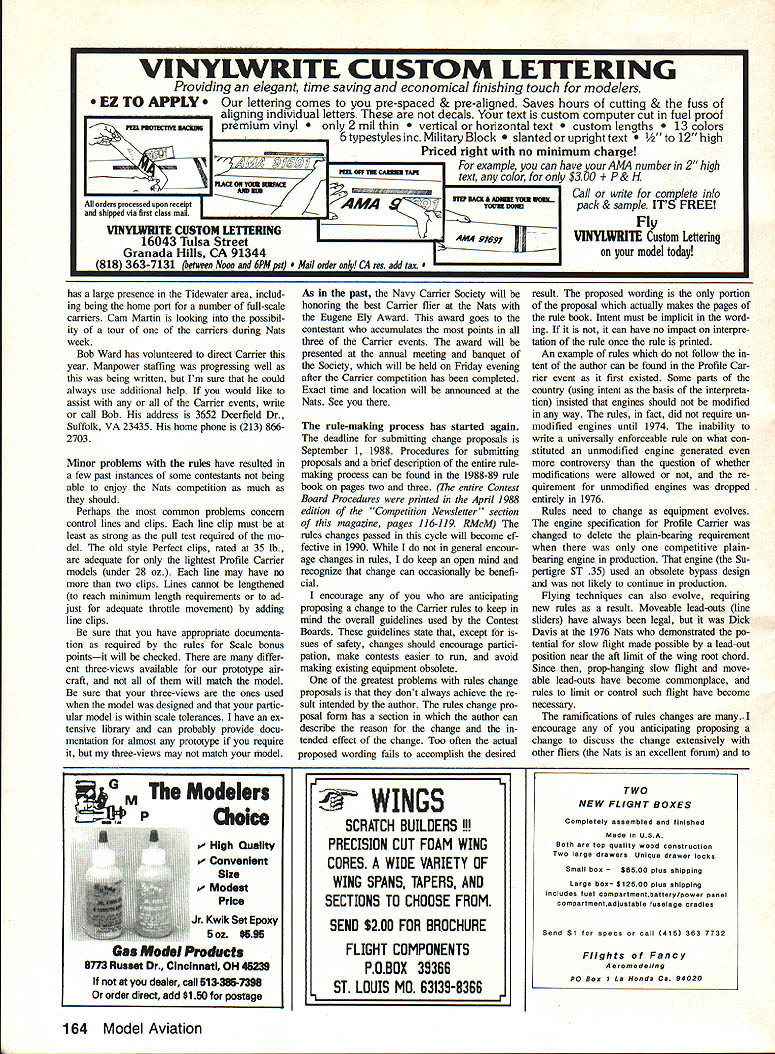
Minor problems with the rules have resulted in some contestants not enjoying the Nats competition as much as they should. Common issues include control lines, clips, and documentation for Scale bonus points.
- Line clips and strength:
- Each line clip must be at least as strong as the pull test required of the model.
- The old-style Perfect clips, rated at 35 lb., are adequate only for the lightest Profile Carrier models (under 28 oz.).
- Each line may have no more than two line clips.
- Lines cannot be lengthened (to reach minimum length requirements or to adjust for adequate throttle movement) by adding line clips.
- Scale bonus documentation:
- Be sure you have appropriate documentation as required by the rules for Scale bonus points — it will be checked.
- Many different three-views exist for a given prototype, and not all will match the model. Use the three-views that were used when the model was designed, and ensure your model is within those scale tolerances.
- I maintain an extensive library and can probably provide documentation for almost any prototype, but my three-views may not match your model; verify before the contest.
Awards
As in the past, the Navy Carrier Society will honor the best Carrier flyer at the Nats with the Eugene Ely Award. This award goes to the contestant who accumulates the most points in all three Carrier events. The award will be presented at the Society's annual meeting and banquet, to be held on Friday evening after the Carrier competition. Exact time and location will be announced at the Nats.
Rules Change Process
The deadline for submitting change proposals is September 1, 1988. Procedures for submitting proposals and a description of the rule-making process can be found in the 1988–89 rule book on pages two and three. (The entire Contest Board Procedures were printed in the April 1988 "Competition Newsletter" section of this magazine, pages 116–119.) Rules changes passed in this cycle will become effective in 1990.
Guidelines and advice:
- The Contest Board guidelines state that, except for safety issues, changes should:
- Encourage participation,
- Make contests easier to run,
- Avoid making existing equipment obsolete.
- Proposals often fail to achieve the author's intent because the actual proposed wording does not accomplish the desired result. The proposed wording is the only portion that will appear in the rule book, so intent must be implicit in the wording.
- Discuss proposed changes extensively with other fliers (the Nats is an excellent forum) and ensure the wording actually accomplishes your intent.
Examples and historical context:
- Engine specifications for Profile Carrier were changed to delete the plain-bearing requirement when only one competitive plain-bearing engine remained in production. That engine used an obsolete bypass design and was not likely to continue in production.
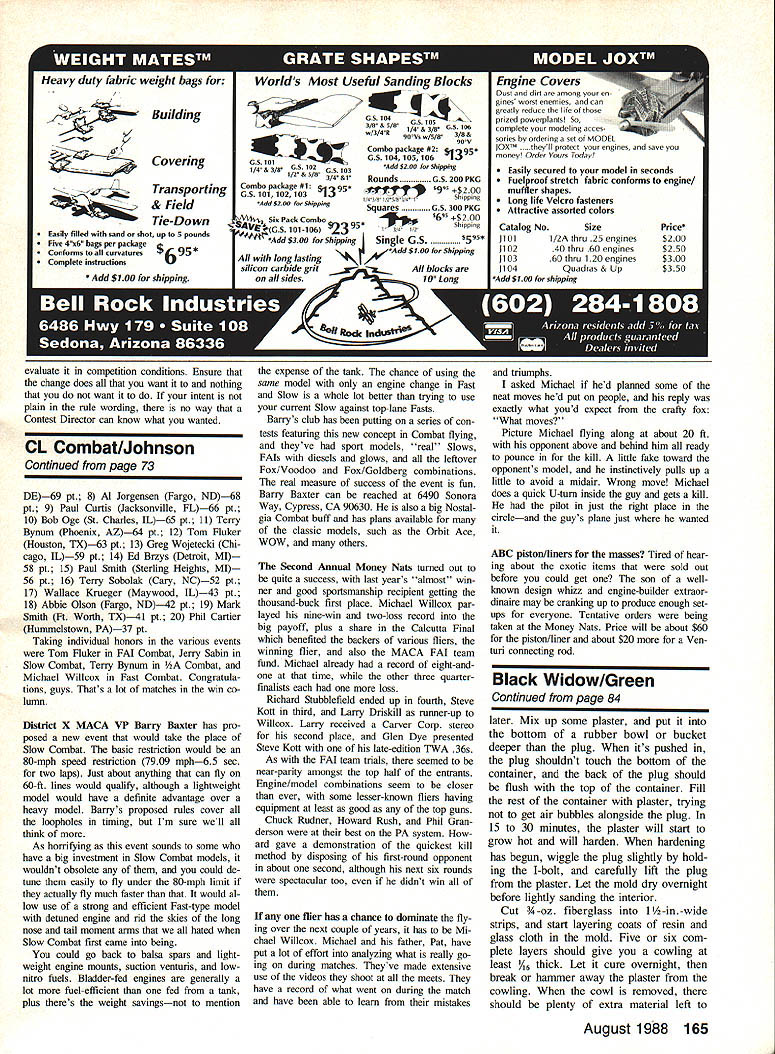
- Flying techniques evolve and may require new rules. Moveable lead-outs (sliders) have always been legal, but Dick Davis demonstrated at the 1976 Nats the potential for slow flight by positioning the lead-out near the aft limit of the wing root chord. Since then, prop-hanging slow flight and moveable lead-outs have become commonplace, and rules to limit or control such flight have become necessary.
I encourage anyone anticipating proposing a change to discuss it broadly and to draft wording that clearly accomplishes the intended effect.
Transcribed from original scans by AI. Minor OCR errors may remain.

