
Control Line
Navy Carrier
Dick Perry 10035 Deadwood Ave. Ellsworth AFB, SD 57706
THE WINNER of the Mystery Plane contest for the June issue was Leonard "Red" Barber. There were surprisingly few correct answers (the plane was the Loire-Nieuport LN-42), probably because the French aircraft designed for carrier operations at the beginning of World War II were produced in very small numbers, if at all, and saw little action in the role for which they were intended.
The aircraft in the August issue is the Miles M.35 Libellula. The name is derived from the scientific name of the dragonfly and is based on the tandem-wing layout shared by the aircraft and the insect. The easier-to-remember common name had already been used on the de Havilland D.H.90, so the Libellula ended up with a name almost as obscure as the aircraft itself.
Difficulties with the Ministry of Aircraft Production brought on by the fact that the Libellula was built without the Ministry's knowledge or approval, combined with George Miles' criticism of the Admiralty, tended to severely limit official enthusiasm for the concept of an operational fighter based on the configuration. We had to wait 30 more years for Burt Rutan to make the configuration successful in civil applications.
Jerry Martin's name was selected from among those who correctly identified the Libellula. He and Red Barber have each been awarded a year's membership in the Navy Carrier Society for their correct answers.
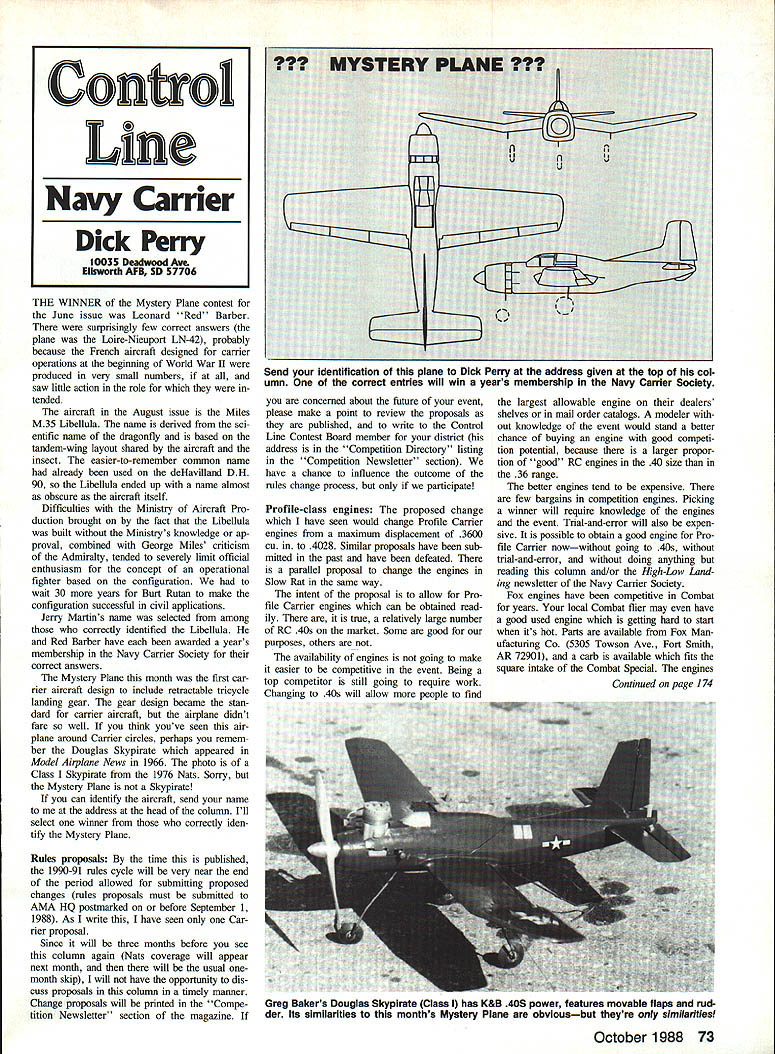
The Mystery Plane this month was the first carrier aircraft design to include retractable tricycle landing gear. The gear design became the standard for carrier aircraft, but the airplane didn't fare so well. If you think you've seen the airplane around Carrier circles, perhaps you remember the Douglas Skypirate which appeared in Model Airplane News in 1966. The photo is of a Class I Skypirate from the 1976 Nats. Sorry, but the Mystery Plane is not a Skypirate!
If you can identify the aircraft, send your name to me at the address at the head of the column. I'll select one winner from those who correctly identify the Mystery Plane. Send your identification of this plane to Dick Perry at the address given above. One of the correct entries will win a year's membership in the Navy Carrier Society.
Rules proposals
By the time this is published, the 1990–91 rules cycle will be very near the end of the period allowed for submitting proposed changes (rules proposals must be submitted to AMA HQ postmarked on or before September 1, 1988). As I write this, I have seen only one Carrier proposal.
Since it will be three months before you see this column again (Nats coverage will appear next month, and then there will be the usual one-month skip), I will not have the opportunity to discuss proposals in this column in a timely manner. Change proposals will be printed in the "Competition Newsletter" section of the magazine. If you are concerned about the future of your event, please make a point of reviewing the proposals as they are published, and of writing to the Control Line Contest Board member for your district (his address is in the "Competition Directory" listing in the "Competition Newsletter" section). We have a chance to influence the outcome of the rules change process, but only if we participate!
Suggested actions:
- Review proposed rule changes in the "Competition Newsletter" as they appear.
- Write to your district Control Line Contest Board member if you have comments or concerns.
- Submit proposed changes by the stated deadline if you want them considered.
Profile-class engines
The proposed change which I have seen would change Profile Carrier engines from a maximum displacement of .360 cu. in. to .4028 cu. in. Similar proposals have been submitted in the past and have been defeated. There is a parallel proposal to change the engines in Slow Rat in the same way.
The intent of the proposal is to allow for Profile Carrier engines that can be obtained ready-made. There are, it is true, a relatively large number of RC .40s on the market. Some are good for our purposes, others are not.
The availability of engines is not going to make it easier to be competitive in the event. Being a top competitor is still going to require work. Changing to .40s will allow more people to find the largest all-round engine on their dealers' shelves or in mail-order catalogs. A modeler without knowledge of the event would stand a better chance of buying an engine with good competition potential, because there is a larger proportion of "good" RC engines in the .40 size than in the .36 range.
The better engines tend to be expensive. There are few bargains in competition engines. Picking a winner will require knowledge of engines and trial-and-error. It is possible to obtain a good competitive Profile Carrier now—without going to .40s, without trial-and-error, and without doing anything but reading this column and/or the High-Low Landing newsletter of the Navy Carrier Society.
Fox engines have been competitive in Combat for years. Your local Combat flier may even have a good used engine which is getting hard to start when it's hot. Parts are available from Fox Manufacturing Co., 5305 Towson Ave., Fort Smith, AR 72901, and a carb is available which fits the square intake of the Combat Special. The engines are light and have potential for good performance, but you can't expect to take one out of the box and win.
There are two other engines which have been potential for winning performance. Indeed, the majority of successful competitors use one or the other of them:
- K&B 5.8 — available direct from K&B Manufacturing, 12152 Woodruff Ave., Downey, CA 90241.
- Tune-Hill conversion of the OS .40 FSR — many OS .40s are available used; Vic Garner (2240 Third Street, Livermore, CA 94550) has the parts needed for conversion and can discuss converting newer OS .40s to the .36 size required.
The most likely avenue to success with the minimum effort is probably the K&B 5.8.
Transcribed from original scans by AI. Minor OCR errors may remain.

