
Control Line: Navy Carrier
By
Dick Perry 480 Wright Dr. Rome, NY 13440
Synopsis
This month's column covers the Mystery Plane winner from the October 1988 issue, availability of the Fox .36 engine, the advantages of simplicity in Carrier models, and the Navy Carrier Society (NCS) positions on Sportsman Carrier and mufflers.
Address change
To those of you who missed my "Navy Carrier" column in its regular bimonthly appearance in the January Model Aviation, I apologize for its absence. It was the first column I have missed in over 13 years of writing it. The decision was a tough one to make, but the turmoil associated with my latest relocation was too much to overcome.
As is apparent by the column byline, I now reside in Rome, NY, having been transferred by the Air Force to Griffiss Air Force Base. It's good to be a little closer to other active Carrier fliers and to be able to attend contests without driving eight hours.
Mystery Plane
The Mystery Plane in the October 1988 column was the Douglas BTD-1 Destroyer. It started life as a prototype two-seat scout bomber, the XSB2D-1, during World War II, but was not placed into production. Instead, the design was modified into a single-seat torpedo bomber, the BTD-1. The end of the war halted production after a run of only 28 aircraft.
I had an outstanding response to this Mystery Plane—the largest so far. The responses included plans for a Profile Carrier version designed and flown by Bob Reynolds of Tucson, AZ. The model shows a lot of promise. I also heard from Jack Scarbrough, who was an aeronautical engineer on the team responsible for the design. I enjoyed reading all of the letters I received. Thanks for the interest in this feature of the column. As soon as I get my drawing board assembled, I'll resume the Mystery Plane contest.
The winner of the October contest is Gary Hetrick from Fremont, NE. Gary pointed out that the aircraft appeared in the July 1988 issue of Air Classics. Maybe that is the reason for the higher-than-usual response.
Fox .36
The October newsletter from Fox Manufacturing indicated that two engines would be discontinued because of slow sales:
- Fox .15BB
- Fox .36
The .15BB has seen some popularity in the .15 Carrier event because of its low cost and ready availability, coupled with light weight and good performance.
The Fox .36 in question is NOT the Fox Combat which has been used successfully in Profile Carrier. The Fox Combat is still available, though not on dealer shelves. The engine can be ordered directly from Fox Manufacturing Co., 5303 Towson Ave., Fort Smith, AR 72901. The cost is $80. Fox makes a carburetor with a square base to fit this engine—the same carb that is used on the .40 RC Compact.
Simple Carrier
I have long encouraged people, particularly those whose time for practice is limited or who can compete only occasionally, to use simple equipment. Simpler equipment increases reliability, keeps cost under control, and greatly reduces frustration while still allowing good competitive performance.
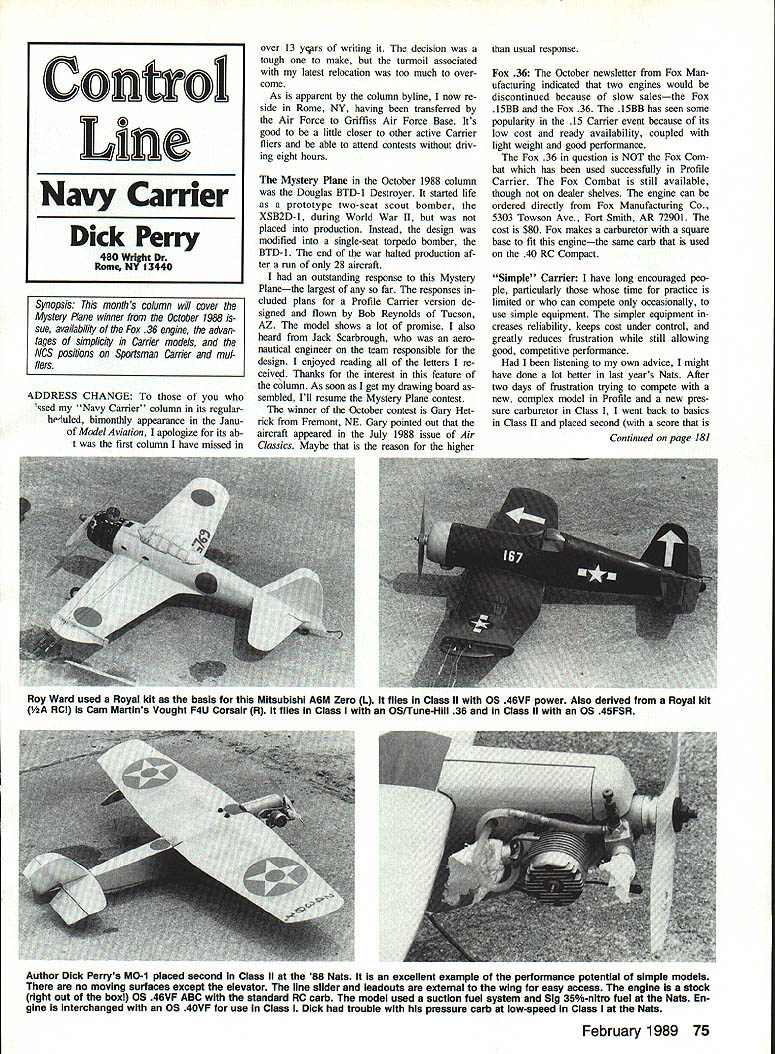
Had I been listening to my own advice, I might have done a lot better in last year's Nats. After two days of frustration trying to compete with new, complex models in Profile and a new pressure carburetor in Class I, I went back to basics in Class II and placed second.
Carrier is like many other things in life—the faster you fly, and the more precise you are in everything, the more error and expense. If your desire is to compete effectively with a minimum of cost and frustration, simplicity is the key. By keeping equipment simple and reliable, practice time can be devoted to flying skills rather than trying to learn the characteristics of complicated equipment.
CL Navy Carrier (model description)
This model has no moving surfaces except the elevator. It is equipped with an external line slider, and the bellcrank mount is in the fuselage for easy access.
The engine is an OS .46VF ABC. It is completely stock, just as it came from the box. I have done nothing to it but run it to break it in. The fuel system is a conventional suction system. The propeller was a Rev-Up 8.5 x 7.5, which was balanced but otherwise unmodified. Fuel was Sig, 35% nitro.
Sportsman Carrier
Lots of discussions have dealt with the issue of an entry-level Carrier event. Most have centered around .15 Carrier, Profile Carrier with various restrictions, or performance categories with existing rules. A consensus developed at the '88 Nats among the competitors that such an event should encourage people to enter by allowing them to compete among themselves without having to fly against experienced competitors. The event should not impose equipment restrictions that would force a contestant to learn new skills or change equipment to be competitive in regular AMA Carrier events.
The Navy Carrier Society (NCS) will sponsor such an event at the 1989 Nats. Sportsman Profile Carrier will probably be flown the day following regular Nats Carrier competition, and will be restricted to contestants who do not enter the Nats event. Details will be made available as the Nats approaches.
To carry the idea into Carrier at local contests, the NCS strongly encourages its members to include Sportsman Carrier in any Carrier contest held in 1989. I think the idea has real merit and should be considered, even if including Sportsman Carrier would require combining other events or reducing the number of trophies in other events.
Mufflers for Carrier
The NCS also discussed the muffler issue at some length. There are proposals before the Contest Board to change the rules to allow mufflers and/or tuned pipes. I believe that most of these proposals are potential enforcement nightmares because of very loose wording. I also believe that something needs to be done to allow our models to be muffled for those flying sites that require it.
Under present AMA guidelines, it is possible to deviate from published competition rules as long as deviations are published in advance. It is, therefore, possible to allow mufflers in Carrier competition for those club contests so equipped; those models would be ineligible for national records.
The NCS adopted the position that mufflers should be allowed in Carrier competition during 1989 to gain information for use in developing an effective muffler rule for the events. Individual Contest Directors will have to take the initiative to allow mufflers and to publicize rules that will be applicable in their own contests.
Meanwhile, a committee, for which I am the chairman, will be working to develop guidelines for muffler use so that alternatives can be explored and a workable rule established before the next rules proposal cycle begins in September 1990. I solicit your opinions about mufflers and any information you may have gathered so that such information may be of use to the committee.
Transcribed from original scans by AI. Minor OCR errors may remain.

