
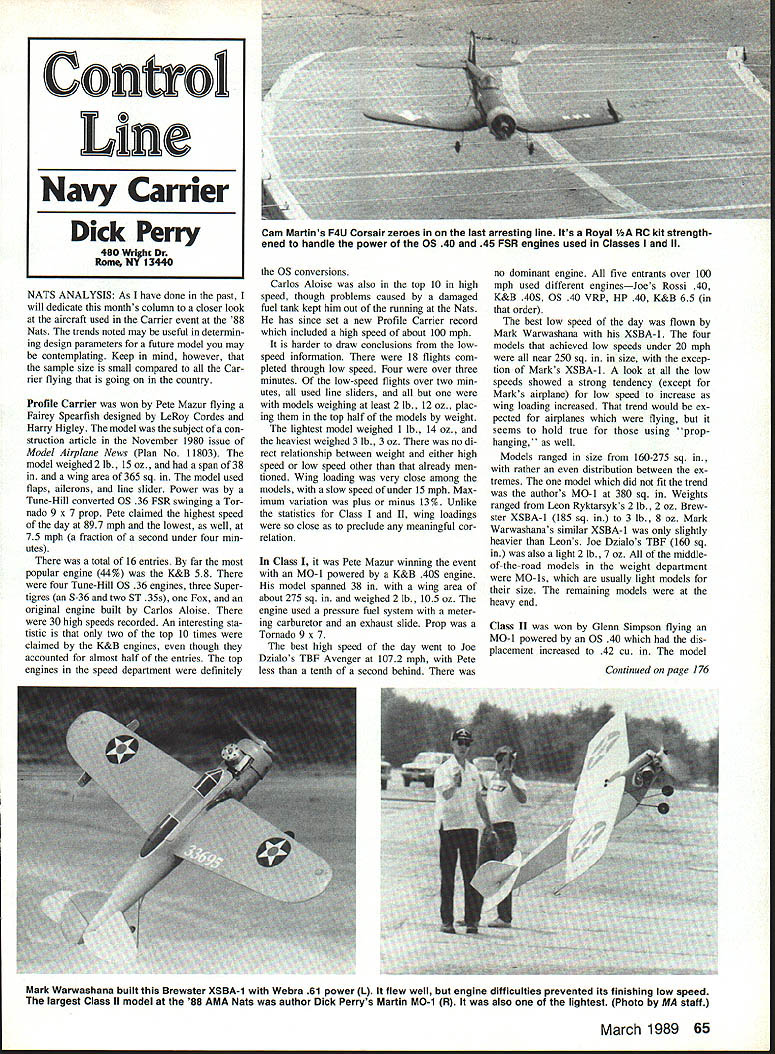
Control Line: Navy Carrier
Dick Perry 480 Wright Dr. Rome, NY 13440
NATS Analysis
As I have done in the past, I will dedicate this month's column to a closer look at the aircraft used in the Carrier event at the '88 Nats. The trends noted may be useful in determining design parameters for a future model you may be contemplating. Keep in mind, however, that the sample size is small compared to all the Carrier flying that is going on in the country.
Profile Carrier
Profile Carrier was won by Pete Mazur flying a Fairey Spearfish designed by LeRoy Cordes and Harry Higley. The model was the subject of a construction article in the November 1980 issue of Model Airplane News (Plan No. 11803). Key data for Pete's model:
- Weight: 2 lb. 15 oz.
- Span: 38 in.
- Wing area: 365 sq. in.
- Controls: flaps, ailerons, and line slider
- Power: Tune-Hill converted .05-.36 FSR swinging a Tornado 9 x 7 prop
- Performance: highest speed of the day 89.7 mph; lowest speed 7.5 mph (a fraction of a second under four minutes)
There were a total of 16 entries. By far the most popular engine (44%) was the K&B .58. Other powerplants included:
- four Tune-Hill .05-.36 engines
- three Super Tigres (one S-36 and two ST .35s)
- one Fox
- one original engine built by Carlos Aloise
There were 30 high speeds recorded. An interesting statistic is that only two of the top 10 times were claimed by the K&B engines, even though they accounted for almost half of the entries. The top engines in the speed department were definitely the OS conversions.
Carlos Aloise was also in the top 10 in high speed, though problems caused by a damaged fuel tank kept him out of the running at the Nats. He has since set a new Profile Carrier record which included a high speed of about 100 mph.
Low-speed analysis is harder to interpret. There were 18 flights completed through low speed. Four exceeded three minutes. Of the low-speed flights over two minutes, all used line sliders, and all but one were with models weighing at least 2 lb. 12 oz., placing them in the top half of the models by weight. Model weights ranged from 1 lb. 14 oz. to 3 lb. 3 oz. There was no direct relationship between weight and either high speed or low speed beyond what has already been mentioned. Wing loading among models showing slow speed under 15 mph was very close—maximum variation about ±13%—so wing loading was too similar to draw meaningful correlations for Profile Carrier.
Class I
Class I was won by Pete Mazur with an MO-1 powered by a K&B .40S engine. His model:
- Span: 38 in.
- Wing area: about 275 sq. in.
- Weight: 2 lb. 10.5 oz.
- Fuel system: pressure fuel with a metering carburetor and an exhaust slide
- Prop: Tornado 9 x 7
The best high speed of the day went to Joe Dzialo's TBF Avenger at 107.2 mph, with Pete less than a tenth of a second behind. There was no dominant engine in Class I: all five entrants over 100 mph used different engines—Joe's Rossi .40, K&B .40S, OS .40 VRP, HP .40, and a K&B 6.5 (in that order).
The best low speed of the day was flown by Mark Warwashana with his XSBA-1. The four models that achieved low speeds under 20 mph were all near 250 sq. in. in size, with the exception of Mark's XSBA-1. Examination of all the low speeds showed a strong tendency (except for Mark's airplane) for low speed to increase as wing loading increased; that trend is expected for airplanes that are flying and seems to hold using prop-hanging as well. Models in Class I ranged in size from 160–275 sq. in., with an even distribution between the extremes; my own MO-1 was 380 sq. in.
Weights in Class I spanned a wide range:
- Leon Ryktarsyk's Brewster XSBA-1 (185 sq. in.): 2 lb. 2 oz.
- Mark Warwashana's XSBA-1: slightly heavier than Leon's
- Joe Dzialo's TBF (160 sq. in.): 2 lb. 7 oz.
- Brewster XSBA-1: up to 3 lb. 8 oz.
Most of the middle-of-the-road weights were MO-1s, which are usually light for their size; several remaining models were toward the heavier end.
Class II
Class II was won by Glenn Simpson flying an MO-1 powered by an OS .40 whose displacement had been increased to .42 cu. in. The model used an OS carburetor and a K&B exhaust baffle and was swinging a Rev-Up 9 x 7 prop. Glenn's MO-1 had a span of 37.5 in., a wing area of 275 sq. in., and weighed 3 lb. 3 oz.
High speed of the event was held by Pete Mazur at 117.2 mph, but he was unable to finish a low speed. Pete's MO-1 (3 lb. 12 oz., 355 sq. in.) was powered by a Webra Speed .61 using a fuel-metering carburetor and exhaust slide with a pressure fuel system. Prop was a fiberglass copy of the Rev-Up 10 x 8 W.
Other observations in Class II:
- Speeds over 90 mph were achieved by models powered by an almost even mix of large (.60 to .65 cu. in.) and small (.41 to .46 cu. in.) engines (four large, eight small).
- While there was an equal mix of large and small engines among entries, that distribution did not hold among those who successfully completed high-speed flights. All of the large engines that finished high speed were over 90 mph. However, small engines greatly outnumbered large engines for finishing high speed.
- Larger engines were usually equipped with pressure fuel systems; some smaller engines ran on vacuum fuel supplies. Many of the smaller engines were equipped with U.S. carburetor systems and stock throttles and seemed more reliable. Reliability of complete systems is usually directly related to the amount of time and practice the contestant can devote to the event.
Best low speed of Class II went to the author at 158 sec. (11.3 mph). Glenn Simpson was close behind at 111.6 mph.
As in the prior class, increasing wing loading correlated very closely with increasing speed during the slow portion. During the fast portion the dominant glow plug was Fox. The propeller used by most contestants was Rev-Up. The most popular sizes in Profile and Class I, as well as among the smaller-engined Class II models, were the 9 x 7.5 and the 9 x 7.
Closing
That's all for this month. As you read this, I hope that you are well along in the building of your models for next season. The snow will be melting here in a month or two, and I'm looking forward to using the vast expanse of parking lot here at Griffiss Air Force Base for practice.
Transcribed from original scans by AI. Minor OCR errors may remain.

