
Control Line: Navy Carrier
Dick Perry 480 Wright Dr Rome, NY 13440
SYNOPSIS: This month's column deals with reminiscences of some of the noncompetition aspects of last summer's Nats, the results of the initial rules voting by the Control Line Contest Board, and an interesting side effect of the large amounts of wing-tip weight being used in our models to enhance low-speed flight.
Nats Carrier tour
In addition to the competition and camaraderie that accompany any Nats, last summer's meet had an extra treat for Carrier enthusiasts. There is a large Navy presence in the Tidewater, VA area. Besides the two naval air stations and the auxiliary field on which the Nats was held, Norfolk is the home port of many ships of the Atlantic Fleet, including several aircraft carriers. Cam Martin, formerly a Public Affairs Officer at Norfolk Naval Station, arranged for a tour of the aircraft carrier USS Independence (CV-62), which was in port while the Nats was being held.
Cam set up the tour primarily for officials and contestants in the Carrier events, and it was publicized in the Navy Carrier Society newsletter, Hi-Low Landings. Publicity at the Nats got the word out to additional people, and the tour was attended by a variety of contestants and spectators.
The officers and crew of the Independence gave us a very informative and interesting tour, showing us around the flight deck, hangar deck, flight operations and control areas, and explaining the intricacies of operating, maintaining, and controlling over 60 aircraft from the confines of an aircraft carrier. The tour was such a hit that a second tour was arranged for later in the week. Thanks to both Cam and the Independence for helping to make the Tidewater Nats a particularly memorable one.
Memories
Another highlight of last summer's Nats was meeting "Andy" Anderson, a Tidewater-area resident and longtime modeler well known to fellow modelers in the region. Andy came over to the Carrier decks to watch the action and we had an opportunity to talk with him at length during one of the lunch breaks. Andy flew Carrier in the early Fifties with a model of the Vought VE-7 biplane. That particular airplane was Andy's favorite because he served as a VE-7 plane captain in the Twenties when he was in the Navy.
Andy was in Norfolk during the earliest attempts at carrier aviation in the Navy. The USS Langley, the United States' first aircraft carrier, was stationed at Norfolk, and the VE-7 was not only the first aircraft to fly from her deck but also the type most often deployed aboard her.
As a result, Andy had a lot of experience with the VE-7 aboard Langley and with the development and testing that led up to the Navy's first operational capability with aircraft carriers.
The MO-1 was also quite familiar to Andy. For part of the time he served aboard Langley, there was an MO-1 squadron assigned to the ship. Andy was able to confirm what we have long believed but had little concrete proof to substantiate—that the MO-1 had served operationally aboard an aircraft carrier. Thanks, Andy, for sharing your experiences with us. I hope we meet again.
Rules proposals
The results of the Initial Vote ballot on the 1990–1991 rules proposals were published in the March edition of the Competition Newsletter section of Model Aviation. All proposals which would have had any significant effect on our events were defeated. The two proposals remaining will not change the way the event is flown or scored, and will not change the equipment we are presently using. One will clarify the intent of the three-inch exhaust extension rule, and the other will combine the two-minute allowance to appear for a flight with the three-minute engine starting time. A very similar procedure has been used at the Nats for many years.
The end result is that the rules will be stable for the next three competition seasons, at least. For most of us, that's good news.
Nats Carrier tour — additional notes
Competition and camaraderie accompany every Nats, but the large Navy presence in Tidewater made last summer particularly special for Carrier enthusiasts. Besides the two naval air stations and auxiliary field, Norfolk is the home port for many ships of the Atlantic Fleet, including aircraft carriers. Cam Martin arranged the USS Independence tour primarily for Carrier officials and contestants; the Navy Carrier Society newsletter and Nats publicity helped attract a broad group of contestants and spectators. The Independence crew's informative tour of flight and hangar decks, flight operations, and control areas made the Tidewater Nats especially memorable.
Effects of wing-tip weight
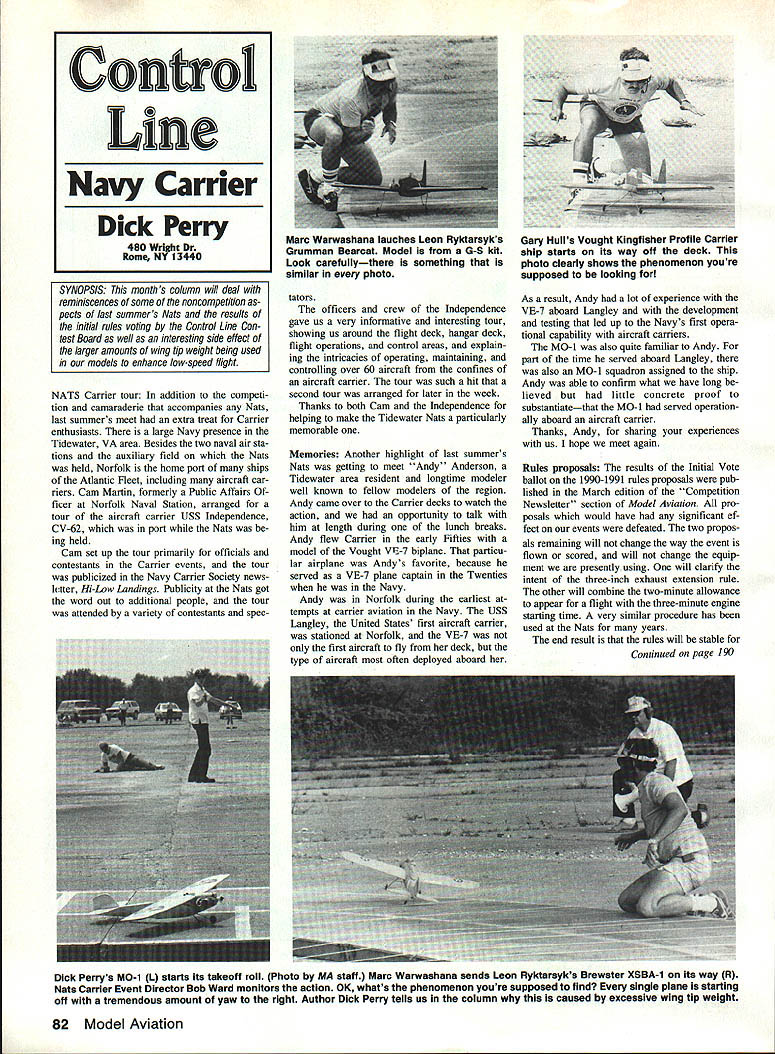
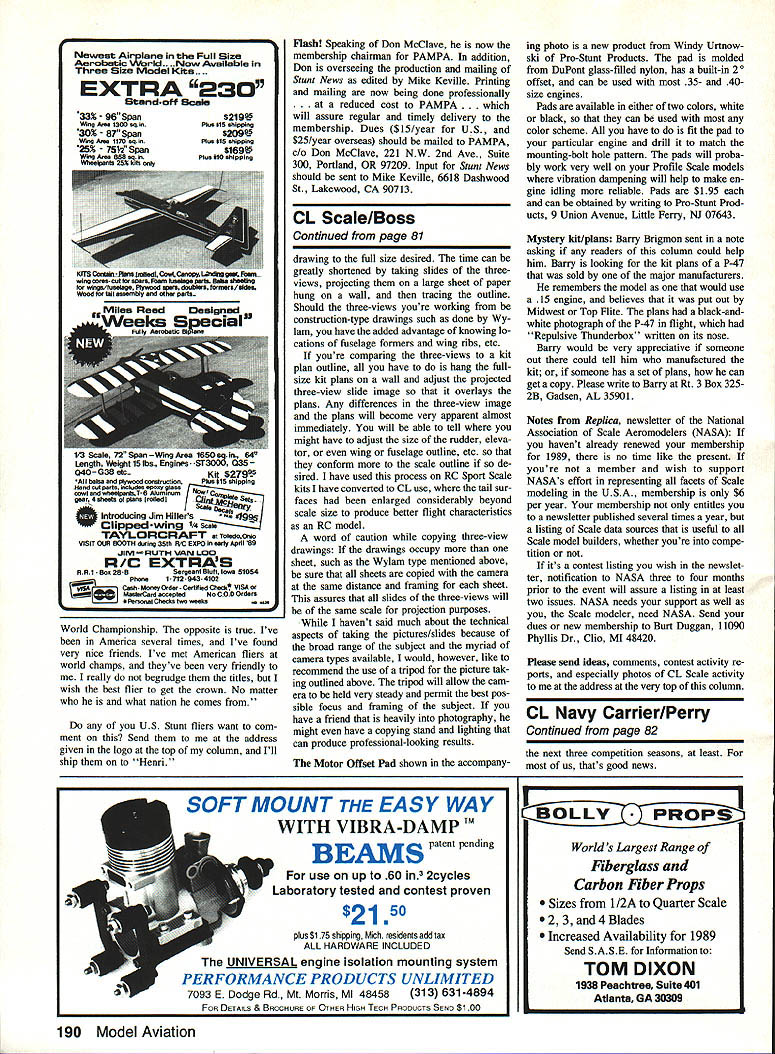
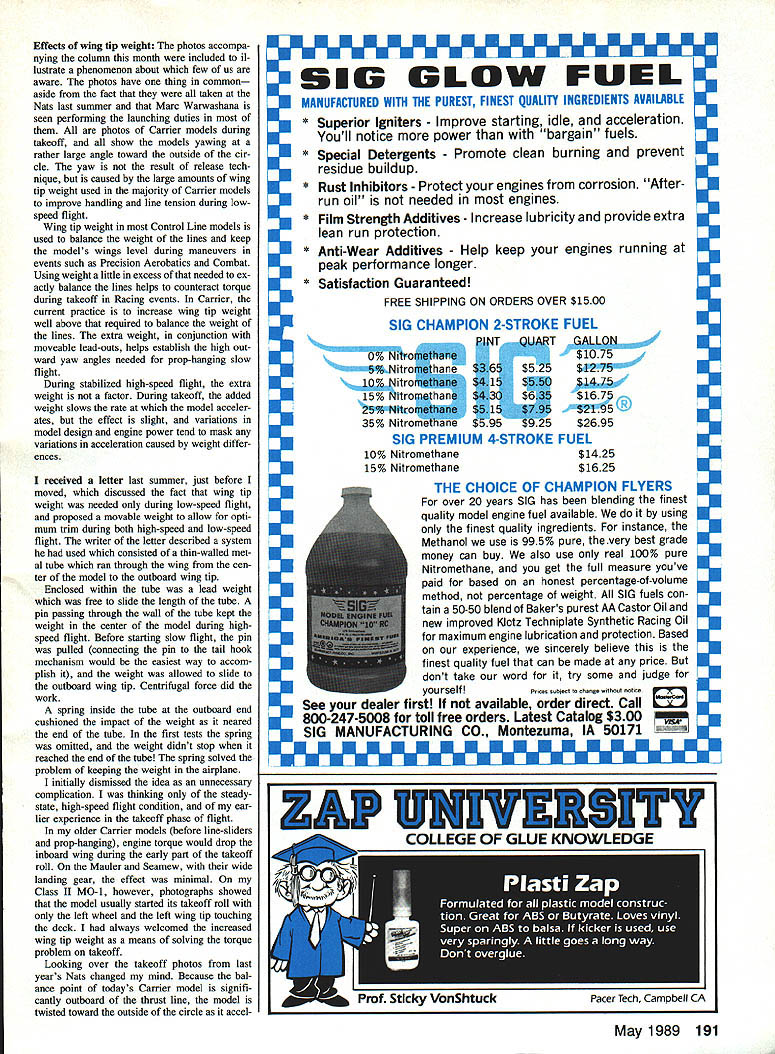
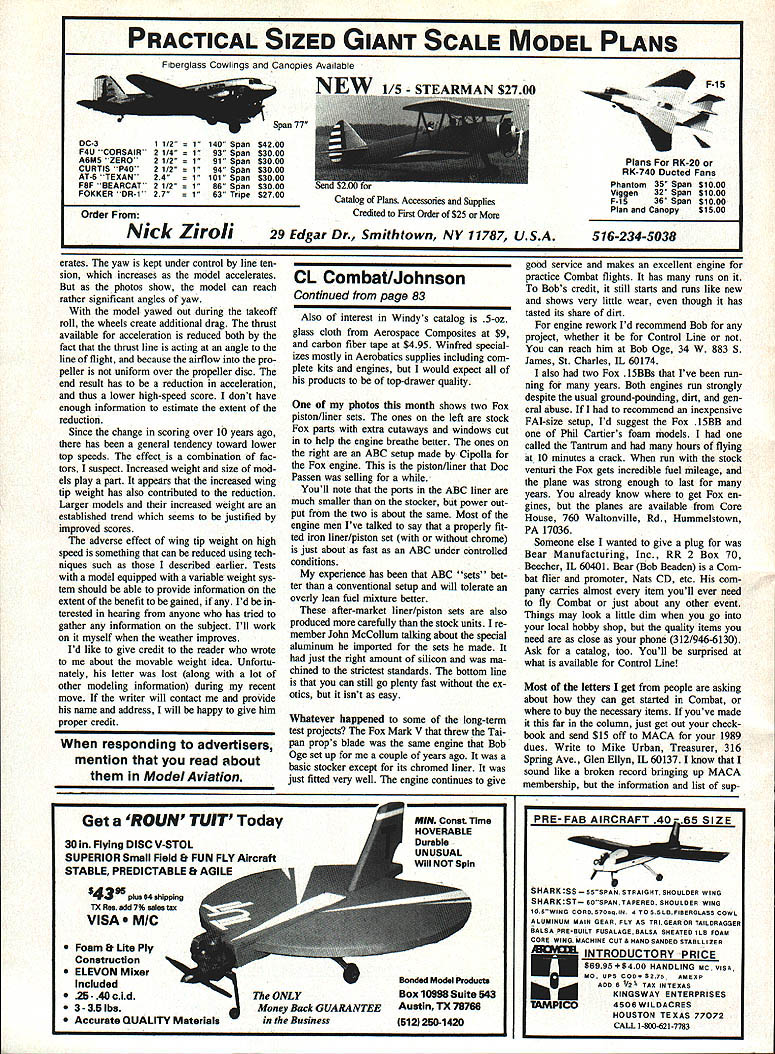
The photos accompanying this column were included to illustrate a phenomenon about which few of us are aware. The photos have one thing in common—aside from the fact that they were all taken at last summer's Nats and that Marc Warwashana is seen performing the launching duties in most of them. All are photos of Carrier models during takeoff, and all show the models yawing at a rather large angle toward the outside of the circle. The yaw is not the result of release technique but is caused by the large amounts of wing-tip weight used in the majority of Carrier models to improve handling and line tension during low-speed flight.
Wing-tip weight in most control-line models is used to balance the weight of the lines and keep the model's wings level during maneuvers in events such as Precision Aerobatics and Combat. Using weight a little in excess of that needed to exactly balance the lines helps to counteract torque during takeoff in Racing events. In Carrier, the current practice is to increase wing-tip weight well above that required to balance the weight of the lines. The extra weight, in conjunction with moveable leadouts, helps establish the high outward-yaw angles needed for prop-hanging slow flight.
During stabilized high-speed flight, the extra weight is not a factor. During takeoff, the added weight slows the rate at which the model accelerates, but the effect is slight, and variations in model design and engine power tend to mask any variations in acceleration caused by weight differences.
I received a letter last summer, just before I moved, which discussed the fact that wing-tip weight was needed only during low-speed flight and proposed a movable weight to allow for optimum trim during both high-speed and low-speed flight. The writer described a system he had used consisting of a thin-walled metal tube that ran through the wing from the center of the model to the outboard wing tip.
Enclosed within the tube was a lead weight free to slide the length of the tube. A pin passing through the wall of the tube kept the weight in the center of the model during high-speed flight. Before starting slow flight, the pin was pulled (connecting the pin to the tail-hook mechanism would be the easiest way to accomplish it), and the weight was allowed to slide to the outboard wing tip. Centrifugal force did the rest.
A spring inside the tube at the outboard end cushioned the impact of the weight as it neared the end of the tube. In the first tests the spring was omitted, and the weight didn't stop when it reached the end of the tube! The spring solved the problem of keeping the weight in the airplane.
I initially dismissed the idea as an unnecessary complication. I was thinking only of the steady-state, high-speed flight condition, and of my earlier experience in the takeoff phase of flight.
In my older Carrier models (before inline slides and prop-hanging), engine torque would drop the inboard wing during the early part of the takeoff roll. On the Mauler and Seamew, with their wide landing gear, the effect was minimal. On my Class II MO-1, however, photographs showed that the model usually started its takeoff roll with only the left wheel and the left wing tip touching the deck. I had always welcomed the increased wing-tip weight as a means of solving the torque problem on takeoff.
Looking over the takeoff photos from last year's Nats changed my mind. Because the balance point of today's Carrier plane is significantly outboard of the thrust line, the model is twisted toward the outside of the circle as it accelerates. The yaw is kept under control by line tension, which increases as the model accelerates. But as the photos show, the model can reach rather significant angles of yaw.
With the model yawed out during the takeoff roll, the wheels create additional drag. The thrust available for acceleration is reduced both by the fact that the thrust line is acting at an angle to the line of flight and because the airflow into the propeller is not uniform over the propeller disc. The net result must be a reduction in acceleration, and thus a lower high-speed score. I don't have enough information to estimate the extent of the reduction.
Since the change in scoring over 10 years ago, there has been a general tendency toward lower top speeds. The effect is a combination of factors, I suspect. Increased weight and size of models play a part. It also appears that the increased wing-tip weight has contributed to the reduction. Larger models and their increased weight are an established trend that seems to be justified by improved scores.
The adverse effect of wing-tip weight on high speed is something that can be reduced using techniques such as the variable weight system described earlier. Tests with a model equipped with a variable weight system should provide information on the extent of any benefit to be gained. I'd be interested in hearing from anyone who has tried to gather information on the subject. I'll work on it myself when the weather improves.
I'd like to give credit to the reader who wrote to me about the movable weight idea. Unfortunately, his letter was lost (along with a lot of other modeling information) during my recent move. If the writer will contact me and provide his name and address, I will be happy to give him proper credit.
Transcribed from original scans by AI. Minor OCR errors may remain.

