
Control Line: Navy Carrier
Dick Perry 480 Wright Dr. Rome, NY 13440
Synopsis
This month the topics include a new Mystery Plane contest, a discussion of the WAM Carrier events, and a new Sig kit with potential as a Profile Carrier model.
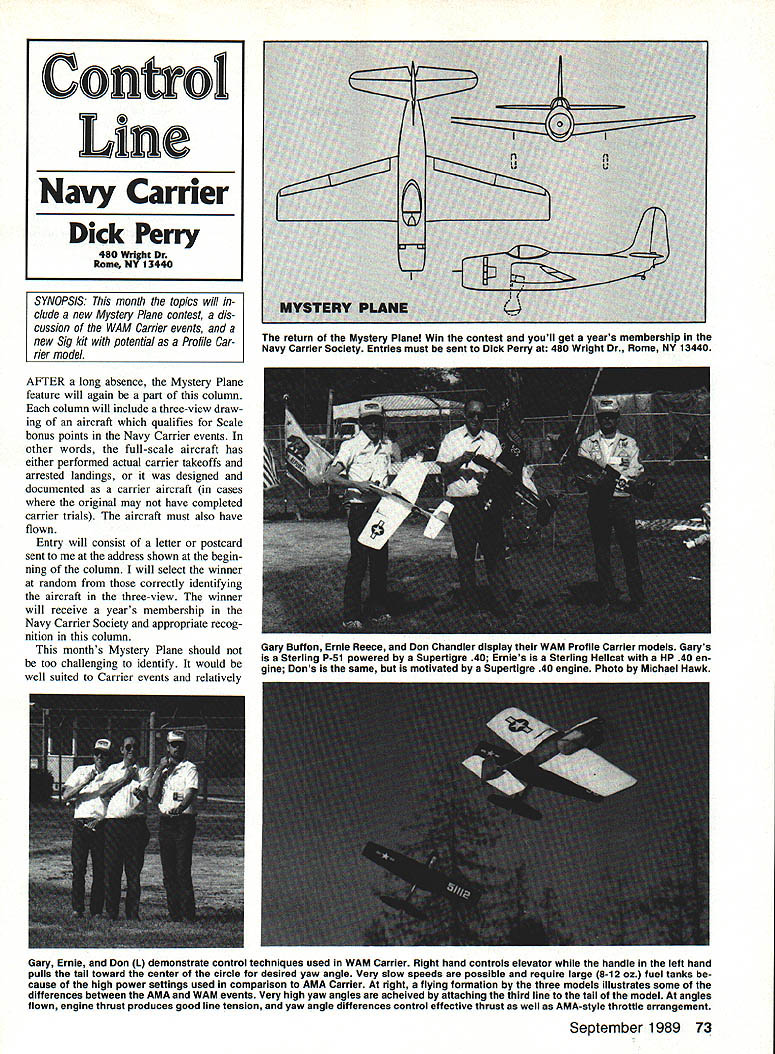
After a long absence, the Mystery Plane feature will again be part of this column. Each column will include a three-view drawing of an aircraft that qualifies for scale bonus points in the Navy Carrier events. In other words, the full-scale aircraft has either performed actual carrier takeoffs and arrested landings, or it was designed and documented as a carrier aircraft (in cases where the original may not have completed carrier trials). The aircraft must also have flown.
Entry will consist of a letter or postcard sent to me at the address shown at the beginning of the column. I will select the winner at random from those correctly identifying the aircraft in the three-view. The winner will receive a year's membership in the Navy Carrier Society and appropriate recognition in this column.
This month's Mystery Plane should not be too challenging to identify. It would be well suited to Carrier events and relatively easy to recognize. Good luck.
WAM Carrier
The Western Associated Modelers (WAM) has been active in northern California for quite some time. I first became aware of their activities when I was flying in Arizona and southern California in the early 1970s. WAM events are similar to AMA events but differ considerably in the details. WAM requires mufflers for all events, as well as safety features such as engine retainers connecting the engine to the control system to prevent separation in an accident.
WAM Carrier is readily recognizable to modelers familiar with AMA Carrier. They use similar models and a similar carrier deck. The event is flown with high-speed, low-speed, and landing runs, just as in AMA Carrier. Additional scoring categories are used, however, and the method of scoring in each category differs considerably from that used in AMA Carrier.
Scoring highlights:
- High-speed: 1 point for each mile per hour.
- Low-speed: 1 point for each second of low-speed flight. There are few restrictions on low-speed flight, except that the model may not stop its forward (counterclockwise) motion.
- Landing: maximum of 100 points for a normal arrested landing. Fifty points are awarded for a landing on the deck without the aid of the arresting cables. There is no deduction for missing the deck on a landing approach—it seldom happens at the very slow flight speeds of WAM models. Landings are made more challenging by having an arrested landing area less than five feet long with only two arresting cables.
- Scale and appearance bonuses: from 5 to 20 bonus points available in each of five areas: fuselage, wing, cowl, landing gear, and overall appearance. Profile models compete with full-fuselage aircraft but can earn no more than 60 bonus points compared to the 100 points available for full-fuselage models.
- Takeoff quality: up to 25 points.
- Keeping the tail hook up until after the high-speed run is complete: 10 points.
Although WAM Carrier models look like AMA models from a distance, closer examination reveals fundamental differences that reflect deviations in WAM rules. The most obvious feature is the mandatory muffler. Three control lines are required, but there is no restriction on their location. The standard configuration consists of a normal two-line bellcrank with lead-outs mounted in the wing. Line sliders, though not prohibited, are not used. The third line is attached to the tail and provides all the outboard yaw required, eliminating the need for line sliders.
The model is flown with two handles. One handle is used for elevator control as with most control-line models. The second handle is attached to the third line, which pulls the tail toward the center of the circle during slow flight. The third line also actuates the throttle: it holds the throttle open for high-speed flight, and as tension is applied to pull the tail inboard for slow flight it closes the throttle. The engine speed control is little more than a two-speed operation, with engine speed reduced to about 70–85% of full throttle for slow flight. Because of the high power settings used in slow flight, models usually carry 8 to 12 ounces of fuel.
The technique for slow-speed flying is to pull the tail in to reduce the engine's rotational speed to the preset low. Model attitude is controlled with the elevator. At the limit of yaw angle, the pull on the tail is increased to reduce the thrust available for forward flight. There is no limit on pitch angle and no time limit for the flight. Slow speeds of a minute a lap are not uncommon.
WAM Carrier competition is divided into two engine classes (1/2A and ABC). Modelers usually choose a .40-sized engine for profile models; full-fuselage models are often powered by .60-class engines. Profile and full-fuselage models are flown together. Three performance classes (Beginner, Advanced, and Expert) are used based on flight scores and placing. Although the record is over 1,000 points, Expert scores usually run over 600 points.
Information for this segment of the column was provided by Michael Hawk, WAM Public Relations Officer, and Gary Buffon, WAM President.
New Products
Sig has introduced a new profile model, the Skyraider. The Skyraider has characteristics that make it a good candidate for the AMA Profile Carrier event, particularly as an introductory model. The wing is large (about 400 sq. in.) and has an airfoil that will produce good handling qualities. It should also be quite strong—an advantage in carrier flights—because of the lite-ply ribs and spruce spars. Its design, along with the relatively shallow fuselage, should keep weight within reason even with the heavier materials used in the wing. The fuselage is long enough to give plenty of room for the fuel tank.
Building in modifications to adapt the kit to Profile Carrier would be fairly simple. Those feeling adventurous might consider modifying it to a Curtiss XS2C-1 configuration (Mystery Plane, September 1984).
Transcribed from original scans by AI. Minor OCR errors may remain.

