
Navy Carrier
Richard L. Perry
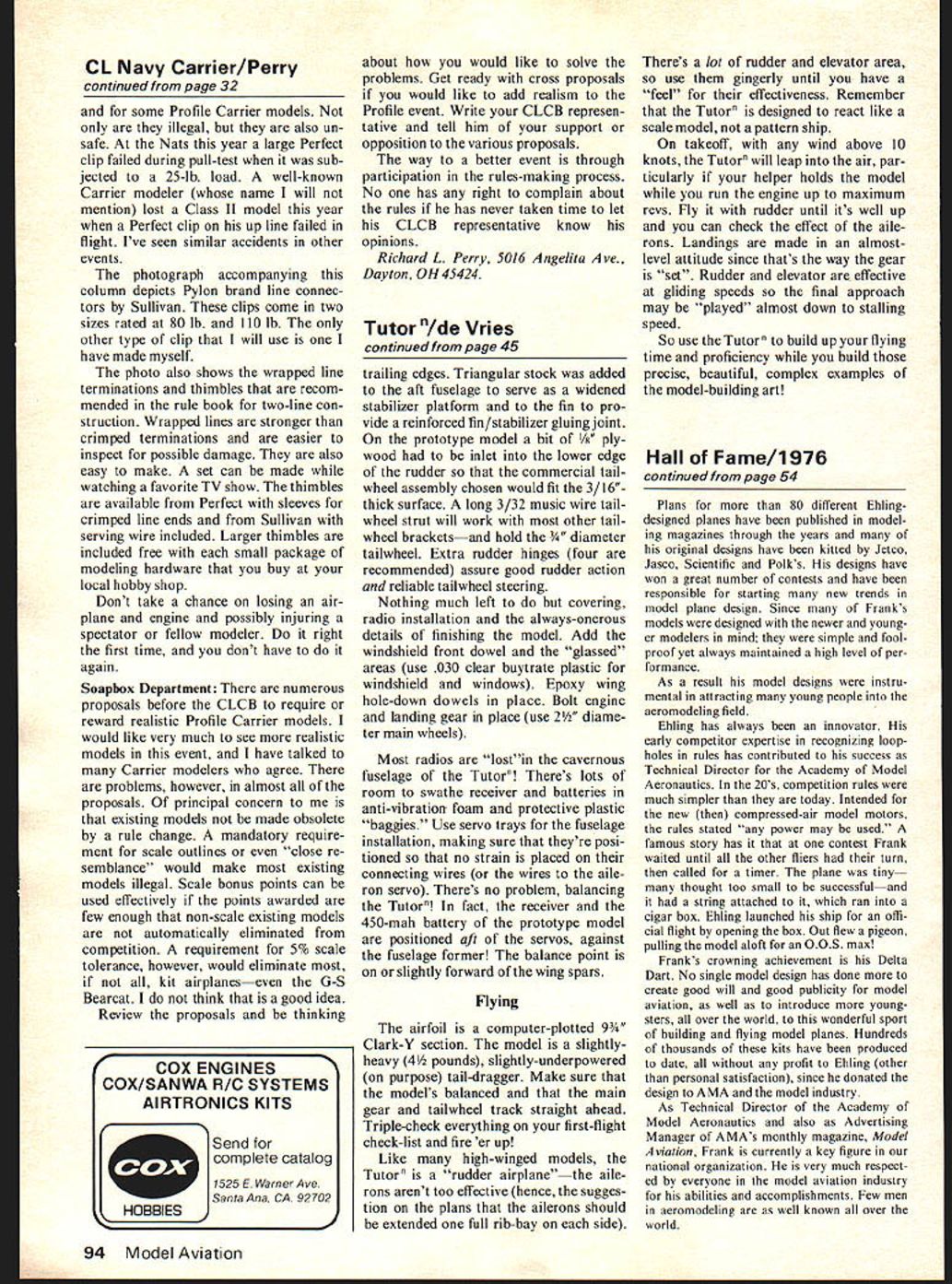
G-S Products F8F Bearcat: There are very few kits on the market designed for the Profile Carrier event. G-S Products Corp., International, PO Box 466, LaGrande, OR 97850, makes three of them—Skyraider, Corsair, and Bearcat. I built the Bearcat and found it to be a well-engineered kit with good flying qualities. The $24.95 price is not unreasonable considering the workmanship and the hardware included in the kit. Parts are sawn, not die-cut, and tail surfaces are shaped and have hinge slots already cut. Hardware includes Klett hinges and a G-S 3-line bellcrank with leadouts.
The kit parts, as received, weighed 18¼ oz. Some judicious lightening produced an airplane (with 2 oz. of tip weight added) weighing 17½ oz. ready to cover. Covering, finish, and wheels brought the weight to 20¾ oz. I cut lightening holes in the motor-mount blocks, the leading-edge joiner, and the ribs, and I hollowed out the fuselage blocks.
The fuselage consists of a frame of 1/4 x 1/4 balsa and spruce with 1/8-in. balsa and plywood sides. The top and bottom of the fuselage are formed from soft balsa blocks. The wing has dihedral which adds to the appearance of the model. Support blocks for the tip ribs are provided so that the wing may be built warp-free.
Wood selection was good with no warps and weights well suited to the part except for the ribs. I thought the rib stock was too heavy, but the stronger wood allowed larger lightening holes, so the end result was about the same.
Flying qualities are good. The model flies very slightly nose down, due to the mildly cambered airfoil, and is quite stable. The 308 sq.-in. wing is capable of 100-second-plus low speed without stalling, but the airplane can be stalled with ease.
In general, the model is quite strong, but for Carrier flying I recommended that the hollow leading edge be backed by vertical sheet (3/32 or 1/8") for one or two bays outboard of the landing gear. The 5/8-in. diameter landing gear is quite stiff, and a hard landing puts a lot of stress on the leading edge where the landing gear attaches. Bending the landing gear forward a little will allow the gear to flex more on hard landings.
The big advantage that the G-S Bearcat has over the standard Profile Carrier model is its appearance. It is easily recognized as an F8F by anyone familiar with the real airplane. With the exception of the wing chord (the tip is enlarged) the model is within about 5% of scale outlines. With careful attention to weight, the G-S Bearcat can be a competitive and realistic Profile Carrier model.
Speed Controls: Exhaust restrictors are an effective method of speed control for suction engines and have been used with some success on Schnuerle-ported engines running on pressure. Those of you with K&B 6.5cc engines can order part number 9053, exhaust extension adapter with exhaust butterfly assembly, for $4.00. This is the throttle unit supplied with the marine version of the engine. Semco makes an exhaust throttle for side-exhaust engines which is priced at $6.95. This unit requires a 90° bellcrank or some other means to convert throttle arm travel from fore-and-aft to up-and-down or left-and-right. A $14.95 unit fits OPS 40 and 60 engines with rear exhaust.
Line Ends and Connectors: The AMA Rule Book is provided to all members, and it is hard to imagine that anyone would go to a contest without first learning the rules that govern competition in the events he intends to fly, but as a CD, I run into quite a few people who claim ignorance of the rules governing the lines which we use to fly our models. These rules were written for safety reasons.
The most-often-ignored rules concern line clips. Two clips per line is the maximum allowable. The reason for this is that two clips together are more likely to foul than a single clip when lines are slack (as before takeoff). Each clip must have a fail strength greater than the pull-test load of the model. Under this rule, Perfect line clips are not legal for Class I and Class II. and for some Profile Carrier models. Not only are they illegal, but they are also unsafe. At the Nats this year a large Perfect clip failed during pull-test when it was subjected to a 25-lb. load. A well-known Carrier modeler (whose name I will not mention) lost a Class II model this year when a Perfect clip on his up line failed in flight. I've seen similar accidents in other events.
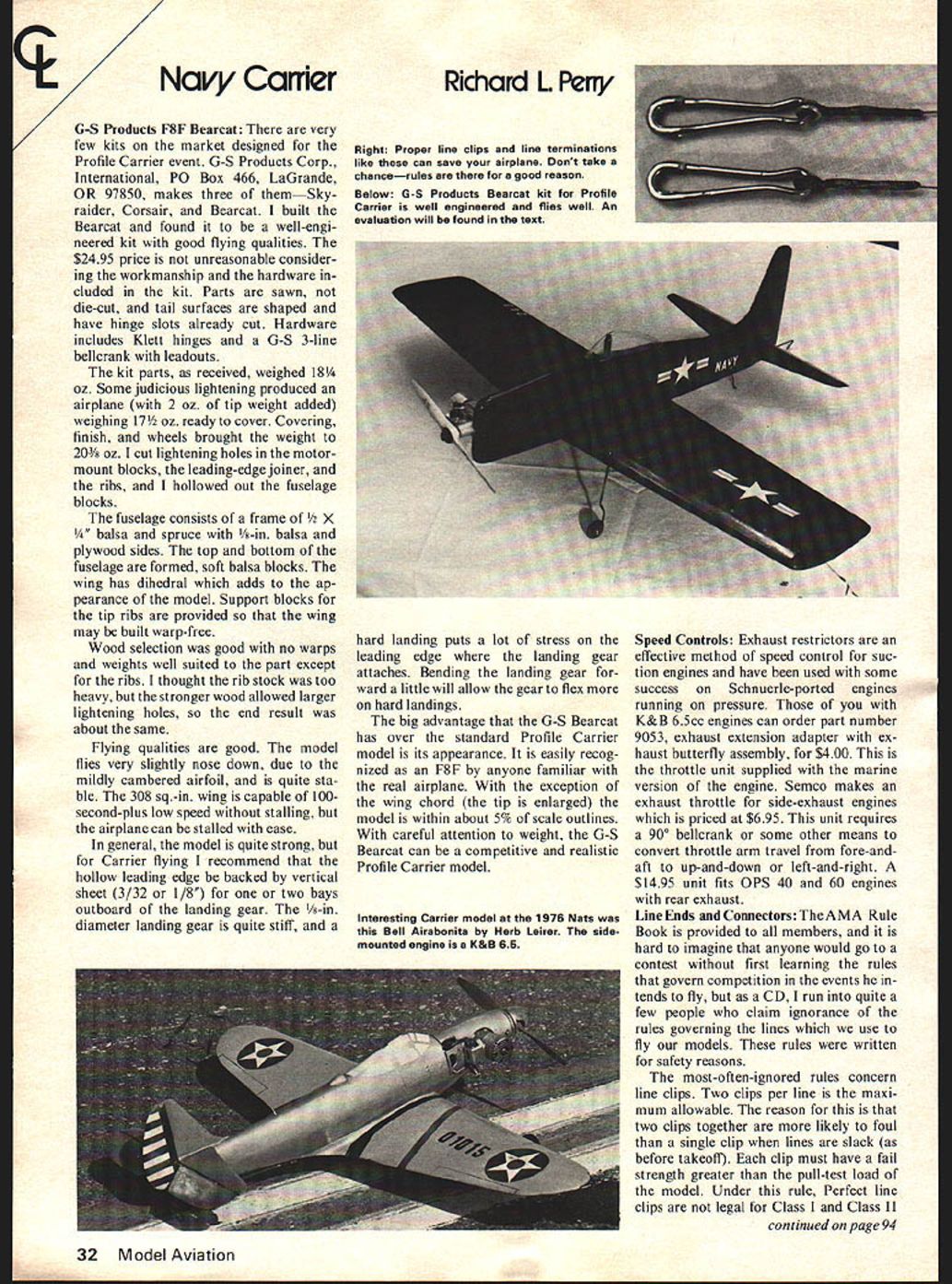
The photograph accompanying this column depicts Pylon brand line connectors by Sullivan. These clips come in two sizes rated at 80 lb. and 110 lb. The only other type of clip that I will use is one I have made myself.
The photo also shows the wrapped line terminations and thimbles that are recommended in the rule book for two-line construction. Wrapped lines are stronger than crimped terminations and are easier to inspect for possible damage. They are also easy to make. A set can be made while watching a favorite TV show. The thimbles are available from Perfect with sleeves for crimped line ends and from Sullivan with serving wire included. Larger thimbles are included free with each small package of modeling hardware that you buy at your local hobby shop.
Don't take a chance on losing an airplane and engine and possibly injuring a spectator or fellow modeler. Do it right the first time, and you don't have to do it again.
Soapbox Department: There are numerous proposals before the CLCB to require or reward realistic Profile Carrier models. I would like very much to see more realistic models in this event, and I have talked to many Carrier modelers who agree. There are problems, however, in almost all of the proposals. Of principal concern to me is that existing models not be made obsolete by a rule change. A mandatory requirement for scale outlines or even "close resemblance" would make most existing models illegal. Scale bonus points can be used effectively if the points awarded are few enough that non-scale existing models are not automatically eliminated from competition. A requirement for 5% scale tolerance, however, would eliminate most, if not all, kit airplanes—even the G-S Bearcat. I do not think that is a good idea.
Review the proposals and be thinking about how you would like to solve the problems. Get ready with cross proposals if you would like to add realism to the Profile event. Write your CLCB representative and tell him of your support or opposition to the various proposals.
The way to a better event is through participation in the rules-making process. No one has any right to complain about the rules if he has never taken time to let his CLCB representative know his opinions.
Richard L. Perry, 5016 Angelita Ave., Dayton, OH 45424.
Transcribed from original scans by AI. Minor OCR errors may remain.

