
Control Line: Navy Carrier
Dick Perry 9009 Arley Dr. Springfield, VA 22153
Abstract
This month the column identifies the December Mystery Plane, introduces a new V‑tailed Mystery Plane, and discusses Bill Bischoff's Profile Zero.
My Address
My address has changed. When I wrote the December 1989 column I assumed I would be staying in New York through the winter. Between columns I not only learned about a new assignment, I completed the move as well. I'm now assigned at the Pentagon again and living in northern Virginia very near where we were living three years ago. I'll be flying with the Northern Virginia Control Line Association and will once again be within driving distance of carrier contests in Virginia, New Jersey, Pennsylvania, and New York. More important, I'll be free to travel on weekends and to spend a little more time on building and flying. My new address appears at the head of the column.
December Mystery Plane
The Mystery Plane in the December issue was the Mitsubishi A7M1 Reppu (Hurricane). It carried the code name "Sam." It was intended to be a replacement for the Zero, and the family resemblance is quite strong. The smaller canopy and the dihedral break outboard of the landing gear were the more prominent distinguishing features in the general layout of the design.
If the two aircraft had been placed side by side, there would have been no mistaking the A7M1. It was about 30% larger than the A6M Zero in linear dimensions, weighed 70% more, and had almost twice the power.
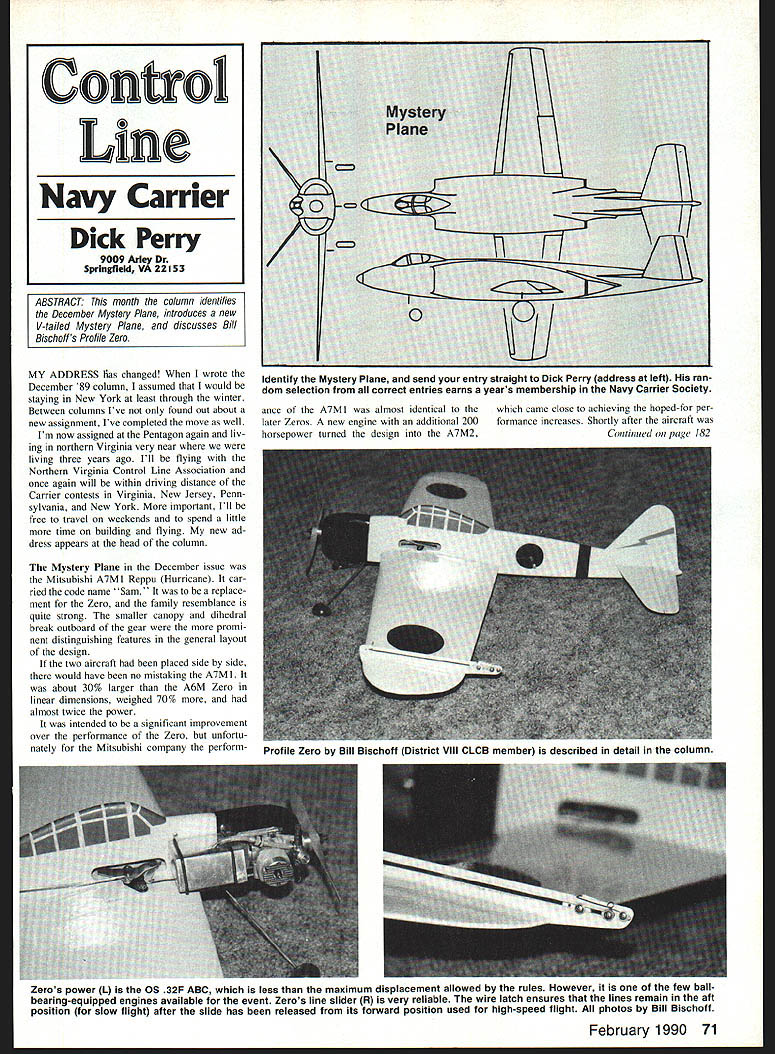
Identify the Mystery Plane and send your entry straight to Dick Perry (address at left). His random selection from all correct entries earns a year's membership in the Navy Carrier Society.
The A7M1 was intended to be a significant improvement over the Zero, but unfortunately the A7M1's performance was almost identical to the later Zeros. A new engine with an additional 200 horsepower turned the design into the A7M2, which came close to achieving the hoped-for performance increases. Shortly after the aircraft was ordered into production, the plant was struck by an earthquake. By the time the war had ended, only eight aircraft had come off the production line.
I will not name the winner of the December Mystery Plane contest this time because the entries are still catching up with me after having been sent to New York. The winner's name will appear in the April column.
This Month's Mystery Plane
This month's Mystery Plane is the first (and likely the last) V‑tailed carrier aircraft you will see in this column. I am aware of no other V‑tail carrier designs other than the sister aircraft of the subject of this month's contest. If any of you know of others, I'd be happy to hear from you.
Entries for the Mystery Plane contest should be sent to me at my new address. I'll select a winner at random from those correctly identifying the aircraft.
Profile Zero
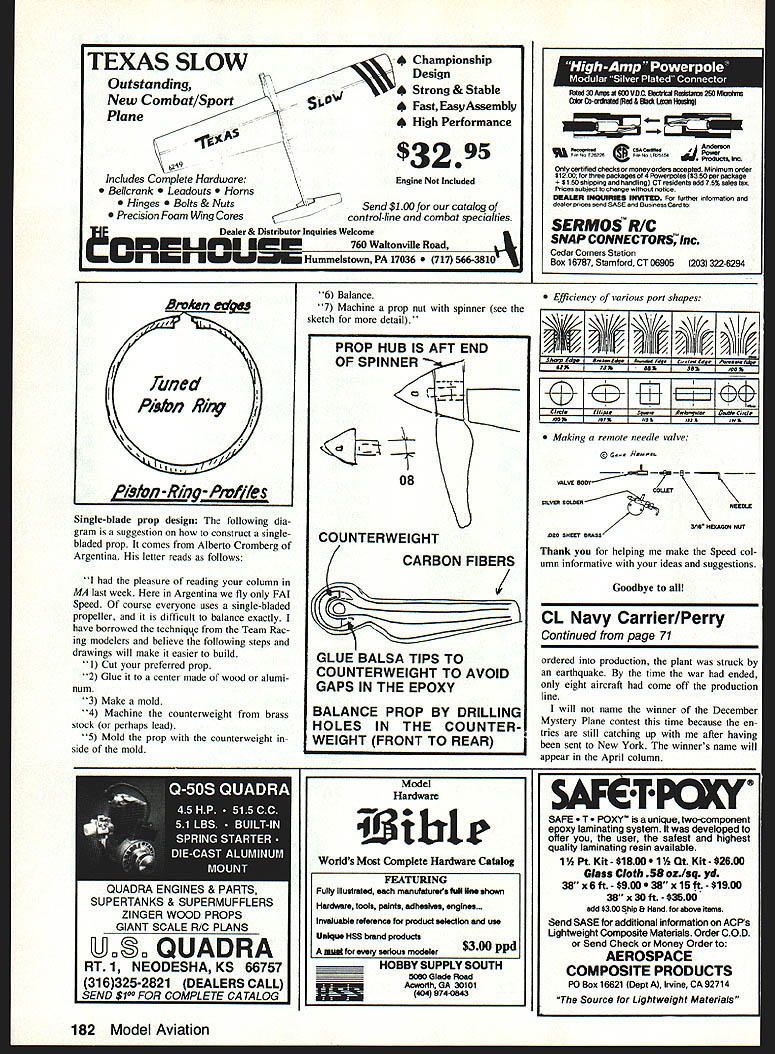
Bill Bischoff's model Zero was completed long before the A7M1 was featured, and it is a Zero rather than a Sam. Bill designed the model especially for the OS .32F ABC engine, which has the significant advantage of being readily available — often at discount. Besides its availability, the .32F ABC benefits from the usual high-quality workmanship and excellent engineering typical of OS engines. Bill has found it very reliable and easy to operate. He is still experimenting with props, but was flying 83 mph in all-up testing.
Construction and Weight
- Wing: foam wing.
- Fuselage: built-up profiled fuselage.
- Total weight: 35 oz.
Hook and Slide Release Mechanism
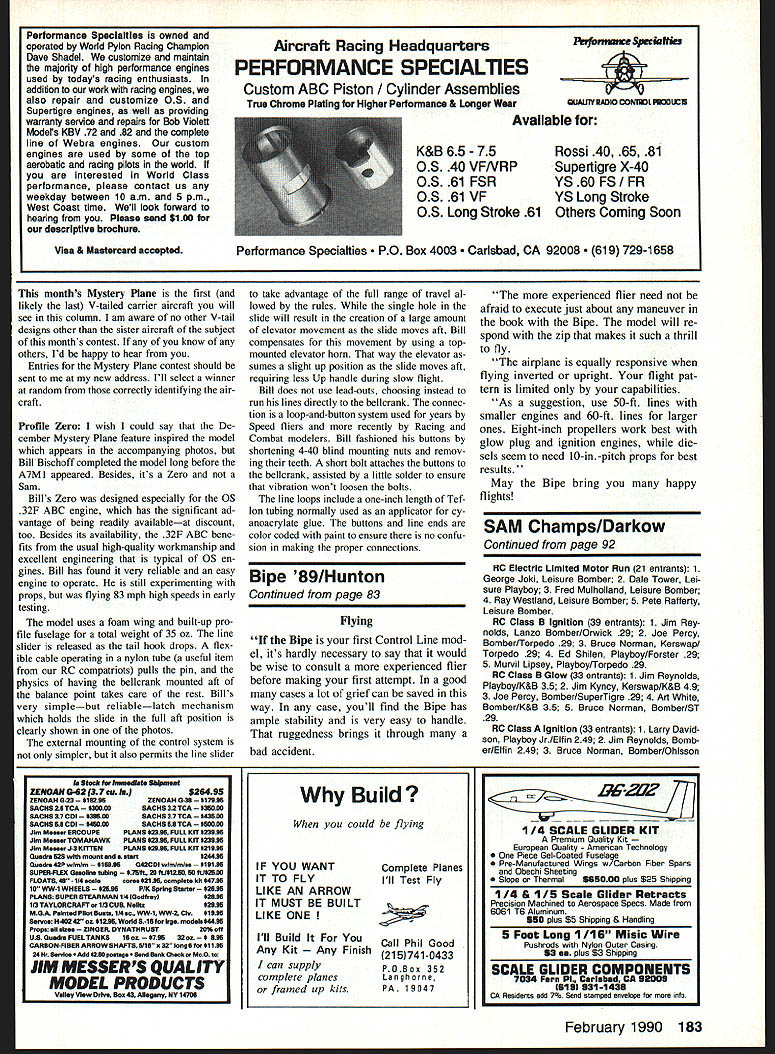
- The line slide is released as the tail hook drops.
- A flexible cable operating in a nylon tube (a useful item borrowed from R/C practice) pulls the pin.
- The lines are hoisted by a bellcrank mounted aft of the balance point.
- To reduce the chance of the wire latch being dislodged in contact landings, Bill uses a simple but very reliable latch mechanism that holds the slide in the full aft position.
Control System and Trim
- The external mounting of the control system is simpler and permits the slide to take advantage of the full range of travel allowed by the rules.
- The single hole in the slide results in a large amount of elevator movement as the slide moves aft. Bill compensates for this by using a top-mounted elevator horn. As the slide moves aft the elevator assumes a slight up position, requiring less up handle during slow flight.
Lines and Connections
Bill does not use lead-outs, choosing instead to run his lines directly to the bellcrank. He uses a loop-and-button connection system long used by Speed Ring and more recently by Racing and Combat modelers. Details:
- Buttons: fashioned by shortening 4-40 blind mounting nuts and removing their teeth.
- Attachment: a short bolt attaches each button to the bellcrank; a little solder is applied to ensure vibration won't loosen the bolts.
- Line loops: include a one-inch length of Teflon tubing (normally used as an applicator for cyanoacrylate glue) to protect the lines.
- Identification: the buttons and line ends are color coded with paint to ensure there is no confusion when making the proper connections.
Transcribed from original scans by AI. Minor OCR errors may remain.

