
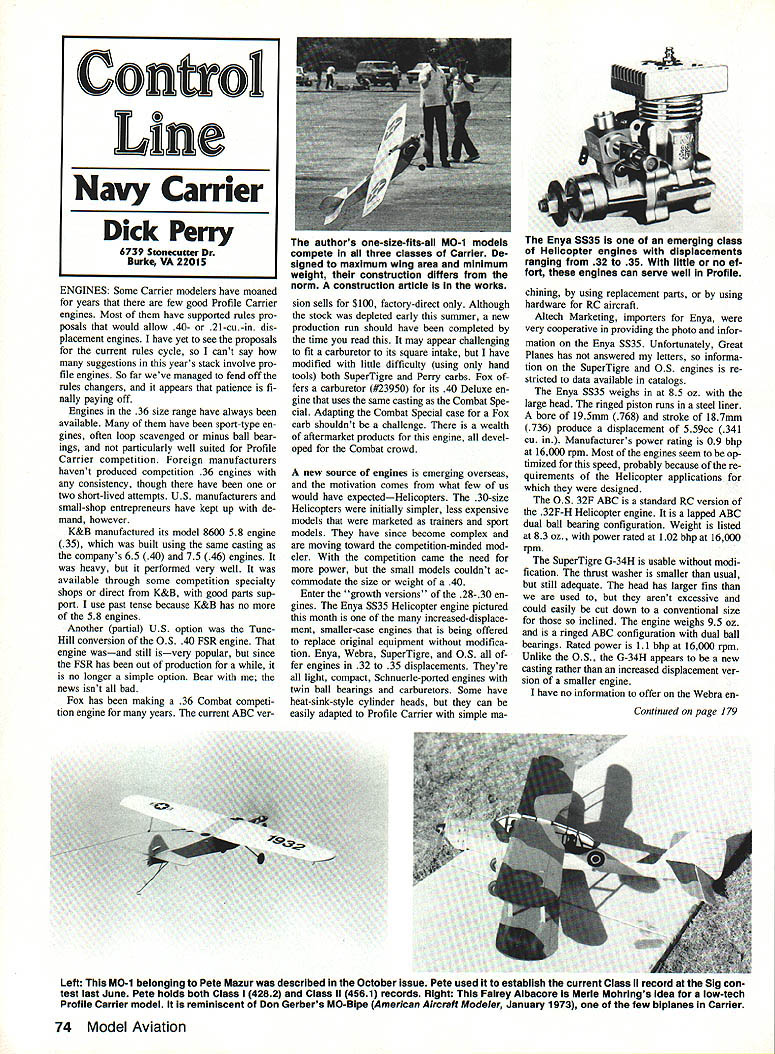
Control Line: Navy Carrier
Dick Perry 6739 Stonecutter Dr. Burke, VA 22015
Engines
Some Carrier modelers have long complained that there are few good Profile Carrier engines. Many have supported rules proposals to allow .21- to .40-cu.-in. displacement profile engines. So far, most proposals have been held off, and patience appears to be paying off.
Engines in the .36 size range have always been available. Many are sport-type engines (often loop-scavenged and lacking ball bearings) that are well suited for Profile Carrier competition. Foreign manufacturers have not produced competitive .36 engines consistently, though there have been one or two short-lived attempts. U.S. manufacturers and small-shop entrepreneurs have generally kept up with demand.
- K&B manufactured its model 8600 .58 engine, built using the same casting as some of the company's other engines (.40 and .46 sizes). It was heavy but performed well and had good parts support when available. (K&B no longer lists a .58 engine.)
- Tune-Hill conversions of the O.S. .40 FSR engine have been a partial U.S. option. The FSR was—and still is—popular, but with the FSR out of production, conversions are no longer a simple option.
- Fox has produced a .36 Combat competition engine for many years. The current ABC version sells factory-direct for about $100. Although stock was depleted early in the season, a new production run was expected soon.
Fox Combat details:
- Square intake can be modified to accept common carbs; I have adapted Combat cases (using only hand tools) to accept SuperTigre and Perry carburetors.
- Fox offers carburetor #23950 for its .40 Deluxe engine; that casting is the same as the Combat Special, so adapting a Combat Special case to a Fox carb should be straightforward.
- There is a strong aftermarket for this engine developed by the Combat community.
A new source of suitable small engines is emerging overseas, driven in part by developments in model helicopters. As helicopter models grew more complex and competition demanded more power, manufacturers developed larger-displacement small-case engines in the .28–.35 range. Several established makers now offer compact, high-rpm engines that adapt well to Profile Carrier use.
Notable helicopter-derived engines:
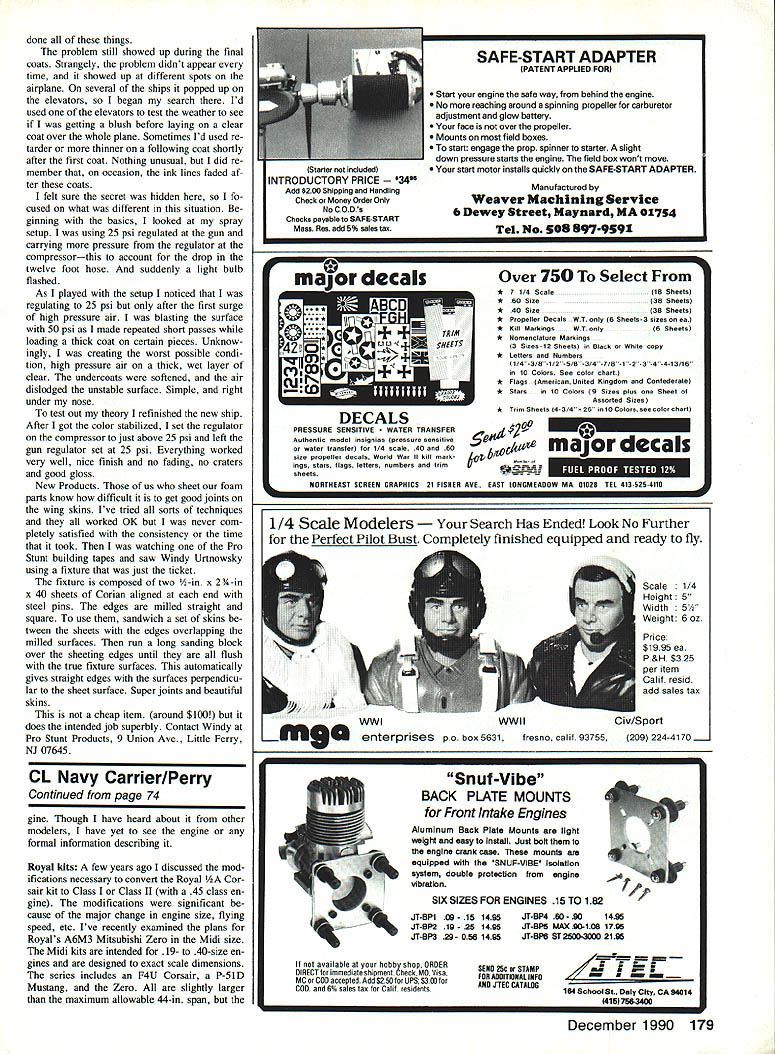
- Enya SS35
- Weight: 8.5 oz (with large head)
- Construction: ringed piston in a steel liner
- Bore: 19.5 mm (.768 in), Stroke: 18.7 mm (.736 in)
- Displacement: 5.59 cc (.341 cu. in.)
- Rated power: 0.9 bhp at 16,000 rpm
- Optimized for high rpm (helicopter requirements)
- O.S. 32F ABC (RC version of the .32F-H helicopter engine)
- Lapped ABC, dual ball bearings
- Weight: 8.3 oz
- Rated power: 1.02 bhp at 16,000 rpm
- SuperTigre G-34H
- Ringed ABC, dual ball bearings
- Weight: 9.5 oz
- Rated power: 1.1 bhp at 16,000 rpm
- Usable without major modification (thrust washer slightly smaller; head fins larger but can be reduced)
- Appears to be a new casting rather than an increased-displacement version of a smaller engine
- Webra
- I have no specific information on the Webra helicopter engine at this time.
These engines are generally light, compact, Schnuerle-ported, have twin ball bearings and factory carburetors, and some feature heat-sink–style cylinder heads. They can be adapted to Profile Carrier use with simple machining and by using replacement parts or hardware from RC aircraft. Altech Marketing (importers for Enya) were helpful in providing photo and information on the Enya SS35. Information on SuperTigre and O.S. is limited to available catalogs.
CL Navy Carrier — Perry
Royal kits
A few years ago I discussed modifications to convert the Royal .4 Corsair kit to Class I or Class II (using a .45-class engine). Those modifications were significant because of the change in engine size and flying speed.
I recently examined plans for Royal's A6M3 Mitsubishi Zero in the Mid series. Mid kits are intended for .19–.40 engines and are designed to exact scale dimensions. The Mid series includes an F4U Corsair, a P-51D Mustang, and the Zero. All are slightly larger than the maximum allowable 44 in. span, but the span can be reduced within the 5% allowance; at 44-1/4 in., the Corsair requires almost no modification.
- Expected wing areas: 325–350 sq. in.
- These kits tend to be a bit heavy for Class I or small Class II engines unless the builder takes special care to lighten the structure.
- Best engine choice for these kits would probably be a .60–.65, with appropriate engine-mount modifications.
Royal kits are expensive but are one of the few options for kit-builders seeking accurate scale outlines. If kit quality matches Royal's attention to detail, they are likely worth the price.
Rules proposals
The first rules proposals should appear in the "Competition News" section of this issue. These proposals could become the official rules by 1992. I cannot comment on all proposals before they reach AMA Headquarters. If a proposal interests or concerns you, contact your Contest Board representative listed in the "Competition News" section promptly—initial voting by the Control Line Contest Board (CLCB) will occur shortly after publication.
The Navy Carrier Advisory Committee (NCAC) provides Carrier expertise to assist the CLCB in deliberations. The NCAC welcomes your opinions. Contact:
- Mark Warwaschana (NCAC chairman)
43670 Candlewood, Canton, MI 48187
Mufflers
Current restrictions on exhaust extension length effectively prohibit mufflers in Navy Carrier events. I do not want mufflers to be mandatory in any CL event, but I also do not think they should be prohibited.
For two years the Navy Carrier Society has recommended that Contest Directors allow mufflers in Navy Carrier events, so we could gather data and draft a rules proposal permitting mufflers. There has been little systematic experimentation so far. Tom Schaefer has done most of the work I know about on systems that preserve or enhance engine performance while providing silencing. A few others have experimented, but many avoid investing effort in equipment currently prohibited by the rules.
I have proposed a rules change to allow longer exhaust extensions (i.e., mufflers). Key points of the proposal:
- Allow exhaust extensions up to 13 in. long (measured per the rule book).
- Require the single round exhaust exit to be no larger than 0.335 in. (8.7 mm) diameter.
- Intent: allow most commercially available mufflers (including tuned mufflers) while preventing full tuned pipes that could provide scale-destroying performance advantages.
- Practical check: an 1/8-in. drill bit (or roll) will not fit inside a legal exhaust exit, making legality easy to verify.
The NCAC and I welcome suggestions. If you have changes or additions to propose, contact us so we can refine the proposal before the rules cycle.
Helicopters (overview)
Thirty-size helicopter models began as simple, inexpensive trainers and sport models and have evolved toward competition-level designs. As competition grew, the need for more power in small models drove the development of larger-displacement small-case engines (around .28–.35 cu. in.). These engines—offered by Enya, Webra, SuperTigre, and O.S.—are light, compact, and suitable for adaptation to Profile Carrier with modest machining and parts swaps.
Key adaptations and considerations:
- Many helicopter-derived engines are optimized for high rpm; gearing and prop/throw selection should reflect that.
- Head fins, carburetor configurations, and thrust washer sizes may require minor modification for carrier use.
- Replacement parts and RC hardware facilitate conversion.
Notes
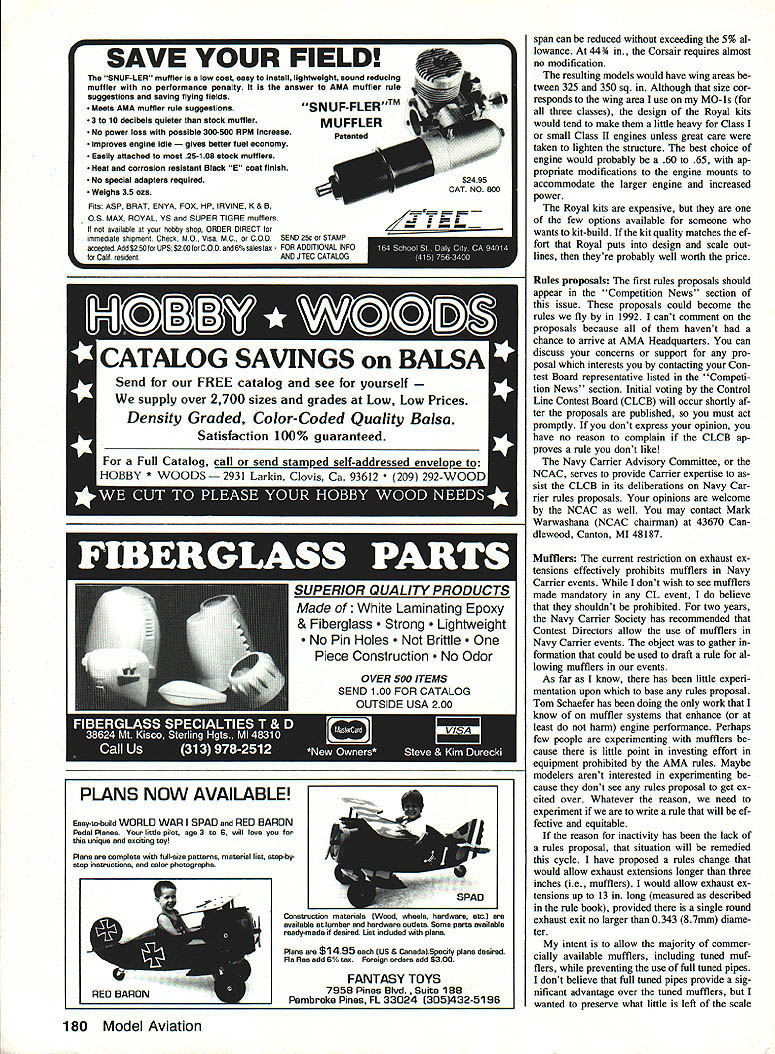
- Pete Mazur's MO-1 (described in the October issue) was used to establish the current Class II record at the Sig contest last June. Pete holds both the Class I (142.82) and Class II records.
Transcribed from original scans by AI. Minor OCR errors may remain.

