
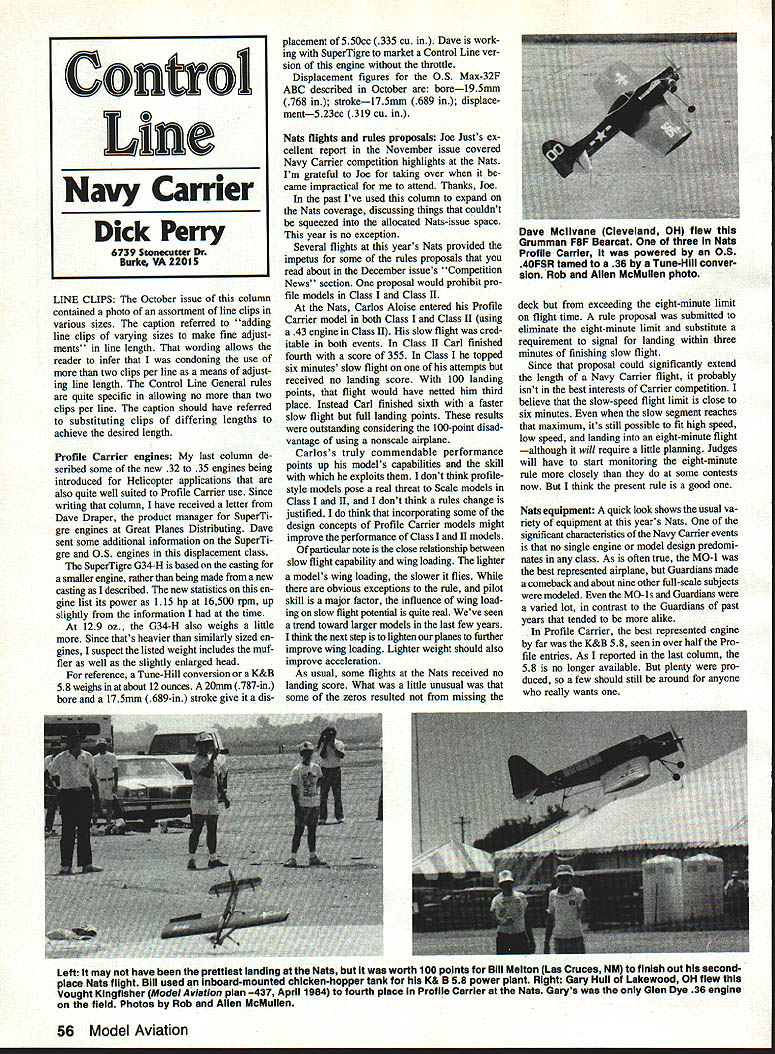
Control Line: Navy Carrier
Dick Perry 6739 Stonecutter Dr. Burke, VA 22015
LINE CLIPS
The October issue of this column contained a photo of an assortment of line clips in various sizes. The caption referred to "adding line clips of varying sizes to make fine adjustments" in line length. That wording could be interpreted to condone using more than two clips per line to adjust length. The Control Line General rules are specific: no more than two clips per line. The caption should have referred to substituting clips of differing lengths to achieve the desired length.
Profile Carrier engines
My last column described some of the new .32 to .35 engines being introduced for helicopter applications that are also well suited to Profile Carrier use. Since then I received a letter from Dave Draper, product manager for SuperTigre engines at Great Planes Distributing, with additional information on the SuperTigre and O.S. engines in this displacement class.
SuperTigre G34-H
- The G34-H is based on the casting for a smaller engine, not a new casting as I previously described.
- Power: 1.15 hp at 16,500 rpm (slightly up from earlier information).
- Weight: 12.9 oz. (slightly heavier than similarly sized engines; this likely includes the muffler and the slightly enlarged head).
- Bore: 20 mm (.787 in.)
- Stroke: 17.5 mm (.689 in.)
- Displacement: 5.50 cc (.335 cu. in.).
- Dave is working with SuperTigre to market a Control Line version of this engine without the throttle.
For reference, a Tune-Hill conversion or a K&B 5.8 weighs about 12 ounces.
O.S. Max-32F ABC
Displacement figures for the O.S. Max-32F ABC are:
- Bore: 19.5 mm (.768 in.)
- Stroke: 17.5 mm (.689 in.)
- Displacement: 5.23 cc (.319 cu. in.)
Nats flights and rules proposals
Joe Just's excellent report in the November issue covered Navy Carrier competition highlights at the Nats. I appreciate Joe taking over when it became impractical for me to attend.
Several flights at this year's Nats prompted some of the rules proposals you read about in the December issue's "Competition News" section. One proposal would prohibit profile-style models in Class I and Class II.
At the Nats, Carlos Aloise entered his Profile Carrier model in both Class I and Class II (using a .43 engine in Class II). His slow flight was creditable in both events. In Class II Carlos finished fourth with a score of 355. In Class I he topped six minutes' slow flight on one attempt but received no landing score. With 100 landing points that flight would have netted him third place; instead he finished sixth with a faster slow flight but full landing points. These results were outstanding considering the 100-point disadvantage of using a nonscale airplane. Carlos's performance highlights his model's capabilities and his skill. I don't think profile-style models pose a real threat to scale models in Class I and II, and I don't think a rules change is justified. I do think that incorporating some of the design concepts of Profile Carrier models might improve the performance of Class I and II models.
Wing loading and model weight
There is a close relationship between slow-flight capability and wing loading: the lighter a model's wing loading, the slower it can fly. While pilot skill and design exceptions matter, wing loading's influence on slow flight potential is real. We've seen a trend toward larger models in recent years; I think the next step is to lighten our planes to improve wing loading. Lighter weight should also improve acceleration.
Eight-minute rule proposal
As usual, some flights at the Nats received no landing score. Some zeros resulted not from missing the deck but from exceeding the eight-minute flight-time limit. A proposal was submitted to eliminate the eight-minute limit and instead require a signal for landing within three minutes of finishing slow flight. That change could significantly extend the length of a Navy Carrier flight, which probably isn't in the best interests of Carrier competition. I believe that with the slow-speed flight limit close to six minutes, it's still possible to fit high speed, low speed and landing into an eight-minute flight if planned carefully. Judges will need to monitor the eight-minute rule closely at contests. Overall, I think the present rule is a good one.
Nats equipment
A quick look shows the usual variety of equipment at this year's Nats. One significant characteristic of Navy Carrier events is that no single engine or model design predominates in any class. The MO-1 was the best represented airplane, but Guardians made a comeback and about nine other full-scale subjects were modeled. MO-1s and Guardians were more varied than Guardians of past years, which tended to be more alike.
Engines and performance
- Profile Carrier: The K&B 5.8 was by far the most represented engine in Profile Carrier, seen in over half the Profile entries. As I reported in the last column, the 5.8 is no longer available, but many were produced so some should still be around. Despite its popularity, the K&B didn't dominate performance—fliers with the best high speeds used five different engines.
- Carlos Aloise's custom X-36 (based on the SuperTigre X-40) was fastest at 91.7 mph.
- Bill Melton had the fastest K&B at 84.8 mph.
- The rest of the K&Bs ran between 79 and 82.4 mph.
- Class I: K&Bs appeared here too (three .65s and two older .40s). Rossi, HP, O.S., and Fox engines rounded out the list, along with Carlos's X-36. Pete Mazur's K&B .40S was fastest at 105.4 mph; Bill Melton's O.S. .40 VRP was close at 103.9 mph.
- Class II: Engines were diverse, with no single power plant standing out. Five models used comparatively small engines, though only two completed attempts. Kevin Warwashana used an O.S. .45 FSR on his Profile Carrier plane, and Carlos Aloise put a custom-built X-43 on his profile model to fly Class II. The other models (all full-body scale machines) used .60s or .65s.
- Top speed honors in Class II went to Pete Mazur: his Webra Speed .61R pulled his MO-1 at 108 mph.
- Bill Melton's Guardian with an old SuperTigre .65 recorded 106.7 mph.
- John Castiglione's Rossi .65 ran 106.0 mph (it may have had conservative normal-sleeve timing).
With the lower rpm ranges mandated by the 10-inch diameter props used in Class II, loop-scavenged engines can hold their own against Schnuerles. However, newer high-torque .61s being developed for RC Pattern events may change that.
Props and future trends
It's interesting that present high speeds are well below the levels of 15 years ago. Larger models have increased drag, though other drag factors have remained constant; we still use many of the same props that were available more than a decade ago.
Speed events have eliminated some advantages of the tuned pipe in D Speed and recorded gains with the introduction of Schnuerle engines. There may be potential for increasing performance of small, high-speed piston engines as well.
One consistent factor in Class II competition is the prop. Speed engines that fit the Class II Carrier engine limit of .65 cu. in. are timed for high engine speeds and may be somewhat mismatched to the traditional Rev-Up 10-8W propeller. The newer .61-cu.-in. Schnuerle engines designed to meet sound-level limits for RC Pattern flying tend to have long strokes and conservative timing for high torque at lower rpm rather than for high rpm. The RC Pattern move toward lower engine speed to reduce noise has produced the first new prop sizes in years, as pitches have been increased to compensate for lower engine rpm. These newer props may allow better matching of power curves to engines — more on that in a later column.
Note to advertisers
When responding to advertisers, mention that you read about them in Model Aviation.
Transcribed from original scans by AI. Minor OCR errors may remain.

