
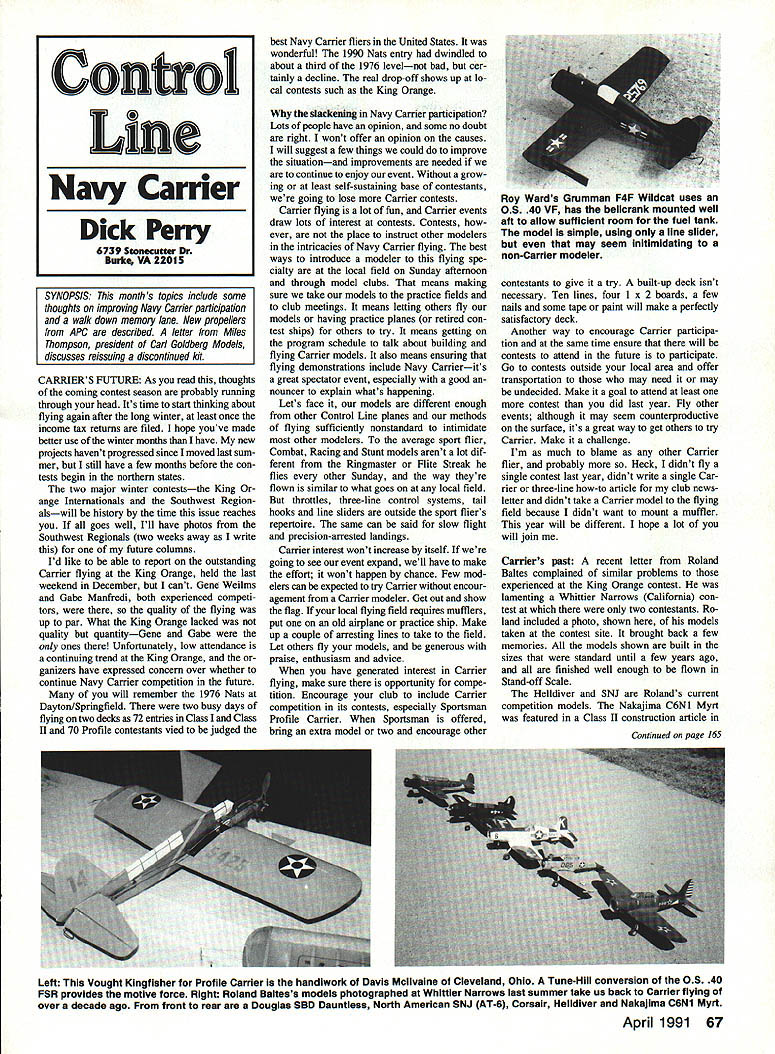
Control Line: Navy Carrier
Dick Perry 6739 Stonecutter Dr. Burke, VA 22015
SYNOPSIS: This month's topics include some thoughts on improving Navy Carrier participation and a walk down memory lane. New propellers from APC are described. A letter from Miles Thompson, president of Carl Goldberg Models, discusses reissuing a discontinued kit.
CARRIER'S FUTURE
As you read this, thoughts of the coming contest season are probably running through your head. It's time to start thinking about flying again after the long winter — at least once the income tax returns are filed. I hope you've made better use of the winter months than I have. My new projects haven't progressed since I moved last summer, but there are still a few months before contests begin in the northern states.
The two major winter contests — the King Orange Internationals and the Southwest Regionals — will be history by the time this issue reaches you. If all goes well I'll have photos from the Southwest Regionals for a future column. I'd like to be able to report on outstanding Carrier flying at the King Orange, held the last weekend in December, but I can't. Gene Weilm and Gabe Manfredi, both experienced competitors, were there, so the quality of the flying was up to par. What the King Orange lacked was not quality but quantity — Gene and Gabe were the only ones there. Unfortunately, low attendance is a continuing trend at King Orange, and the organizers have expressed concern over whether to continue Navy Carrier competition in the future.
You may remember the 1976 Nats at Dayton/Springfield: two busy days of flying on two decks with 72 entries in Class I and Class II and 70 Profile contestants vying to be judged the best Navy Carrier fliers in the United States. Wonderful! The 1990 Nats entry had dwindled to about a third of the 1976 level — not a collapse, but certainly a decline. The real drop-off shows up at local contests such as King Orange.
Lots of people have opinions about why participation has slackened; some are no doubt right. I won't offer an in-depth diagnosis here, but I will suggest a few things we could do to improve the situation — and improvements are needed if we are to continue to enjoy our event. Without a growing, or at least self-sustaining, base of contestants we're going to lose more Carrier contests.
How to encourage participation
- Take models to the local field on Sunday afternoons. Practice flying where others can watch and try.
- Use club meetings and practice days to introduce modelers to Carrier flying. Let others handle and fly practice planes or retired contest ships.
- Put Carrier on the program schedule at your club: give talks or demonstrations about building and flying Carrier models.
- Make flying demonstrations include Navy Carrier — it's a great spectator event, especially with a good announcer to explain what is happening.
- Be prepared to show novices the nonstandard gear and techniques: throttles, three-line control systems, tail hooks, line sliders, slow flight and precision arrested landings.
- If your local field requires mufflers, put one on an old airplane or practice ship so you can demonstrate without conflict.
- Make up a couple of arresting lines and bring them to the field so interested fliers can try arrested landings.
Encourage competition locally and beyond
- Encourage your club to include Carrier competition in its contests, especially Sportsman and Profile Carrier.
- When Sportsman is offered, bring an extra model or two and encourage other contestants to try it.
- A built-up deck isn't necessary. A perfectly satisfactory deck can be made from:
- Ten lines
- Four 1 x 2 boards
- A few nails
- Some tape or paint
- Go to contests outside your local area and offer transportation to anyone who may need it or is undecided.
- Make it a goal to attend at least one contest you didn't last year. Fly other events — even if it seems counterproductive, it can be a great way to get others to try Carrier.
I'm as much to blame as any other Carrier flier, and probably more so. I didn't fly a single contest last year, didn't write a single Carrier three-line how-to article for the club newsletter, and didn't take my Carrier model to the field because I didn't want to mount a muffler. This year will be different. I hope a lot of you will join me.
CARRIER'S PAST
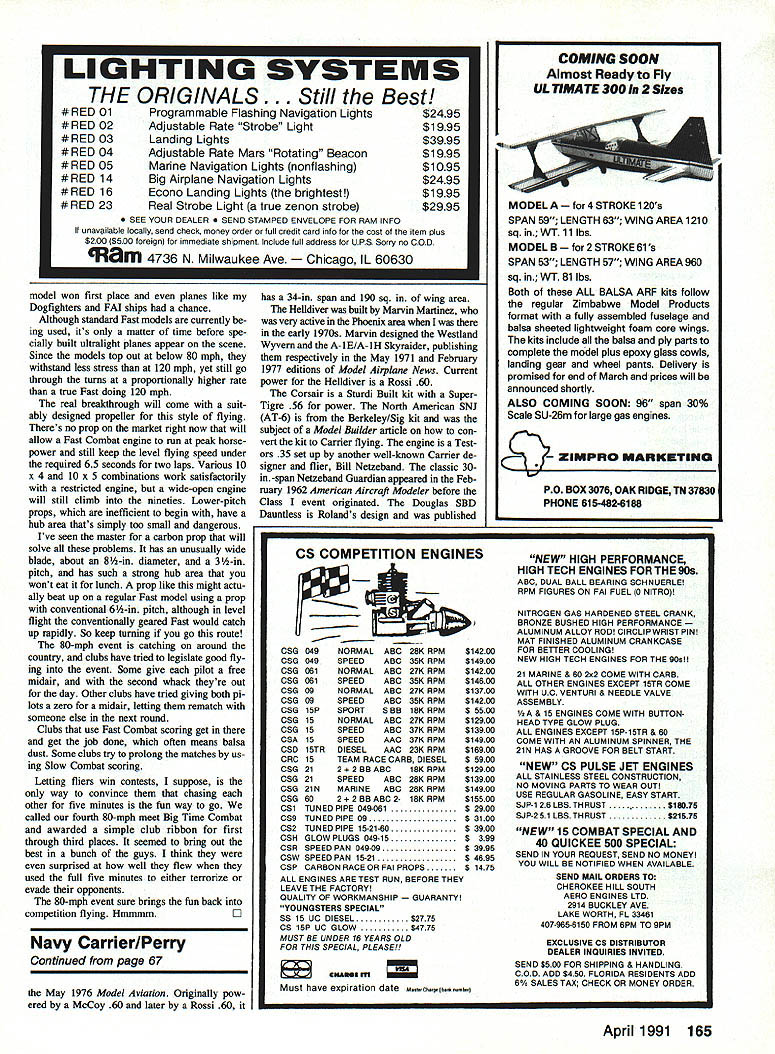
A recent letter from Roland Baltes complained of similar problems to those experienced at King Orange. He lamented a Whittier Narrows (California) contest last summer that had only two contestants and included a photo of his models taken at the contest site. The photo brought back a few memories.
All the models shown were built to the scale that was standard until a few years ago, and all are fine examples of the work flown in Stand-off Scale. Highlights include:
- Nakajima C6N1 "Myrt": Featured in a Class II construction article in the May 1976 Model Aviation. Originally powered by a McCoy .60 and later by a Rossi .60; 34 in. span and about 190 sq. in. of wing area.
- Douglas SBD Dauntless: Roland's own design, published in Model Airplane News some years ago.
- Curtiss Helldiver: Built by Marvin Martinez (active in Phoenix in the early 1970s). Marvin also designed the Westland Wyvern and the A-1E/A-1H Skyraider. Current power for the Helldiver is a Rossi .60.
- Vought F4U Corsair: A Sturdibilt kit, powered by a Super Tigre .56.
- North American SNJ (AT-6): From the Berkeley/Sig kit; the subject of a Model Builder article on converting the kit to Carrier flying. The engine shown was a Testors .35 set up by Bill Netzelband.
- Netzelband Guardian: The classic 30-in. span Guardian appeared in the February 1962 American Aircraft Modeler before the Class I event originated.
These models remind us of the skill and craftsmanship that have long been part of Carrier flying. If we want Carrier to have a future, we need to bring that enthusiasm back to local fields, to contests, and to the next generation of modelers.
Transcribed from original scans by AI. Minor OCR errors may remain.

