
Control Line: Navy Carrier
Dick Perry 6739 Stonecutter Dr. Burke, VA 22015
Introduction
This month's column describes modifications to turn the Sig Skyray .35 kit into a Curtiss XS2C-1 for Profile Carrier.
When Sig introduced the Skyray .35 Carrier event at their annual control-line contest, and later at the Nationals, I obtained two of the kits for evaluation purposes. One I built as a practice model for Profile Carrier—legal for the Skyray Carrier event—and to try out a new idea or two. I was impressed by the quality of the kit (not surprising for a Sig product) and decided to try to convert the other kit into a Profile Carrier model eligible for the ten scale bonus points.
The first challenge was to find a prototype aircraft with a straight, non-tapered wing. Changing the basic structure would have defeated the purpose of starting with a kit in the first place, so a wing with a swept leading edge was out of the question. Because the Skyray was already a big model (396 sq. in., 44 in. span), I didn't want to have to add flaps—even fixed ones—to produce a tapered wing, especially since changing the tips was likely to increase area as well. The fuselage on the Skyray is rather narrow, so a thin fuselage close to the prototype would also be desirable.
There were a few high-wing candidates, but I didn't particularly like their looks, and besides, they would have required a completely new fuselage. The obvious candidate (at least to me, since I drew it as the mystery-plane feature for the September 1984 issue) was the Curtiss XS2C-1. The proportions, wing location, fuselage shape, and high-aspect-ratio straight wing lend themselves almost perfectly to the Skyray configuration.
Prototype background
The single prototype XS2C-1 was manufactured for the Navy in 1933. It was a development of the YA-10 tested by the Army and produced as the A-12. With large flaps and full-span slats, the landing qualities were acceptable. The large size (44 feet) of the externally-braced non-folding wing, however, proved to be quite unsuitable for carrier operations. That fact, combined with the Navy's propensity toward biplanes in their production aircraft, made the project short-lived.
Conversion overview
Converting the Sig Skyray .35 to Profile Carrier operation is relatively simple. The process and options for the project were described in detail in the June 1990 column. The same procedures apply to the XS2C-1.
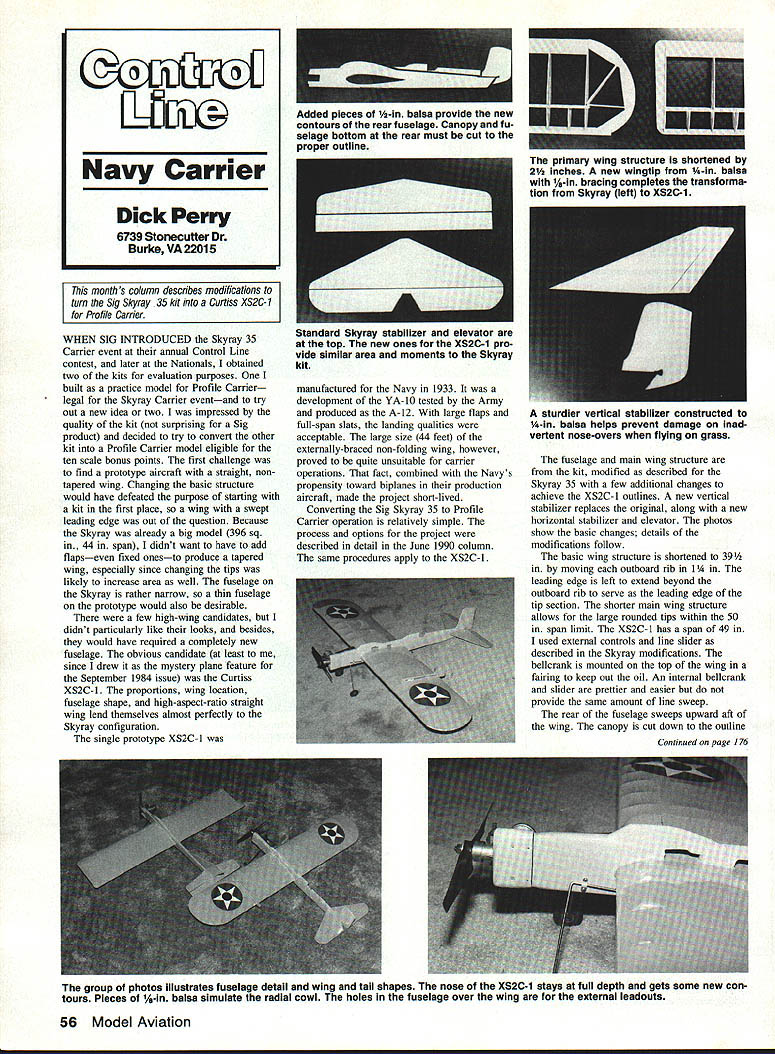
The fuselage and main wing structure are from the kit, modified as described for the Skyray .35 with a few additional changes to achieve the XS2C-1 outlines. A new vertical stabilizer replaces the original, along with a new horizontal stabilizer and elevator. The photos show the basic changes; details of the modifications follow.
Wing modifications
- Shorten the basic wing structure to 39½ in. by moving each outboard rib in 1¼ in.
- Leave the leading edge to extend beyond the outboard rib to serve as the leading edge of the tip section.
- The shorter main wing structure allows for the large rounded tips within the 50 in. span limit—the XS2C-1 has a span of about 49 in.
- The primary wing structure is shortened 2 in. A new wingtip of 1¼-in. balsa with 1/8-in. bracing completes the transformation from Skyray to XS2C-1.
Controls
- I used external controls and a line slider as described in the Skyray modifications.
- The bellcrank is mounted on top of the wing in a fairing to keep out the oil. An internal bellcrank and slider are prettier and easier but do not provide the same amount of line sweep.
Fuselage modifications
Rear fuselage:
- The rear of the fuselage sweeps upward aft of the wing.
- Add pieces of 1/8-in. balsa to provide new contours to the rear fuselage.
- The fuselage bottom rear must be cut to the proper outline.
- The rear cockpit and turtledeck are formed from 1/16-in. balsa.
Forward fuselage and cockpit:
- Keep the forward fuselage at full depth.
- Add 1/4-in. pieces to expand the plywood doublers to the same height as the balsa.
- Cut the outline to resemble the radial cowl of the prototype.
- Add a few pieces of 1/8-in. balsa around the nose and finish with sandpaper to complete the radial engine illusion.
(Note: the forward cockpit requires careful shaping to match the prototype contours.)
Tail surfaces
- Horizontal stabilizer: 1/4-in. balsa with 1/8-in. x 1/2-in. spruce on each piece at the hinge line to hold the dacron thread hinges.
- The spruce in the elevator section spans the full width of the tail and connects the two halves of the elevator.
- Vertical stabilizer: formed from 1/8-in. balsa for added strength.
- The canopy is cut down to the proper outline.
Final notes and offer
I've kept the text short this month to allow for more photographs of the XS2C-1 model. I would be happy to hear from anyone who wishes to try an XS2C-1 conversion of the Sig Skyray .35. I will provide full-size outlines for cuttings, horizontal stabilizer, elevator, fuselage, and vertical stabilizer, plus a three-view drawing of the prototype XS2C-1 for bonus point documentation.
- Cost of the package: $5.00.
There's still plenty of time to prepare for the Nationals. The control-line flight areas have been paved since last year, so the flying conditions should be considerably improved. I hope to see many of you there.
Dick Perry 6739 Stonecutter Dr. Burke, VA 22015
Transcribed from original scans by AI. Minor OCR errors may remain.

