
Control Line: Navy Carrier
Dick Perry 6739 Stonecutter Dr. Burke, VA 22015
ABSTRACT: This month's column contains information about the new competition series of APC propellers, some more discussions about Carrier from earlier years, and a request for information from east coast Carrier fliers.
APC Propellers
In the April issue I mentioned the most recent propeller releases from Landing Products — the competition series of APC propellers in nine-inch diameter and pitches of 6.5, 7.5, and 8.5 inches. I've since received information from Fred Burgdorf describing the development and production of the APC propellers and the differences between the sport and competition propellers.
APC propellers were first described in the last of four "Model Propeller Noise" articles by Vess, Heathcoat, and Nagel that appeared in the December 1989–March 1990 issues of Model Aviation. Those articles described the mechanisms by which propellers on model aircraft contribute to overall noise. The primary observations of the researchers were:
- Propellers are the predominant source of noise on model aircraft; effective mufflers do little to reduce it.
- Torque noise is a prominent type of propeller noise.
- The reason torque noise is high is because model propellers are very inefficient at converting engine torque into thrust.
The final article described APC propellers and cited quiet operation as a point of interest. No measurements had been taken of APC propellers because they were not available when the research began; however APC props were tested subjectively compared to other propellers. The results, although not quantified, showed APC propellers to be significantly quieter. Certain APC propellers also produced higher flight speeds than were achieved with other propellers on the same models and engines. APC props are quieter because they turn less torque into noise, leaving more torque to convert into thrust.
Historically, propeller design procedures were basically unchanged from the Wright brothers through the 1960s. Improvements were often the result of experimentation rather than comprehensive theory. Since the development of computational fluid dynamics and powerful computers, propellers could be designed and tested with the benefit of wind-tunnel data and experimental flight tests. Commercial propeller designs have also been influenced by production limitations and the economics of carving wood props.
Landing Products took a different approach using computer-aided design and manufacturing (CAD/CAM). A computer program uses carefully chosen mathematical descriptions of propeller shapes, allowing high design flexibility without sacrificing desirable aerodynamic characteristics. The mathematically defined shapes are converted into commands for a numerically controlled milling machine that makes production molds. For example, an 11-inch-diameter propeller requires about seven hours of computer time to compute control commands and another seven hours of machining to produce molds.
Tests by Vess et al. demonstrated propeller efficiencies generally less than 50% — less than half of the engine's power becomes thrust, the rest lost to noise and other losses. Full-scale propeller efficiencies can top 85%, so significant improvement is possible. I do not have quantitative efficiency data for APC propellers, but subjective performance comparisons and reduced noise levels point to markedly improved efficiencies.
I was first introduced to APC sport props designated "B-11" cast into the hub. The B-11 props had an abrupt transition from hub to optimum blade airfoil within about a one-inch radius (for a 9-inch diameter prop). Early B-11s experienced some failures in the field; they were replaced in the sport series by the "C-2" design, which is significantly stronger.
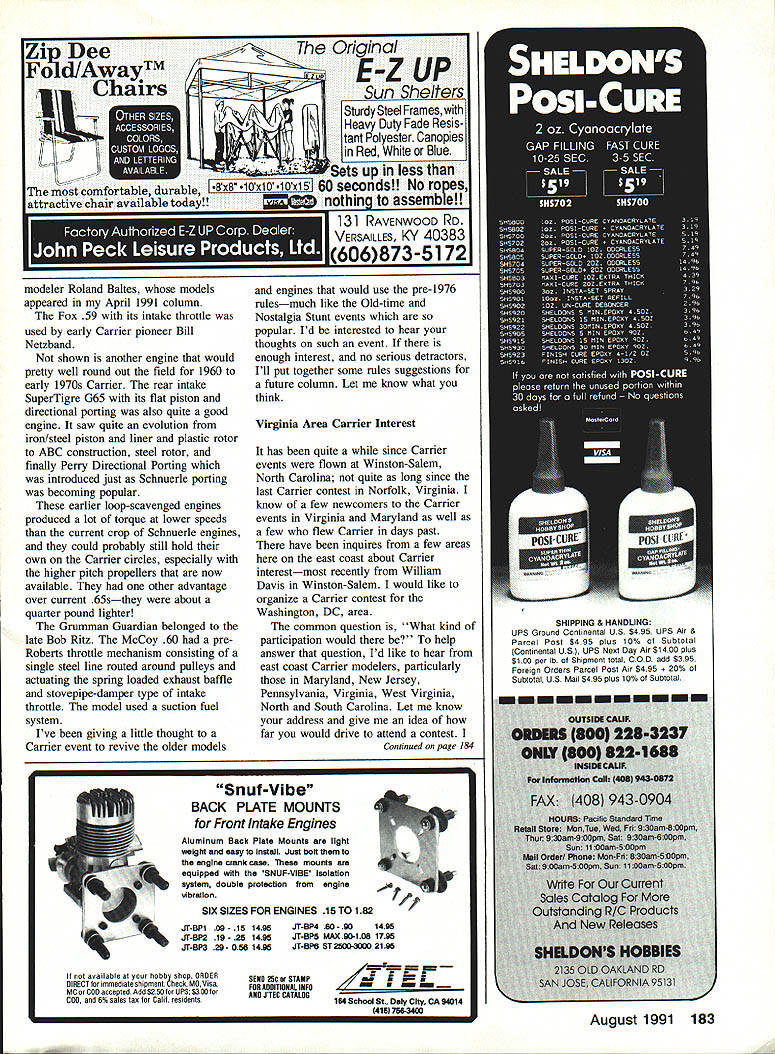
The competition-series propellers are designated "D-1." The D-1 props have more blade area in the inboard 65–70% of the diameter and an enlarged hub. A comparison between a 9x7 C-2 sport prop and a 9x7.5 D-1 competition prop showed the D-1 able to absorb 70% more power at 15% higher rpm and produce 40% more thrust with the same internal stresses on the blade.
APC propellers are molded from a long-fiber composite material that has over double the strength of unreinforced nylon and is 25–30% stronger than short-fiber glass-filled nylon. The resulting prop is very stiff — stiffness improves performance but increases stresses when the blade is subjected to shock loading (for example, hitting the deck on landing). Prudence dictates replacing the prop after each arrested landing, or at least thoroughly inspecting it before using it again — good advice for any propeller.
As this is written, I have yet to complete my muffler-equipped practice model for use at my club (Northern Virginia Control Line Association). Test results comparing the APC props to other propellers commonly used in Carrier will have to wait for the next installment.
Production-Quality Variations (A Note from Max Fattelson)
Some older engines and props varied widely in quality due to manufacturing differences. Max Fattelson of San Antonio, Texas, who worked for GHQ in 1938–39, described how extensive rework made a poor engine run well. His steps included:
- Honed out the cylinder bore.
- Removed all webs and flash.
- Chromed the piston to fit the cylinder.
- Honed the crankshaft bearing.
- Chromed the shaft to fit the bearing.
His note explains why some units ran poorly and others ran well after rework.
Nostalgia
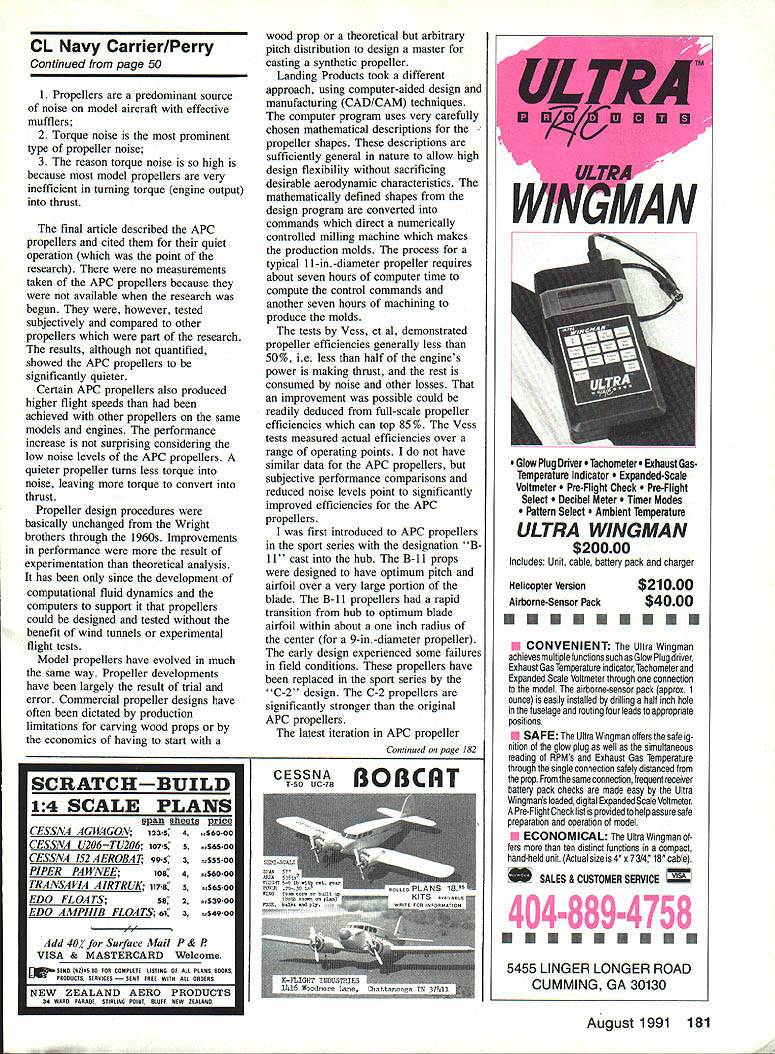
The model and engine photos this month are from Ron Duffy of Burbank, California. Ron was active in Navy Carrier for quite a while and is now renewing his activity in the event. He won Class I and II at the Riverside NATS in 1977 and was the first recipient of the Eugene Ely Award as the outstanding Navy Carrier flier at Riverside. He started flying Carrier in 1967 with a Sturdi-Built AM-1 Mauler and a McCoy .60. The Mauler kit could be purchased for about $15 back then.
The three engines shown have quite a history. The Rossi with a Bill Johnson fuel meter and exhaust slide was Ron's engine at the 1977 NATS and could top 120 mph on a good day. The McCoy .60 was probably the most popular engine since the beginning of Carrier flying, used from the early ignition days through Class II. This particular McCoy, fitted with a Johnson meter and slide, belonged to a long-time Carrier flier. Modeler Roland Baltes, whose models appeared in my April 1991 column, used a Fox .59 with intake throttle — a type used by early Carrier pioneer Bill Netzband.
Not shown is another engine common in 1960–early 1970s Carrier: the rear-intake SuperTigre G55 with its flat piston and directional porting. It evolved from iron/steel piston and liner and plastic rotor to ABC construction, steel rotor, and finally Perry directional porting, introduced just as Schnuerle porting was becoming popular. These earlier loop-scavenged engines produced a lot of torque at lower speeds than current Schnuerle engines and could probably still hold their own on Carrier circles, especially with higher-pitch propellers now available. They had one other advantage — they were about a quarter pound lighter than contemporary .65s.
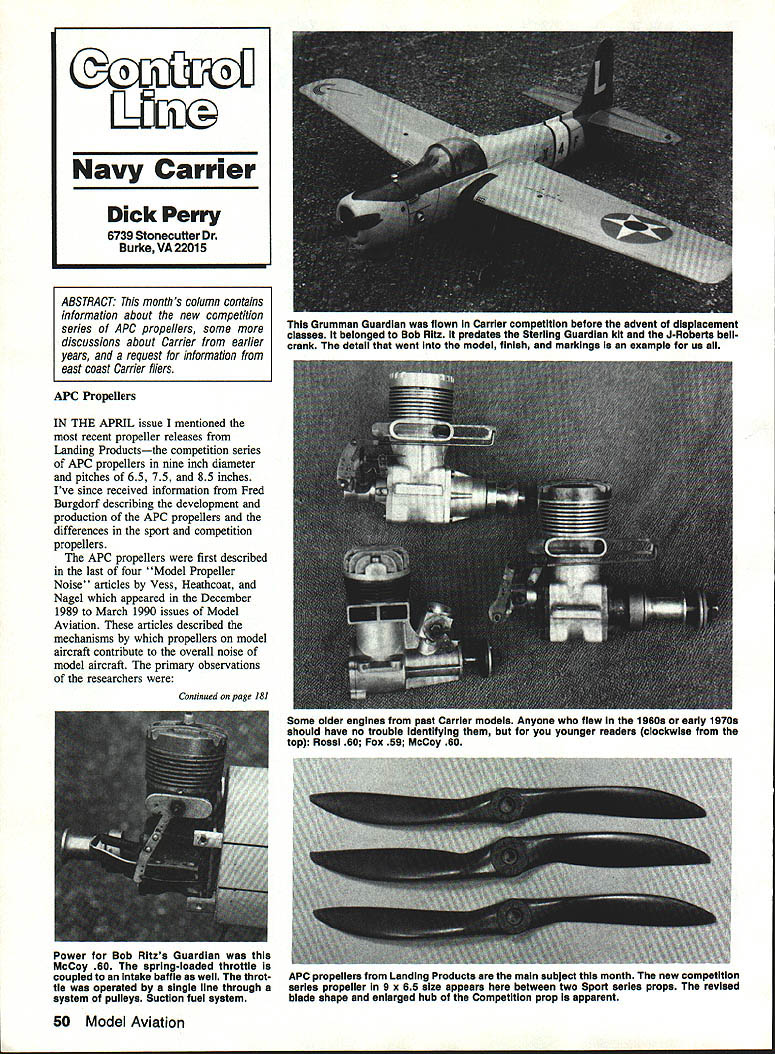
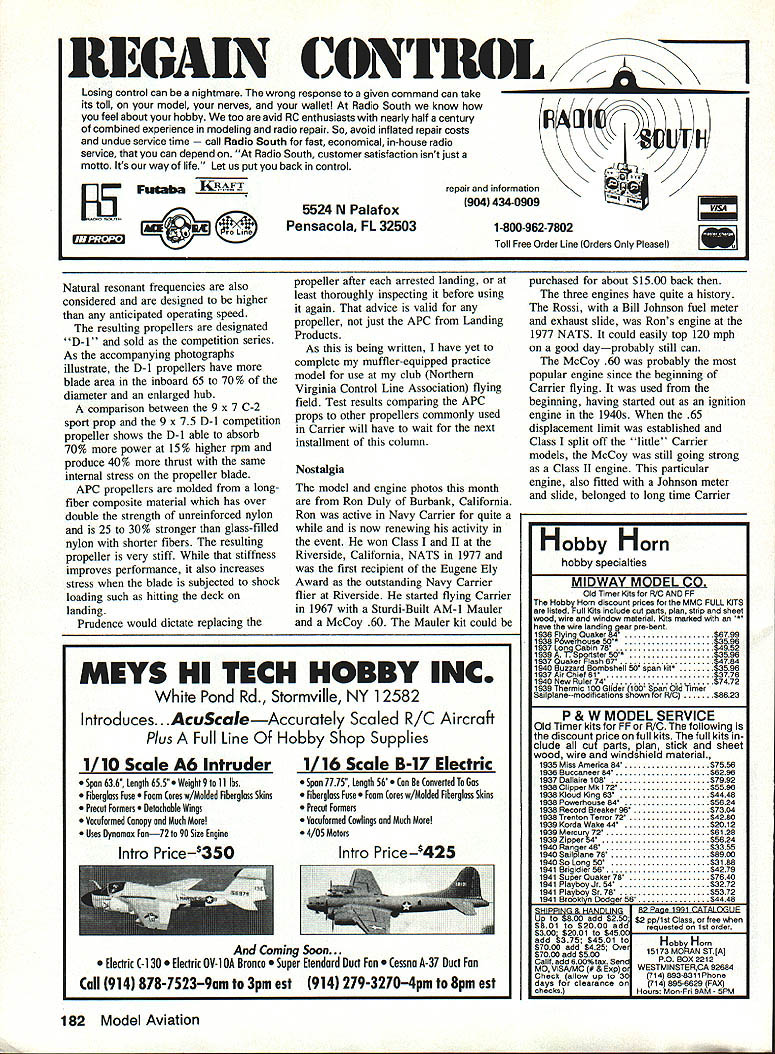
The Grumman Guardian pictured belonged to the late Bob Ritz. The McCoy .60 installation used a pre-Roberts throttle mechanism consisting of a single steel line routed around pulleys to actuate a spring-loaded exhaust baffle and stovepipe-damper type intake throttle. The model used a suction fuel system.
I've been thinking about a Carrier event to revive older models and engines under pre-1976 rules — similar to Old-Time and Nostalgia Stunt events. I'd be interested in your thoughts. If there's enough interest and no serious detractors, I'll put together some rules suggestions for a future column. Let me know what you think.
MORE NAVY NATS STUFF
Fran Ptaszkiewicz of Towanda, New York, sent color prints from old slides that capture the feel of the old National Championships. The photos show a great deal of shine on model wings — silk covering and many coats of clear dope, hand-rubbed — a workmanship style that is becoming a dying art. The prints also show young fellows working on models (some in shop aprons), sleeping cots in front of work benches, model trailers, and a mix of Free Flight and Control Line models. The photo reproduced only about one third of the total work bench area.
Fran also recalls the night flight of a pulse-jet-powered control line model between two hangars at the 1950 Nats in Dallas: a glowing tube going round and round with noise echoing off the hangar walls. He remembers two stunt models tied tail-to-tail in an engine tug of war, and Jim Walker doing ceiling-walker and glider routines with many tricks.
Fran is a source of reprints of old deBolt kit plans — contact him at 23 Marlee Drive, Towanda, NY 14850 for information.
Virginia Area Carrier Interest
It has been quite a while since Carrier events were flown at Winston-Salem, North Carolina, and somewhat less time since the last Carrier contest in Norfolk, Virginia. I know of a few newcomers to Carrier in Virginia and Maryland as well as some who flew Carrier in days past. Inquiries about Carrier interest have come from several areas on the east coast — most recently from William Davis in Winston-Salem. I would like to organize a Carrier contest for the Washington, DC area.
The common question is, "What kind of participation would there be?" To help answer that, I'd like to hear from east coast Carrier modelers, particularly those in Maryland, New Jersey, Pennsylvania, Virginia, West Virginia, and North and South Carolina. Please let me know your address and give an idea of how far you would drive to attend a contest. I will make the list of names and addresses available to anyone thinking about organizing a Carrier contest. Perhaps better communication can bring Carrier flying back to the central east coast region.
EDCO Gyro Plans
Through the kindness of Frank Zelinka of Coral Gables, Florida, I now have enough drawings to pursue the control line gyro I mentioned in the last column. Frank writes that his dad, Nick, saw one fly around 1951, bought the kit, and built it. Frank was born in 1953 and learned to fly control line by age five. He took third at Nationals in a Jr./Sr. stunt when he was six with a deBolt All American powered by a Johnson .35.
Frank and his dad tried to fly the gyro with a Bullet .29. Like mine, it would not fly reliably. After release it would run along the ground, sometimes cutting into the circle, so you had to run away to avoid being hit. Several readers pointed out — although the instructions did not mention it — that the only way to get the gyro to fly was to give the blades a vigorous spin before release. Once pre-spun, it flew well; the engine simply did not provide enough spin to drive the rotors otherwise. I'll keep you posted as I get farther into this project.
Another of Those Weird Coincidences
These sorts of coincidences keep happening to me. I had planned to use photos of the enlarged Astro Hog and to mention Bruce Daugherty's connection with the Astro Hog and the old Di-Doe. Along came the May issue and George Aldrich had a three-view and information on the Di-Doe. D.D.C. was the firm that kitted the Di-Doe; the gentlemen responsible were Bruce Daugherty, Fred Dunn, and Herb Consider. When Dunn moved from Ohio to California, he developed the Astro Hog, which swept the top four places at the 1958 Nats and became a legend. Wonder if George knew this — also see George's "Up and Around" for a photo of the earlier-mentioned All American stunter.
A Little White Bipe
The little white bipe is not a scratch-designed Ultimate — it's a highly modified 4-40 bipe. I started with a 4-40 kit and reworked the cockpit and turtledeck, vertical fin, and swept the wings, but it's still a 4-40 under the skin.
I'm so delighted with it that I couldn't resist using the photo. Early flight testing indicates the K&B .45 Sportster is the absolute top end of the power curve; it would probably fly nicely on a .25 cu. in. power plant. It is wildly fast at full throttle with breathtaking vertical performance. At this point it's an exercise with no definite decision about publication or kitting, but it turned out pretty.
Photos Please
Support from the RC groups has been excellent; now I need more material from the Free Flighters. If you Free Flight folks will send me some stuff, I'll gladly report on sport free flight activities.
Transcribed from original scans by AI. Minor OCR errors may remain.

