
Control Line: Navy Carrier
Dick Perry 6739 Stonecutter Dr. Burke, VA 22015
Correction to August Column
Oops! A block of text was misplaced between the bottom of page 181 and the top of page 182 in the August issue. For those who would like the missing material, the paragraph is reproduced below with the deleted section in brackets:
"The latest iteration in APC propeller [design is the result of additional software development which allows both performance and stress to play in the design process. The new software considers centrifugal, bending, and torsional vibration loads and manages stress to stay under the fatigue endurance stress limits of the propeller material.] Natural resonant frequencies are also considered and are designed to be higher than any anticipated operating speed."
Wingtip Weight
Both the Stunt and Carrier communities have long known the benefits of adjusting wingtip weight to suit a particular model or match the day's flying conditions. Key points:
- Higher overall weight reduces acceleration.
- Increased tip weight can cause excessive outboard yaw during the early stages of takeoff, which increases drag (especially from the wheels) and reduces effective thrust.
- Tip weight is necessary for good low-speed performance. Additional tip weight can help transition to a nose-high, low-speed attitude and provide extra stability and line tension on windy days.
Adjustable tip-weight methods:
- Bolted-on external weights: simple but less tidy and more prone to snagging.
- Internal weight compartment (preferred): removable panels allow adding or substituting large weights. Note that large unsecured weights can concentrate stress; many smaller weights distribute load better and reduce damage risk.
- Cigar-tube method (my preferred approach): include a length of cigar tube in the wingtip and plug the outer end with a threaded wood block (R/C-style). I use a 1/4-in. hole in the block and a short length of brass tubing for a removable center. Center a nut on the block so you can access it from the underside of the wing. When the nut and bolt are in place the weight is held securely; when removed the tube can accept lead shot or steel slugs to change weight as required.
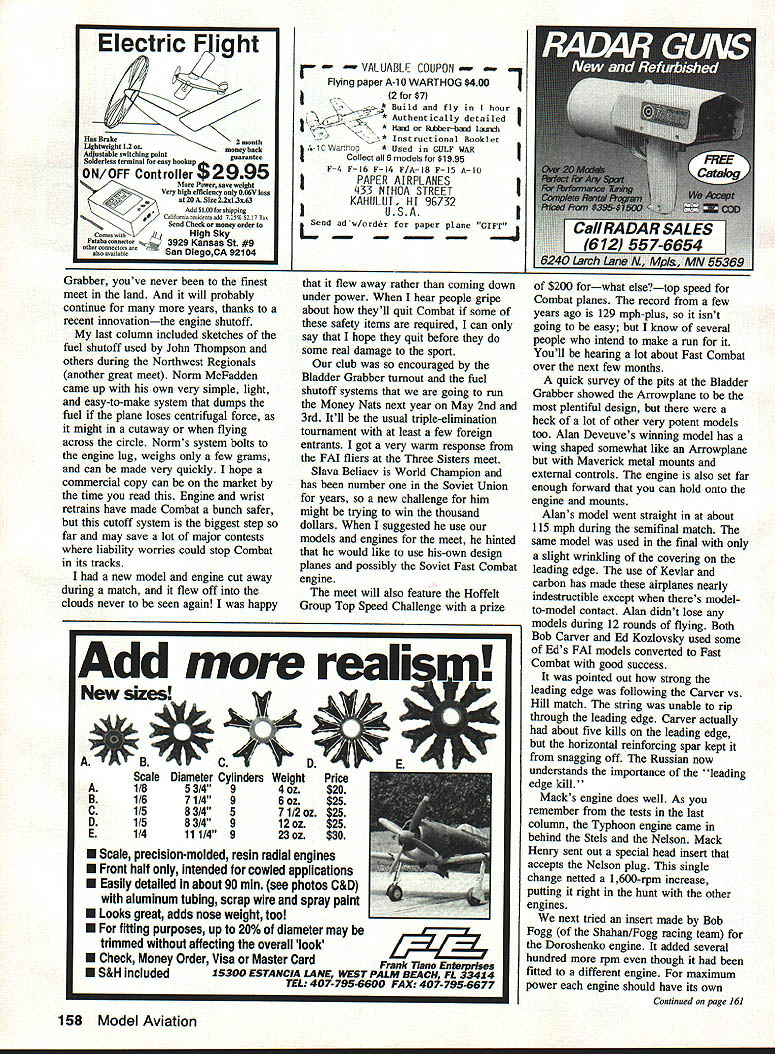
- Lead-shot compartment: enclose the outermost rib bay with plywood, create a lead-shot container, and use nylon screw plugs for the fill holes to permit easy addition and removal of shot for daily tuning.
MO-1 Carrier History
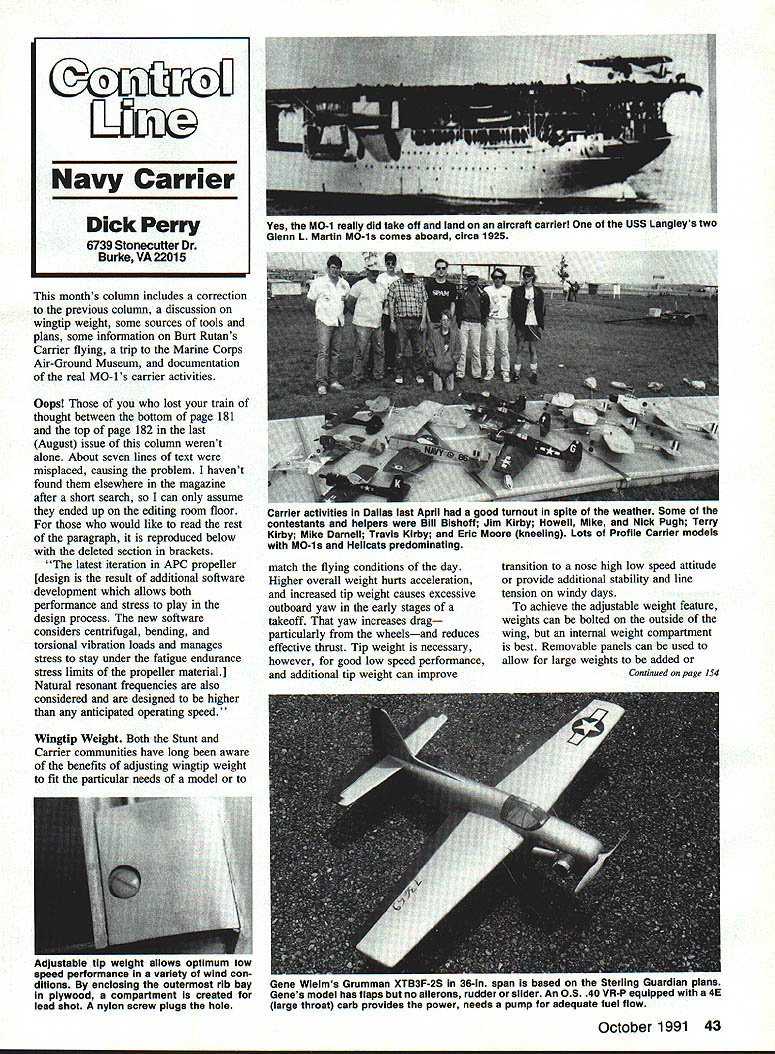
Yes, the Glenn L. Martin MO-1 really did take off from and land on the aircraft carrier USS Langley. Two MO-1s were carried aboard circa 1925.
Engine Shutoff and Safety
If you haven't been to the Bladder Grabber, it's one of the finest meets around — and recent safety innovations are helping ensure it stays that way. My last column included sketches of the fuel shutoff used by John Thompson and others at the Northwest Regionals. Norm McFadden developed a very simple, light, and easy-to-make system that dumps fuel if the plane loses centrifugal force, as might happen in a cutaway or when flying across the circle.
- Norm's system bolts to the engine lug, weighs only a few grams, and can be made quickly.
- I hope a commercial version will be available soon.
- Engine and wrist restraints have made Combat a lot safer, but this centrifugal-force fuel cutoff may be the biggest safety advance yet and could prevent liability issues from threatening Combat events.
Our club was encouraged by the Bladder Grabber turnout and these fuel-shutoff systems, so we will run the Money Nats next year on May 2–3. It will be the usual triple-elimination tournament with likely foreign entrants. The meet will also feature the Hoffelt Group Top Speed Challenge with a $200 prize for top speed; the record is about 129+ mph, so it won't be easy.
Slava Beliaev (World Champion and long-time Soviet number-one) may try for the prize. When I suggested he use our models and engines, he hinted he might prefer his own designs and possibly the Soviet Fast Combat engine.
Combat Models, Materials, and Engines
A quick survey of the pits at the Bladder Grabber showed the Arrowplane to be the most potent flank-design, but many other effective models were present. Highlights:
- Alan Deveuve's winning model: wing shape similar to an Arrowplane, Maverick metal mounts, thin outer center-section, engine set far forward so you can hold the engine and mounts. It went straight in at about 115 mph with the semiflat Cid prop and survived 12 rounds with only minor covering wrinkling.
- Use of Kevlar and carbon has made these airplanes nearly indestructible except in model-to-model contact.
- Bob Carver and Ed Kozlowski had success converting some FAI models to Fast Combat.
- Carver vs. Hill match demonstrated how strong a reinforced leading edge can be: the string failed to rip through the leading edge, and a horizontal reinforcing spar prevented the leading edge from snagging off. The importance of the "leading edge kill" is now well understood.
Engine notes:
- Mack's engine performed well. From tests in the previous column the Typhoon engine trailed the Stels and the Nelson.
- Mack Henry sent a special head insert that accepts the Nelson plug; this change gained about 1,600 rpm, bringing it into contention.
- Bob Fogg (Shahan/Fogg racing team) made an insert for the Doroshenco engine that added several hundred rpm even though it was fitted to a different engine.
Photos and Contest Activity
About photos: pencil your address on the back of the photo. Make small stick-on number labels and place them on the back in an extreme corner; write the photo descriptions on a separate piece of paper corresponding to the numbers. A little extra care preserves photos.
Contest listing:
- Lafayette Esquadrille (St. Louis area) is sponsoring the 4th Annual Broken Arrow Stunt Contest on October 6, 1991. The AMA-sanctioned contest will take place at Ruder Park, Valley Park, Missouri (just west of St. Louis on the north side of I‑44). Main events: PAMPA Olde Tyme Stunt and Sport Scale. Profile and full-bodied models welcome. Framed certificates and awards; special Red Max trophies for some 3rd-place events; 1st-place Sport Scale award. For details contact Bob Arata, 561 Goldwood, Ballwin, MO 63021; telephone 314/391‑0272.
A note on contest reports and advertising: I receive very little contest advertising or reports. I include a plug in the column to promote CL Scale events — doing the flying and winning helps get a contest mentioned here. Keep in mind the publication lead time is at least three months (for example, the October column is submitted in late June). Please send ideas, notices of upcoming CL Scale events, contest reports, and especially photos. The CL Scale activity address is at the top of this column.
Transcribed from original scans by AI. Minor OCR errors may remain.

