
Control Line: Navy Carrier
Author
Dick Perry 6739 Stonecutter Dr. Burke, VA 22015
Abstract
This month's column looks at the types of equipment used at the Nationals and discusses preliminary plans for the Navy Carrier facilities at Muncie.
Nationals Analysis
Nationals provides an opportunity to see a wider variety of equipment than is usual for local contests. The space allocated for Nationals coverage of the Navy Carrier events doesn't provide sufficient room to go into detail on the equipment used, so I want to devote the first column after the Nationals coverage to discussing the equipment trends at the Nationals. Information is derived from discussions with the contestants and from the data sheets which most contestants fill out at processing.
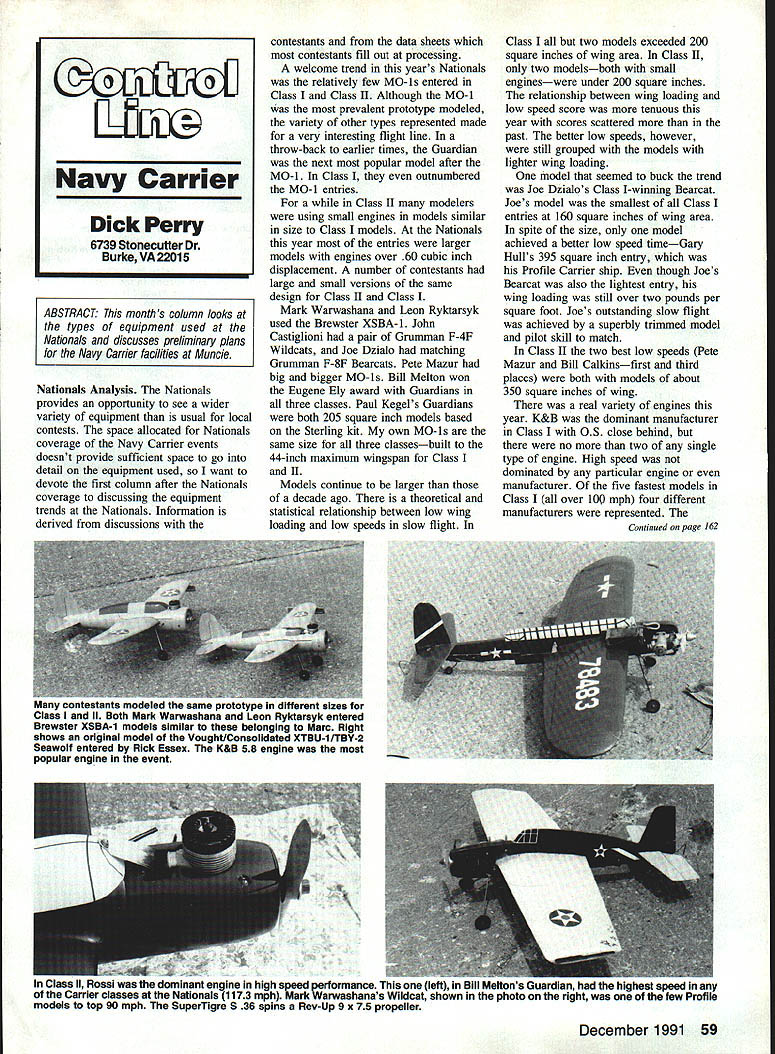
A welcome trend in this year's Nationals was the relatively few MO-1s entered in Class I and Class II. Although the MO-1 was the most prevalent prototype modeled, the variety of other types represented made for a very interesting flight line. In a throwback to earlier times, the Guardian was the next most popular model after the MO-1. In Class I, Guardians even outnumbered MO-1 entries.
For a while in Class II many modelers were using small engines in models similar in size to Class I models. At the Nationals this year most of the entries were larger models with engines over .60 cubic inch displacement. A number of contestants had large and small versions of the same design for Class II and Class I.
Notable entries included:
- Mark Warwashana and Leon Ryktarsyk: Brewster XSBA-1
- John Castiglioni: a pair of Grumman F4F Wildcats
- Joe Dzialo: matching Grumman F8F Bearcats
- Pete Mazur: big and bigger MO-1s
- Bill Melton: Guardians in all three classes (won the Eugene Ely award)
- Paul Kegel: Guardians, both 205 square inch models based on the Sterling kit
- My own MO-1s: same size for all three classes—built to the 44-inch maximum wingspan for Class I and II
Models continue to be larger than those of a decade ago. There is a theoretical and statistical relationship between low wing loading and low speeds in slow flight. In Class I all but two models exceeded 200 square inches of wing area. In Class II, only two models—both with small engines—were under 200 square inches. The relationship between wing loading and low speed score was more tenuous this year with scores scattered more than in the past. The better low speeds, however, were still grouped with the models with the lighter wing loading.
One model that seemed to buck the trend was Joe Dzialo's Class I-winning Bearcat. Joe's model was the smallest of all Class I entries at 160 square inches of wing area. In spite of the size, only one model achieved a better low speed time—Gary Hull's 395 square inch entry, his Profile Carrier ship. Even though Joe's Bearcat was also the lightest entry, his wing loading was still over two pounds per square foot. Joe's outstanding slow flight was achieved by a superbly trimmed model and pilot skill to match.
In Class II the two best low speeds (Pete Mazur and Bill Calkins—first and third places) were both with models of about 350 square inches of wing.
There was a real variety of engines this year. K&B was the dominant manufacturer in Class I with O.S. close behind, but there were no more than two of any single type of engine. High speed was not dominated by any particular engine or even manufacturer. Of the five fastest models in Class I (all over 100 mph) four different manufacturers were represented. The fastest model was Bill Melton's Guardian. Bill had the only SuperTigre X.40 powerplant. His propeller was a Grish 9-7. The engine was equipped with a Rossi carb and used an OPS plug.
In Class II, not only were large engines more numerous than smaller ones, they also dominated the high speed performance. The only high speeds over 100 mph were achieved with engines larger than .60 cubic inches. In fact, only one large engine was slower than 100 mph. Unlike Class I, there was a definite performance advantage for one particular make of engine: a Rossi (Bill Melton again) was the fastest of the day at 117.3 mph, and three of the fastest seven engines were Rossis. The other four included two Webra .61s and an old SuperTigre G.65.
Bill Melton achieved his high speed performance with:
- Rev-Up 10-8W prop cut to 9-1/2" diameter
- Walbro carburetor (based on the Perry design, but with an aluminum body)
- OPS plug
- Crankcase pressure fuel system
His model was within one ounce of being the heaviest entered. Apparently the mass provided a solid engine mount—it certainly didn't slow acceleration appreciably.
Only two other models were faster in acceleration. John Castiglioni's Wildcat (with another Rossi .65) was the fastest off the deck and almost as fast on top end. The slight acceleration advantage was gained through a 20% lighter model and a larger propeller diameter. John's Top Flite prop was largest in both pitch (8.25 inches) and diameter (11 inches). John also used a unique pressure fuel system which I'll describe in a later column.
In Profile Carrier almost half of the models were MO-1s, although individual design characteristics varied. Most models were larger than the minimum required wing area of 300 square inches, but none exceeded 448 square inches in span even though larger models are common in Profile. Carlos Aloise's excellent low speed flight was described in the Nationals coverage. His model had the lightest wing loading (1.04 pounds per square foot) of any to achieve more than 200 seconds in low speed.
In the engine department for Profile Carrier there was a definite preference for the K&B 5.8 (37% of the Open entries). There was also a decided lack of K&Bs among the top speeds of the day. They were very consistent, however: all but one of the K&Bs had top speeds between 81 and 85 mph. The four highest speeds (all over 90 mph) included:
- Two O.S. FSR .40 conversions (a Tune-Hill and one by Glenn Dye)
- Carlos Aloise's SuperTigre X.36
- Mark Warwashana's SuperTigre S.36
The fastest time (93.5 mph, 19.24 seconds) was Dick Perry's MO-1 with Tune-Hill power, O.S. 4BK carb, Fox R/C plug, and the APC 9-7.5 competition prop.
What does it take to win the Nationals? Does high speed or low speed dominate? In Profile Carrier, an event where low speed usually determines the winners, there was no clearly dominant factor. Of the top seven places, all were over 82 mph and over 210 seconds low. It took very good performance in both high and low speed to place in the top half. Both high speed and low speed performance were closely correlated with placing in the top half of the competitors. If you look at only high speed or low speed performance, the relative ranking of five of the top seven finishers would remain the same.
The same control is bad for the Scale Carrier classes. Although there was no dominant factor governing placing in these events, just as in Profile, the reasons were quite different. In the top four places in Class II, high speed varied by almost 20 mph and low speed by almost a minute. Class I was spread even more with over 25 mph differences in high speed and more than two minutes in low.
I think that the path to improved performance lies in Class I and II models similar in size and weight to Profile models, i.e., large, flight models. We are already seeing Profile Carrier models entered in Class I and even Class II with appropriate engines. Their performance is capable of overcoming some of the disadvantage of forfeiting the 100 scale bonus points. My philosophy will be the topic of a later article.
Carrier Facilities at Muncie
John Hunton, an architect and avid modeler from Northern Virginia, and Vince Mankowski, Executive Director at AMA Headquarters, are working on the design for the AMA's Muncie facility. The preliminary plans call for separate areas dedicated to each Control Line specialty. The Navy Carrier facility will consist of two circles with protective fences. The circles will be separated by a center section divided into spectator and pit sections and containing a shelter. The circles will have protective fencing on two sides, separating the circles from the parking area and the pits and spectators.
The pit area will also have a fence to separate it from the spectators.
The facility is being designed to serve as a Nationals site, and the pit areas are large enough to accommodate a corresponding number of contestants and models. The shelter will serve for processing and tabulation during the Nationals.
The facilities will also be well suited for smaller contests with one or more areas being reserved for each competition. The shelters would provide registration, processing, and administration facilities, concessions, picnic areas, or any other need the host club may have. Parking will be available adjacent to each event area.
I'll provide more details as they are developed.
Other Notes
Hoffelt 36R won with something over 129 mph. The Nelson guys are really licking their chops over this one. Whoa—$200 to go 130 mph. No problem!
The last weekend in July found me making my way to Czestochowa, Poland, for the European Championships. The championships are held in the off year from the World Championships that we're all tuning up for right now. Going by yourself and without sponsorship presents a few problems—like getting airfare for a reasonable fee. Almost every flight was booked solid and at least one airline offered a Business Class ticket for as little as $3,600.
After much newspaper searching (which you can do, too) I found a seat on LOT Airlines, which is the official airline of Poland, at a more or less reasonable price (around a thousand bucks).
Car rental is another dicey operation, but mine proved reliable and a rather large car compared to the little things ring-ding-dingging down the road. Yep, they have some two-cycle-powered cars about the size of the trunk of your Ford.
By pure chance I found a motel right on the highway that was only about a mile from the flying site used for the 1980 World Championships. Being the rich American type, I spent 490,000 Zlotys per night for my room. At 12,000 Zlotys to the U.S. dollar, the price wasn't too bad. We had a contest to see who could find the smallest Zloty note and I won with a 50 Zloty note I'd saved as a souvenir. In case you don't want to bother with the math, that's worth about a third of a penny.
Incidentally, 10-Zloty coins make excellent wing weights.
I'm starting to see why the Europeans seem to be taking us to the cleaners. When we're sitting back in the USA thinking about the next World Champs, the Europeans are having these major meets all the time. They're flying against each other constantly; they keep their top flights to dispose of the Americans first, then settle things amongst themselves.
The speed and Teamrace circles there are permanent, and there were nice workshops for the national teams. Scale used the circles, too, and Stunt had its own workshop.
Transcribed from original scans by AI. Minor OCR errors may remain.

