
Control Line: Navy Carrier
Dick Perry 6739 Stonecutter Dr. Burke, VA 22015
Synopsis
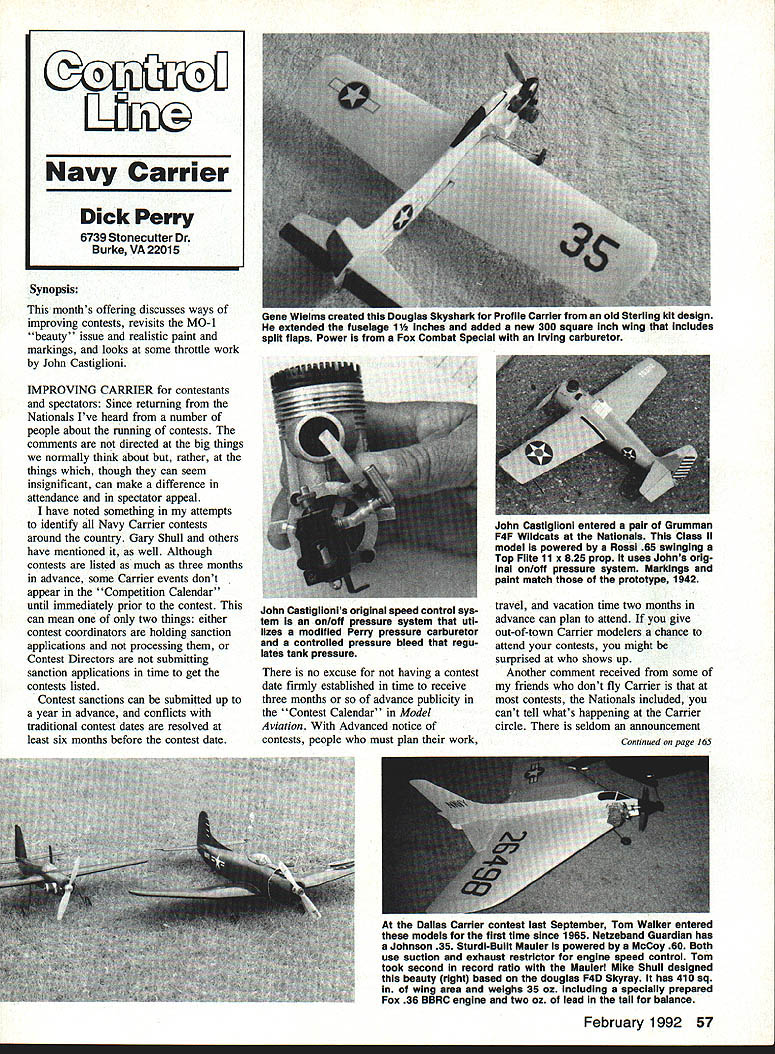
This month's offering discusses ways of improving contests, revisits the MO-1 "beauty" issue and realistic paint and markings, and looks at some throttle work by John Castiglioni.
Improving Carrier for contestants and spectators
Since returning from the Nationals I've heard from a number of people about the running of contests. The comments are not directed at the big things we normally think about but, rather, at the small items which, though they can seem insignificant, can make a difference in attendance and in spectator appeal.
I have noted something in my attempts to identify all Navy Carrier contests around the country. Although contests are listed as much as three months in advance, some Carrier events don't appear in the "Competition Calendar" until immediately prior to the contest. This can mean one of two things: either contest coordinators are holding sanction applications and not processing them, or Contest Directors are not submitting sanction applications in time to get the contests listed.
Contest sanctions can be submitted up to a year in advance, and conflicts with traditional contest dates are resolved at least six months before the contest date. There is no excuse for not having a contest date firmly established in time to receive three months or so of advance publicity in the "Contest Calendar" in Model Aviation. With advance notice of contests, people who must plan their work, travel, and vacation time two months in advance can plan to attend. If you give out-of-town Carrier modelers a chance to attend your contests, you might be surprised at who shows up.
Another comment I heard from friends who don't fly Carrier is that at most contests, the spectators can't tell what's happening at the Carrier circle. There is seldom an announcement about who is flying and what class is being flown. At the Nationals, results were posted at the officials' tent where they could be seen only by contestants and officials; at some local contests results aren't posted at all. Spectators are often kept in the dark about who is winning.
Carrier is hard enough for a spectator to understand without an occasional explanation from a contestant who takes time to talk to those watching the event. Promptly posting scores where both spectators and contestants can see them will not only keep contestants from bothering the tabulation official, it will allow spectators to enjoy the events more. Shouldn't that be one of our objectives?
Imported fiberglass props and Fast Combat
Imported fiberglass props for your .15? It looks like the guys at APC have hit the right combination with their latest offering, which puts them in the ballpark with the best exotic props. A Nelson-powered FAI turned 22.7 seconds for 10 laps with the APC vs. 23.4 for the imported glass prop and only mid-25s using a cut-down Taipan.
Preliminary flight testing indicates that the APC prop pulls as well through turns as the glass prop and much better than a cut-down Taipan. Don't try flipping these props with a glove, though — the trailing edge is razor sharp. Many Fast Combat fliers have discovered the advantages of the APC 9 x 6 and by the time you read this you should be able to get the new FAI size too. It's nice to find something a lot cheaper than glass, less fragile and available right here in the U.S.A. in any quantity you want.
MACA standings and newsletter
The race in the standings for MACA Top Twenty is heating up. Don Cranfill is leading the pack with 95 points, followed by current No. 1 Paul Smith with 87 points. Richard Stubblefield has rolled lately with 85 points. Placing high in the MACA standings requires entering a lot of contests, flying lots of Combat events as well as placing near the top — this helps win some major meets with many entries.
The MACA Newsletter continues to maintain a very high standard, thanks to editor Larry Driskill. The newsletter is the best way to keep informed about Combat. To join MACA, send payment and the following information to Chip Giordano at the address below:
- Send $15 (U.S.); $18 (Mexico/Canada); $25 (foreign).
- Include your name, address, AMA number, and category (Junior, Senior, Open).
- Additional family members are $3 each (no newsletter).
Send to: MACA, in care of Chip Giordano, Box 1000, Toms River, NJ 08754-1000.
Geriatric Combat scoring
I was reading the latest issue of the New England Combat News and came upon their scoring system for Geriatric Combat. Besides collecting points for getting close and for airtime, you also get penalized for hitting the other guy's plane. They also have a penalty for cutting the string leader; the penalty increases with each cut taken (100 points for the first, 150 for the second, and 200 for each additional cut). Flying with these rules for a while would make people very careful about making banzai passes at the other guy's model. Of course it helps when you have to fly at 73 mph or less.
The Geriatric event has a lot going for it. There are benefits to 80 mph and the effects can be seen on the flying field with 20 to 25 contestants whereas only a couple of years ago Combat was almost dead in both areas except for an occasional big meet. We had a full day of 80 mph Combat at our local practice field with no mid-airs.
Either giving no points for a string cut or applying a penalty would make it necessary to use following tactics rather than a crossing style of flying. By the way, you have to use good streamers to make this work, because if you touch just the end of the streamer and the whole thing comes off, it defeats the purpose. The best streamers are the plastic C.A. Reed variety, but conventional streamers with masking tape work well too.
Dallas Carrier contest highlights
At the Dallas Carrier contest last September, Tom Walker entered models for the first time since 1965. Netzeband Guardian has a Johnson .35. A sturdily built Mauler powered by a McCoy .60 — both use suction exhaust restrictor engine speed control. Tom took second.
Mike Shull designed a beauty based on the Douglas F4D Skyray that has 410 sq. in. wing area and weighs 35 oz., including a specially prepared Fox .36 BBRC engine and two ounces of lead tail balance.
Joe Castiglioni's Wildcats at the last Nationals carried the light gray paint and the stars and rudder bars used in early 1942, and they looked great.
MO-1s and pretty paint
I received a letter from Dave "VTO" Linstrom chastising me for my opinion on the lack of aesthetic beauty in the MO-1. As an aeronautical engineer, I appreciate the design of the MO-1 which, as a cantilever monoplane, was a departure from biplanes, but I have trouble seeing it as "beautiful." Dave included plans for his "gorgeous" 8.5-span pistachio-scale MO-1. He sees true beauty in the MO-1 and indicates that the only ugly ones he's seen are flying at Carrier circles!
I have to agree with Dave's main point, however. There has been a trend over the years away from the "scale" aspects of CL Navy Carrier flying. Scale detail, color, and markings have not been emphasized in the rules. Therefore, there has been little reason to pursue such items except for reasons of personal pride. Bob Ritz's beautiful Guardian in the August issue had incorrect markings and color, though it still would qualify for bonus points under the rules.
Although our rules do not reward scale paint and markings, those who devote the extra effort to finishing their models are to be commended. As long as "military" color and national markings are required, why not make them appropriate for the model? Adding unit markings, section stripes, cowl ring colors, bureau numbers and aircraft designations, "U.S. Navy" markings where appropriate, and squadron, ship, or station colors gives the model a great bit of character. There are plenty of reference books in local libraries and book stores that can provide details on correct color and markings for a particular aircraft. Some types, because of large production numbers and rapid changes over short periods, can be finished in a seemingly unlimited array of possible scale color and markings.
Castiglioni throttle system
I've featured some of John Castiglioni's excellent machine work in previous columns. You might remember his very thin slide-valve pressure carburetor with built-in metering and pressure relief, and multiple fuel injection ports described in the March 1986 issue. At last summer's Nationals John showed me some of his latest work.
The photo he showed me (described here) was of a Rossi .65 engine with a modified Perry pressure carburetor installed. The small cylindrical object immediately in front of John's thumb is a pressure bleed valve; I'll call it the regulating cylinder. Crankcase pressure is tapped at the upper right side of the backplate and enters the first (upper) "T" connector just to the left of the regulating cylinder. The tubing extending up past the exhaust stack supplies pressure to the fuel tank. The other branch leads to another "T" (the lower one) which directs the pressure to the regulating cylinder and to a new nipple that John has installed on the carburetor.
John has machined a small pin which is installed in the carburetor to block the metering hole when the regulating cylinder is closed. A small spring holds the pin against the block. Pressure in the tank is adjusted by the bleed valve which is easily accessible. When the bleed is open, the tank pressure is lower and the rpm is lower. When the bleed is closed, pressure increases and the engine comes up to run speed. A small restrictor is installed in the fuel line to discourage flooding when the engine is shut off.
Castiglioni reports that this system works well for Carrier because it is relatively simple, uses only a few small parts, and is repeatable. He has used it on both Rossi and Taipan engines with good results. The design allows the idle mixture to be adjusted for reliable landings and the pressure control gives throttle response for takeoffs and touch-and-goes.
This type of system requires that the pressure line in the tank not be immersed in the fuel at any time. If it were, then opening the vent valve would cause fuel, rather than air, to be released. In the case of John's carburetor, such a situation would serve as an excellent "flood-off" type of engine shutoff.
The regulating cylinder contains an internal screw with a tapered end which acts as a needle valve to allow pressure to escape from the tank. The ratio of area in the pressure tap on the engine to the area of the bleed valve in the regulating cylinder determines the actual pressure in the tank.
Opening the bleed valve reduces tank pressure, requiring that the fuel needle valve on the carburetor be opened to compensate. In that way, the mid-range fuel mixture can be managed. The carburetor needle valve controls both wide-open fuel flow (under pressure) and mid-range fuel flow (on suction). If the mid-range mixture is too lean, John opens the bleed valve in the regulating cylinder. That adjustment dictates a more open fuel needle valve for an optimum high-speed setting. The new high-speed setting also richens the mid-range fuel mixture. John's system worked great at the Nationals.
Another innovation that John showed me is a set of sleeves that he has machined for the throat of the Perry pressure carburetor. The throat of the Perry pressure carb is a nominal 3/8‑in. diameter (9.5 mm). That area (about 65 mm² as given) is too large to function adequately on suction. Using a sleeve with an inside diameter of .310 inches (7.9 mm) produces a throat area of about 45 mm², which John says should be adequate for a high-speed Schnuerle .40 engine. Larger throat diameters should suffice for a .65.
John machines his sleeves from aluminum. He turns the blank to a press fit in the carburetor throat, then mills a 1/16‑in.-wide channel parallel to the axis of the cylinder extending about .230 in. from the end of the blank. This channel results in a cutout in the finished sleeve that slides over the spray bar in the carburetor. John then drills and machines the inside diameter of the sleeve, tapers the entrance and cuts off the finished sleeve at .390‑in. length.
John inserts and removes the sleeves with a tool turned from a 3/16‑in. rod. The end of the rod is turned down to fit inside the smallest throat diameter, leaving a shoulder which pushes against the sleeve. A 1/8‑in.-wide, .200‑in.-deep channel is cut in from the end, just as when making the sleeves, to allow the tool to clear the spray bar. The press fit of the sleeves should keep them in place, but for added insurance, they should be inserted only in the direction of airflow. That way, the spray bar will prevent them from ever being sucked into the engine.
Westover Nationals
By now you should have seen the announcement that the 1992 Nationals will be centered at Chicopee, Massachusetts, at Westover Air Force Base. The facilities at Westover, Chicopee, and Springfield have been sufficient in the past (the 1983 and 1985 Nationals were also held there) to allow all AMA events to be held at the same location. The dates are 20–29 June, about a month earlier than in past years.
It's not too early to start planning your vacations to include Navy Carrier at the Nationals. I'll see you there!
Transcribed from original scans by AI. Minor OCR errors may remain.

