
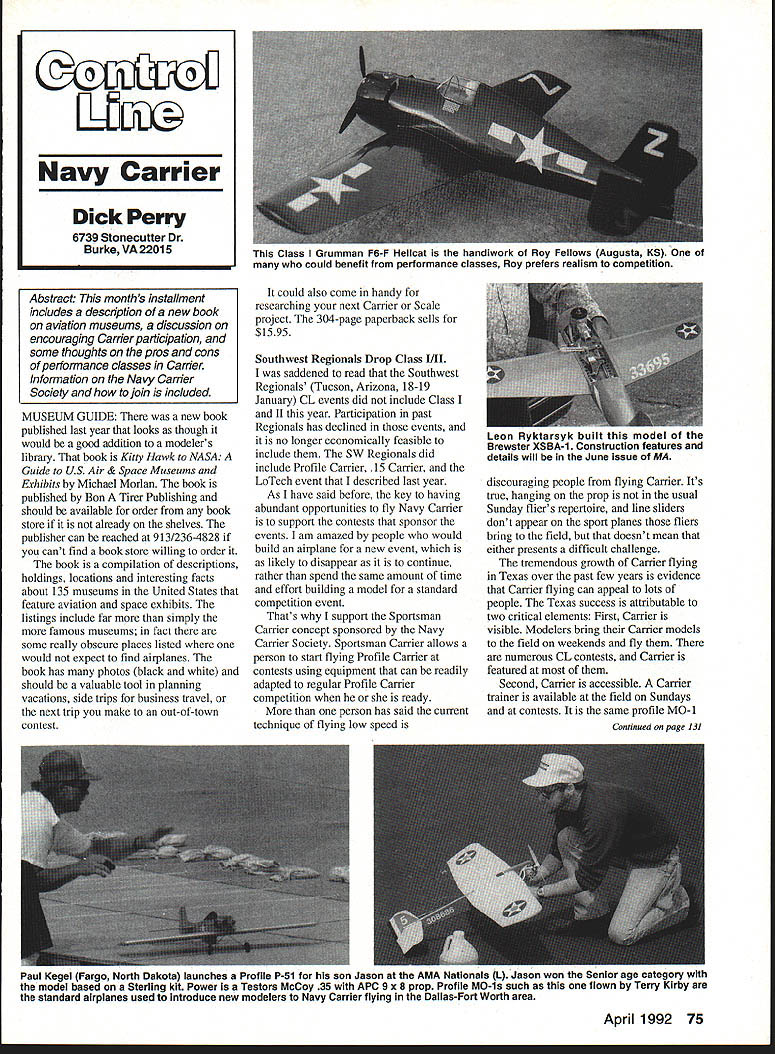
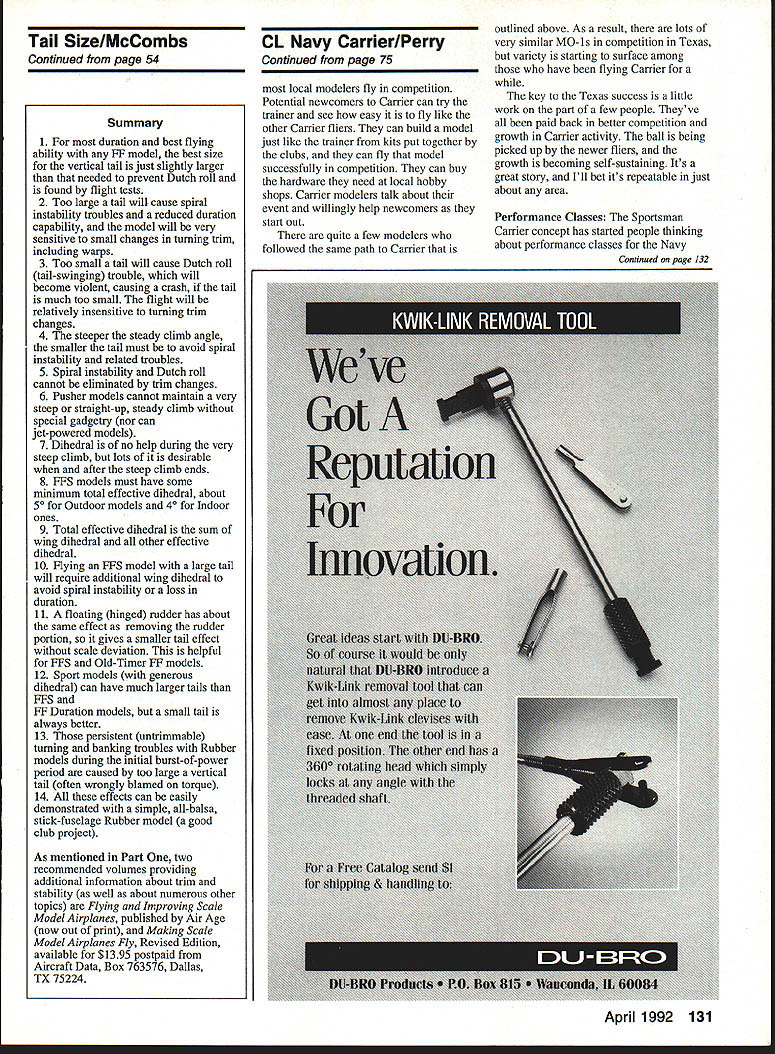
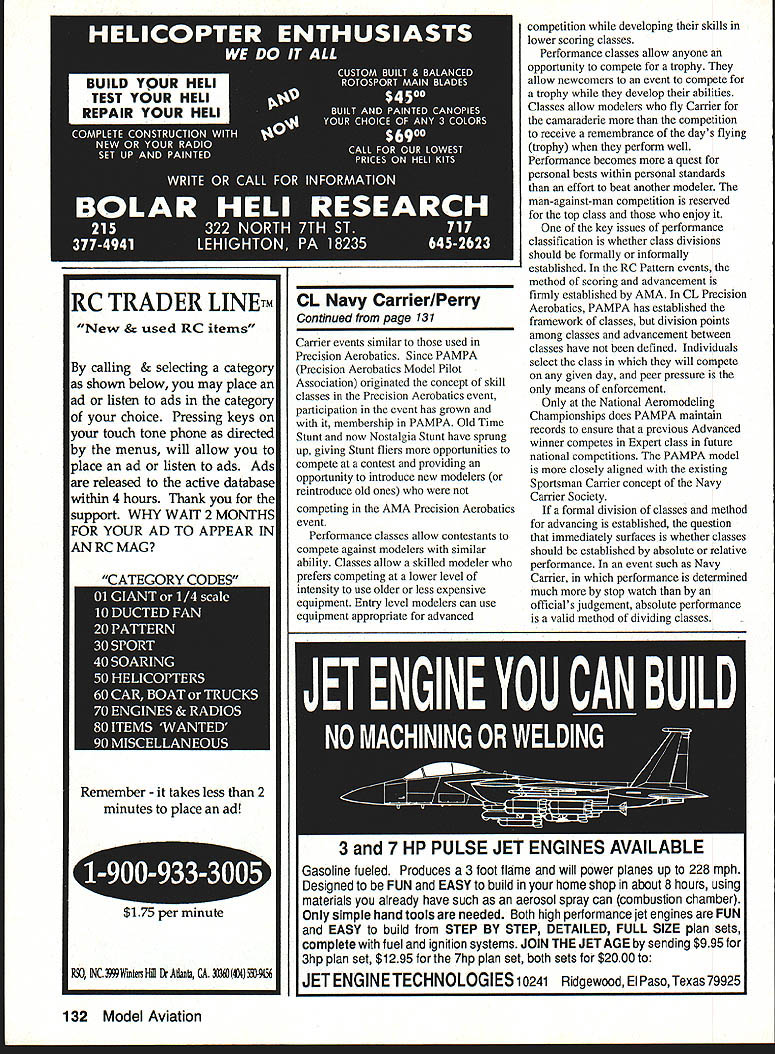
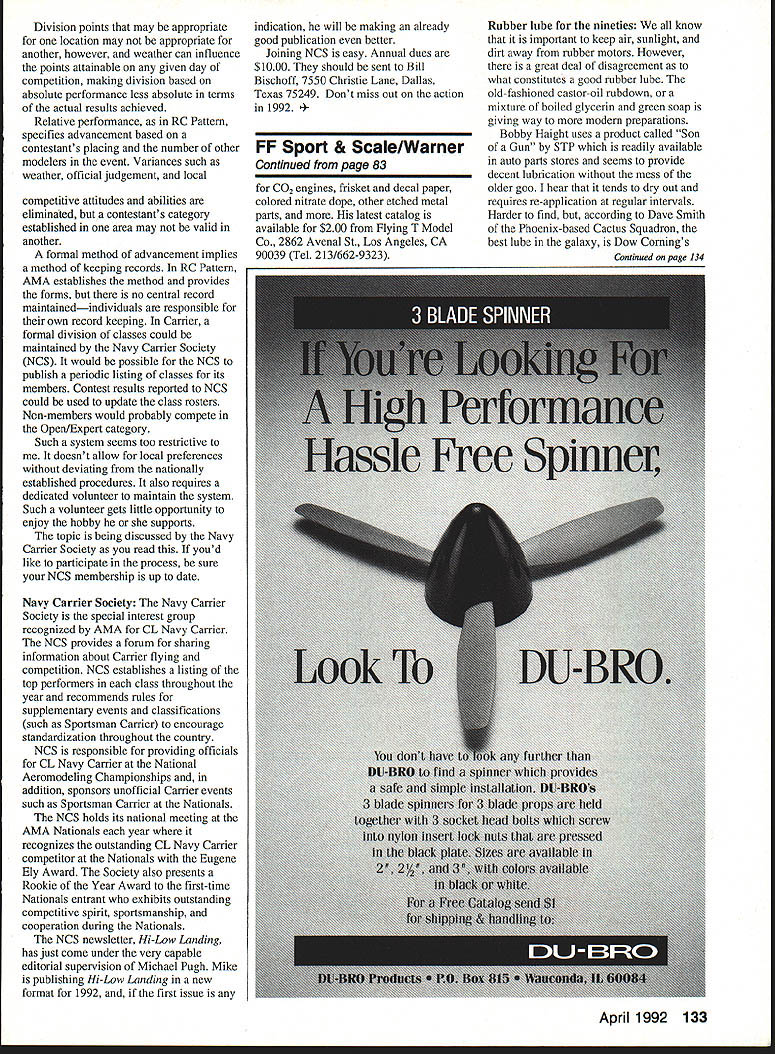
Control Line: Navy Carrier
Dick Perry 6739 Stonecutter Dr. Burke, VA 22015
Abstract
This month's installment includes a description of a new book on aviation museums, a discussion on encouraging Carrier participation, and some thoughts on the pros and cons of performance classes in Carrier. Information on the Navy Carrier Society and how to join is included.
Museum Guide
There was a new book published last year that looks as though it would be a good addition to a modeler's library. The book is Kitty Hawk to NASA: A Guide to U.S. Air & Space Museums and Exhibits by Michael Morlan. The book is published by Bon A Tirer Publishing and should be available for order from any book store if it is not already on the shelves. The publisher can be reached at 913-236-4828 if you can't find a book store willing to order it.
The book is a compilation of descriptions, holdings, locations and interesting facts about 135 museums in the United States that feature aviation and space exhibits. The listings include far more than simply the more famous museums; in fact there are some really obscure places listed where one would not expect to find airplanes. The book has many photos (black and white) and should be a valuable tool in planning vacations, side trips for business travel, or the next trip you make to an out-of-town contest.
It could also come in handy for researching your next Carrier or Scale project. The 304-page paperback sells for $15.95.
Southwest Regionals Drop Class I/II
I was saddened to read that the Southwest Regionals (Tucson, Arizona, 18–19 January) CL events did not include Class I and II this year. Participation in past Regionals has declined in those events, and it is no longer economically feasible to include them. The SW Regionals did include Profile Carrier, .15 Carrier, and the LoTech event that I described last year.
As I have said before, the key to having abundant opportunities to fly Navy Carrier is to support the contests that sponsor the events. I am amazed by people who would build an airplane for a new event, which is as likely to disappear as it is to continue, rather than spend the same amount of time and effort building a model for a standard competition event.
That's why I support the Sportsman Carrier concept sponsored by the Navy Carrier Society. Sportsman Carrier allows a person to start flying Profile Carrier and contests using equipment that can be readily adapted to regular Profile Carrier competition when he or she is ready.
More than one person has said the current technique of flying low speed is discouraging people from flying Carrier. It's true, hanging on the prop is not in the usual Sunday flier's repertoire, and line sliders don't appear on the sport planes fliers bring to the field, but that doesn't mean that either presents a difficult challenge.
The tremendous growth of Carrier flying in Texas over the past few years is evidence that Carrier flying can appeal to lots of people. The Texas success is attributable to two critical elements:
- Carrier is visible. Modelers bring their Carrier models to the field on weekends and fly them. There are numerous CL contests, and Carrier is featured at most of them.
- Carrier is accessible. A Carrier trainer is available at the field on Sundays and at contests. It is the same profile MO-1 most local modelers fly in competition. Potential newcomers to Carrier can try the trainer and see how easy it is to fly like the other Carrier fliers. They can build a model just like the trainer from kits put together by the clubs, and they can fly that model successfully in competition. They can buy the hardware they need at local hobby shops. Carrier modelers talk about their event and willingly help newcomers as they start out.
There are quite a few modelers who followed the same path to Carrier that is outlined above. As a result, there are lots of very similar MO-1s in competition in Texas, but variety is starting to surface among those who have been flying Carrier for a while.
The key to the Texas success is a little work on the part of a few people. They've all been paid back in better competition and growth in Carrier activity. The ball is being picked up by the newer fliers, and the growth is becoming self-sustaining. It's a great story, and I'll bet it's repeatable in just about any area.
Performance Classes
The Sportsman Carrier concept has started people thinking about performance classes for the Navy Carrier events, similar to those used in Precision Aerobatics. Since PAMPA (Precision Aerobatics Model Pilot Association) originated the concept of skill classes in the Precision Aerobatics event, participation in the event has grown and with it, membership in PAMPA. Old Time Stunt and now Nostalgia Stunt have sprung up, giving Stunt fliers more opportunities to compete at a contest and providing an opportunity to introduce new modelers (or reintroduce old ones) who were not competing in the AMA Precision Aerobatics event.
Performance classes allow contestants to compete against modelers with similar ability. Classes allow a skilled modeler who prefers competing at a lower level of intensity to use older or less expensive equipment. Entry-level modelers can use equipment appropriate for advanced competition while developing their skills in lower-scoring classes.
Performance classes allow anyone an opportunity to compete for a trophy. They allow newcomers to an event to compete for a trophy while they develop their abilities. Classes allow modelers who fly Carrier for the camaraderie more than the competition to receive a remembrance of the day's flying (trophy) when they perform well. Performance becomes more a quest for personal bests within personal standards than an effort to beat another modeler. The man-against-man competition is reserved for the top class and those who enjoy it.
One of the key issues of performance classification is whether class divisions should be formally or informally established. In the RC Pattern events, the method of scoring and advancement is firmly established by AMA. In CL Precision Aerobatics, PAMPA has established the framework of classes, but division points among classes and advancement between classes have not been defined. Individuals select the class in which they will compete on any given day, and peer pressure is the only means of enforcement.
Only at the National Aeromodeling Championships does PAMPA maintain records to ensure that a previous Advanced winner competes in Expert class in future national competitions. The PAMPA model is more closely aligned with the existing Sportsman Carrier concept of the Navy Carrier Society.
If a formal division of classes and method for advancing is established, the question that immediately surfaces is whether classes should be established by absolute or relative performance. In an event such as Navy Carrier, in which performance is determined much more by stopwatch than by an official's judgment, absolute performance is a valid method of dividing classes. Division points that may be appropriate for one location may not be appropriate for another, however, and weather can influence the points attainable on any given day of competition, making division based on absolute performance less absolute in terms of the actual results achieved.
Relative performance, as in RC Pattern, specifies advancement based on a contestant's placing and the number of other modelers in the event. Variances such as weather, official judgment, and local competitive attitudes and abilities are eliminated, but a contestant's category established in one area may not be valid in another.
A formal method of advancement implies a method of keeping records. In RC Pattern, AMA establishes the method and provides the forms, but there is no central record maintained—individuals are responsible for their own record keeping. In Carrier, a formal division of classes could be maintained by the Navy Carrier Society (NCS). It would be possible for the NCS to publish a periodic listing of classes for its members. Contest results reported to NCS could be used to update the class rosters. Non-members would probably compete in the Open/Expert category.
Such a system seems too restrictive to me. It doesn't allow for local preferences without deviating from the nationally established procedures. It also requires a dedicated volunteer to maintain the system. Such a volunteer gets little opportunity to enjoy the hobby he or she supports.
The topic is being discussed by the Navy Carrier Society as you read this. If you'd like to participate in the process, be sure your NCS membership is up to date.
Navy Carrier Society
The Navy Carrier Society is the special interest group recognized by AMA for CL Navy Carrier. The NCS provides a forum for sharing information about Carrier flying and competition. NCS establishes a listing of the top performers in each class through the year and recommends rules for supplementary events and classifications (such as Sportsman Carrier) to encourage standardization throughout the country.
NCS is responsible for providing officials for CL Navy Carrier at the National Aeromodeling Championships and, in addition, sponsors unofficial Carrier events such as Sportsman Carrier at the Nationals.
The NCS holds its national meeting at the AMA Nationals each year where it recognizes the outstanding CL Navy Carrier competitor at the Nationals with the Eugene Ely Award. The Society also presents a Rookie of the Year Award to the first-time Nationals entrant who exhibits outstanding competitive spirit, sportsmanship, and cooperation during the Nationals.
The NCS newsletter, Hi-Low Landing, has just come under the very capable editorial supervision of Michael Pugh. Mike is publishing Hi-Low Landing in a new format for 1992, and, if the first issue is any indication, he will be making an already good publication even better.
Joining NCS is easy:
- Annual dues: $10.00
- Send dues to: Bill Bischoff, 7550 Christie Lane, Dallas, Texas 75249
Don't miss out on the action in 1992.
Transcribed from original scans by AI. Minor OCR errors may remain.

