
Control Line: Navy Carrier
Dick Perry 6739 Stonecutter Dr. Burke, VA 22015
Abstract
This month's topics include details of the Ryktarsyk/Warwashana SBN-1 models, an extensive discussion of fuels, and a new release of Paul Matt plans.
SBN-1 models
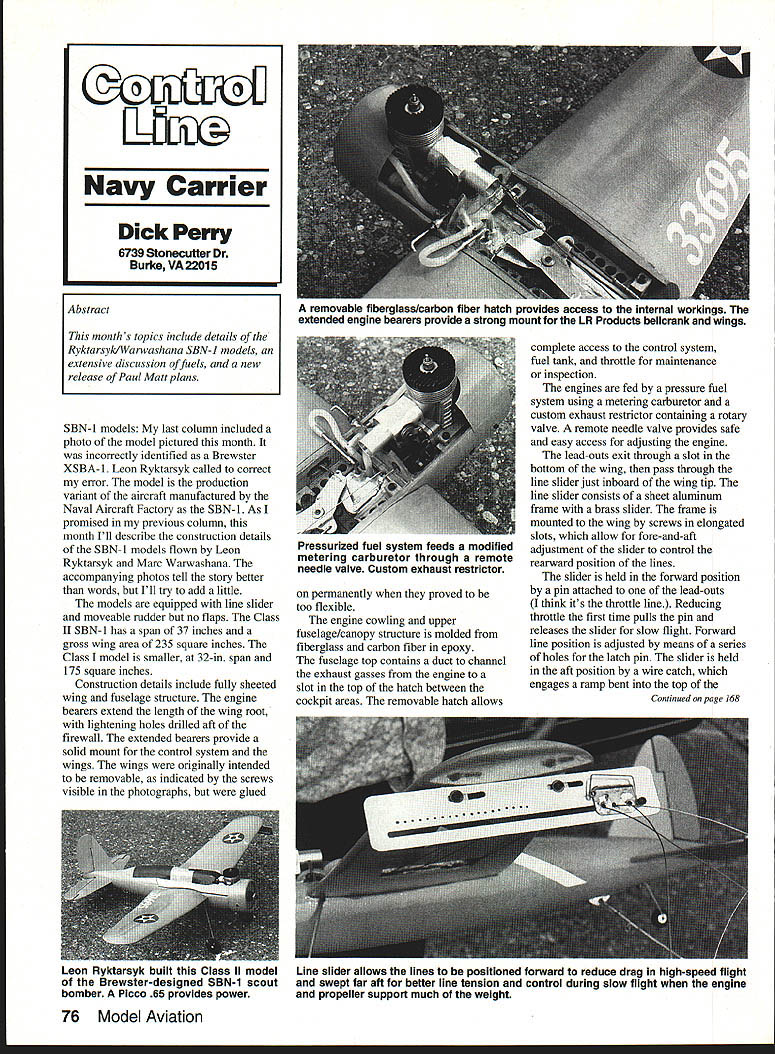
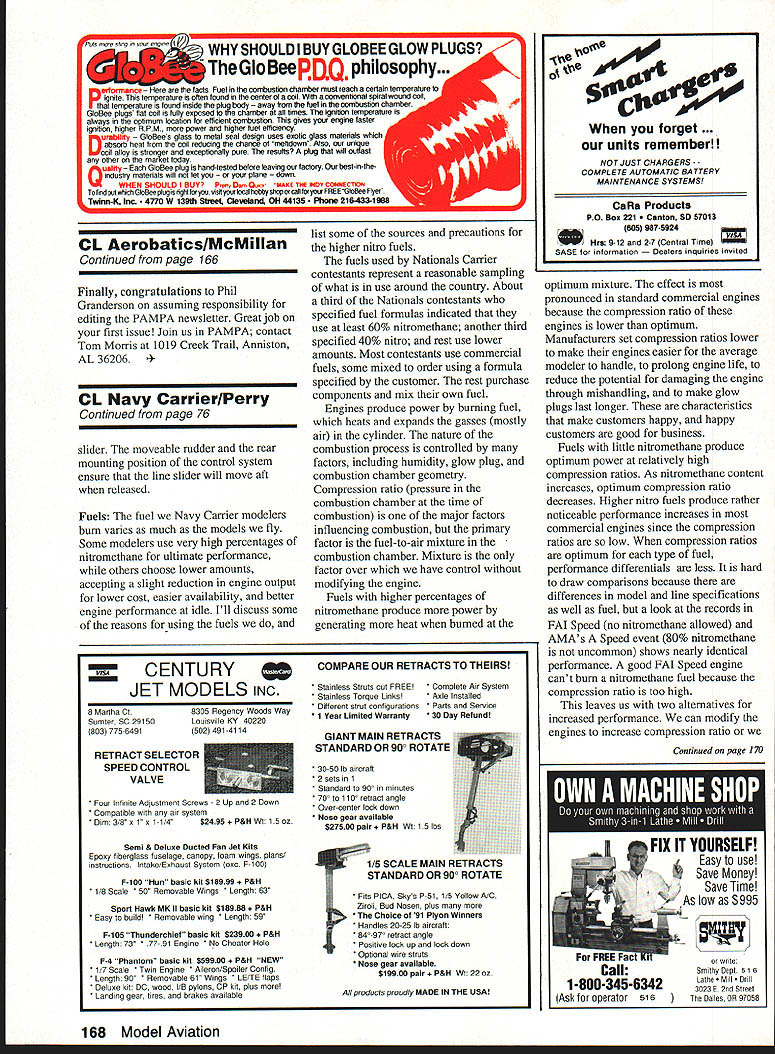
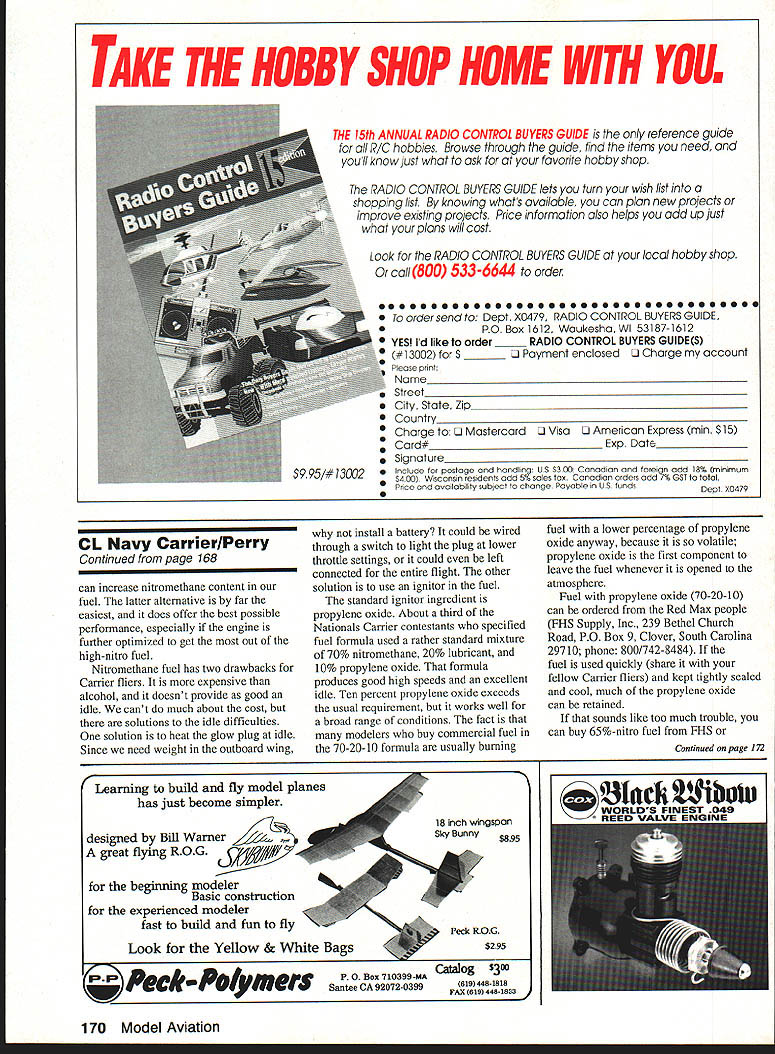
My last column included a photo of the model pictured this month. It was incorrectly identified as a Brewster XSBA-1. Leon Ryktarsyk called to correct my error: the model is the production variant manufactured by the Naval Aircraft Factory as the SBN-1. As I promised in my previous column, this month I'll describe the construction details of the SBN-1 models flown by Leon Ryktarsyk and Marc Warwashana. The accompanying photos tell the story better than words, but I'll add a few details.
- The models are equipped with a line slider and a moveable rudder but no flaps.
- The Class II SBN-1 has a span of 37 inches and a gross wing area of 235 square inches.
- The Class I model is smaller, at 32 inches span and 175 square inches.
Construction details include fully sheeted wing and fuselage structure. The engine bearers extend the length of the wing root, with lightening holes drilled aft of the firewall. The extended bearers provide a solid mount for the control system and the wings. The wings were originally intended to be removable, as indicated by the screws visible in the photographs, but were glued on permanently when they proved to be too flexible.
The engine cowling and upper fuselage/canopy structure are molded from fiberglass and carbon fiber in epoxy. The fuselage top contains a duct to channel the exhaust gases from the engine to a slot in the top of the hatch between the cockpit areas. The removable hatch allows complete access to the control system, fuel tank, and throttle for maintenance or inspection.
The engines are fed by a pressure fuel system using a metering carburetor and a custom exhaust restrictor containing a rotary valve. A remote needle valve provides safe and easy access for adjusting the engine.
Control system and line slider
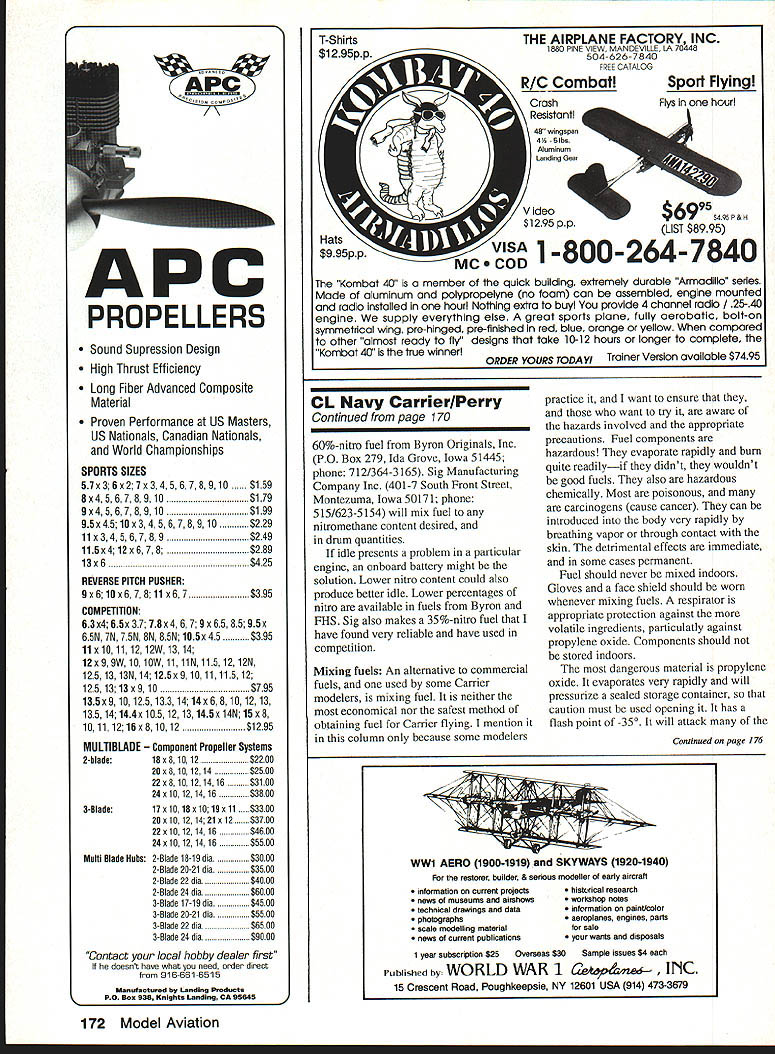
The lead-outs exit through a slot in the bottom of the wing, then pass through the line slider just inboard of the wing tip. The line slider consists of a sheet-aluminum frame with a brass slider. The frame is mounted to the wing by screws in elongated slots, which allow fore-and-aft adjustment of the slider to control the rearward position of the lines.
The slider is held in the forward position by a pin attached to one of the lead-outs (probably the throttle line). Reducing throttle the first time pulls the pin and releases the slider for slow flight. Forward line position is adjusted by means of a series of holes for the latch pin. The slider is held in the aft position by a wire catch, which engages a ramp bent into the top of the slider. The moveable rudder and the rear mounting position of the control system ensure that the line slider will move aft when released.
Fuels
The fuel used by Navy Carrier modelers varies widely. Some modelers use very high percentages of nitromethane for ultimate performance, while others choose lower amounts, accepting a slight reduction in engine output for lower cost, easier availability, and better engine performance at idle. Below are some observations, usage patterns, and precautions.
Fuel usage at Nationals Carrier events (contestants who specified fuel formulas) roughly falls into:
- About one-third use at least 60% nitromethane.
- Another third use about 40% nitromethane.
- The remainder use lower nitro percentages.
Most contestants use commercial fuels, some mixed to order using a formula specified by the customer; others purchase components and mix their own fuels.
Engines produce power by burning fuel, which heats and expands the gases (mostly air) in the cylinder. Combustion is controlled by many factors — humidity, glow plug, combustion-chamber geometry, and compression ratio. Compression ratio (pressure in the combustion chamber at the time of combustion) is a major influence, but the primary factor we can control without modifying the engine is the fuel-to-air mixture.
Fuels with higher percentages of nitromethane produce more power by generating more heat when burned at the optimum mixture. The effect is most pronounced in standard commercial engines because their compression ratios are lower than optimum. Manufacturers set compression ratios lower to make engines easier to handle, prolong engine life, reduce the potential for damage from mishandling, and make glow plugs last longer.
As nitromethane content increases, the optimum compression ratio decreases. Higher-nitro fuels produce noticeable performance increases in many commercial engines because those engines run at relatively low compression. When engines are optimized for each fuel (i.e., compression ratio matched to the fuel), performance differentials are reduced. For example, FAI Speed (no nitromethane allowed) and AMA A Speed (where 80% nitro is not uncommon) show nearly identical performance when engines are optimized for their rules: FAI engines are tuned for rpm rather than torque, so they can't benefit from nitromethane.
This leaves two alternatives for increased performance:
- Modify engines to increase compression ratio (install a higher-compression head, use sub-piston induction, or other mods).
- Increase nitromethane content in the fuel so the engine develops more torque at the existing compression.
The latter alternative (increase nitromethane) is by far the easiest and often offers the best immediate performance, especially if the engine is further optimized to get the most from the high-nitro fuel.
Nitromethane fuel has two drawbacks for Carrier fliers: it is more expensive than alcohol, and it doesn't provide as good an idle. There are solutions for idle difficulties. One is to heat the glow plug at idle — install an onboard battery (useful also because you might want weight in the outboard wing). Wire it through a switch to heat the plug at low throttle, or leave it connected for the entire flight. The other solution is to use an ignitor in the fuel.
The standard ignitor ingredient is propylene oxide. About a third of the Nationals Carrier contestants who specified fuel formulas used a common mixture of 70% nitromethane, 20% lubricant, and 10% propylene oxide. That formula produces high speed and an excellent idle. Ten percent propylene oxide exceeds the usual requirement, but it works well across a broad range of conditions. Because propylene oxide is very volatile, many commercial 70-20-10 fuels actually contain less propylene oxide than labeled once opened.
Vendors and fuel options:
- FHS Supply (Red Max): 70-20-10 fuel available. Address: FHS Supply, Inc., 239 Bethel Church Road, P.O. Box 9, Clover, SC 29710. Phone: 800-742-8484.
- FHS also offers 65%-nitro fuel.
- Byron Originals, Inc.: offers 60%-nitro fuel. Address: P.O. Box 279, Ida Grove, IA 51445. Phone: 712-364-3165.
- Sig Manufacturing Company Inc.: will mix fuel to any nitromethane content desired, even in drum quantities. Address: 4017 South Front Street, Montezuma, IA 50171. Phone: 515-623-5144.
- Sig also makes a 35%-nitro fuel I have found reliable for competition.
If idle is a problem in a particular engine, an onboard battery or lower nitro content might solve it. Lower-nitro fuels are available from Byron and FHS.
Mixing fuels — hazards and precautions
Some Carrier modelers mix their own fuel. This is neither the most economical nor the safest method. Fuel components are hazardous: they evaporate rapidly, burn readily, and many are chemically hazardous or carcinogenic. Vapors can be inhaled and components absorbed through the skin. Effects can be immediate or long-term.
Precautions:
- Never mix fuel indoors.
- Wear gloves and a face shield when mixing fuels.
- Use a respirator against volatile ingredients, especially propylene oxide.
- Do not store fuel components indoors.
Propylene oxide is the most dangerous component:
- It evaporates rapidly and will pressurize sealed containers; exercise caution when opening.
- Flash point: −35°F.
- It attacks many plastics used in airplane construction, fuel lines, and tank O-rings — avoid contact.
- Work with it only in very small amounts, in a well-ventilated area; keep it refrigerated and tightly sealed.
- It disappears faster than other constituents; do not store fuel containing propylene oxide for extended periods.
- Propylene oxide will attack seals used in standard containers and will destroy common plastic fuel containers in about a year.
- It is listed in government regulations as an immediate (acute) health hazard, delayed (chronic) health hazard, fire hazard, and reactive hazard. For these reasons, some manufacturers (Sig and Byron) do not use propylene oxide.
Pure nitromethane has its own hazards. The most serious is its tendency to become unstable. Nitromethane manufactured in the United States must contain a yellow indicator dye; if the dye turns blue, the nitromethane is shock sensitive and very dangerous. Mixing nitromethane with alcohol keeps it stable, but that defeats the purpose when mixing to a high-nitro formula.
Suppliers of components:
- Sig, FHS, and Klotz Special Formula Products, Inc. supply fuel ingredients and components.
- Klotz Special Formula Products, Inc.: P.O. Box 11343, Fort Wayne, IN 46857. Phone: 800-242-0489.
- Propylene oxide is available from FHS and Klotz; Klotz distributes it in 16-oz screw-top metal containers — a relatively safer storage method.
Lubricants:
- Castor oil offers excellent protection but does not mix with nitromethane.
- For nitro percentages above about 40%, synthetic oil must be used for at least part of the lubricant. A commonly accepted ratio is 80% synthetic to 20% castor.
- Byron Originals uses this blend, and Klotz offers a similar product in its KL-100 Super Techniplate line.
- In 70-20-10 fuel, propylene oxide serves as the solvent for the castor oil.
Final caution: handle fuel and fuel ingredients carefully, store them safely, and follow safety precautions — especially with propylene oxide.
Paul Matt's aircraft drawings
I recently received a two-volume set of Paul Matt's Scale Airplane Drawings from SunShine House, Inc. (806 Lockport Road, Terre Haute, IN 47802; phone: 800-999-0141). These books collect Paul Matt's aircraft drawings; each volume contains over 60 aircraft depicted in three or more views on multiple plates. The set is organized by manufacturer: Volume 1 covers Aeromarine through Grumman; Volume 2 covers the rest of the alphabet.
There are many drawings of potential Navy Carrier models, including prototypes that never reached production and rarities such as the Boeing XF7B-1. The books are well done and interesting to browse even if you are not planning a model.
The 8.5 x 11-inch paperback books are priced at $24.95 each; you may want to purchase them as a club reference or encourage your local library to acquire the set. Drawings are available separately from the publisher at twice the size of those in the books; SunShine House will likely supply a list if you send a stamped, self-addressed envelope.
Transcribed from original scans by AI. Minor OCR errors may remain.

