
CONTROL LINE
NAVY CARRIER
Dick Perry 6739 Stonecutter Dr. Burke, VA 22015
Abstract: This month's column includes information about another Grumman Guardian on display and a detailed description and test data for the Webra Speed .32 ABCD engine.
Guardian on display
Since writing in my last column about the AF-2S Grumman Guardian on display at the Pima Air Museum, I've learned of another one. The Naval Aviation Museum at Pensacola Naval Air Station, Florida, has a Guardian with original Navy colors (dark blue), markings, and configuration. The Naval Aviation Museum is without a doubt the largest collection of aircraft and other artifacts dedicated to preserving the history of U.S. naval aviation.
Although I have not yet been fortunate enough to visit it myself, the photographs and descriptions I have seen indicate that the Naval Aviation Museum is an outstanding facility with plenty of room for viewing the aircraft on display. It would be well worth taking the time for a visit if you are ever in the vicinity.
Webra Speed .32 evaluation
As I promised in my last column, here are further details on the Webra Speed .32 RC ABCD engine imported by Hobby Dynamics (4105 Fieldstone Rd., Champaign, IL 61821-8801).
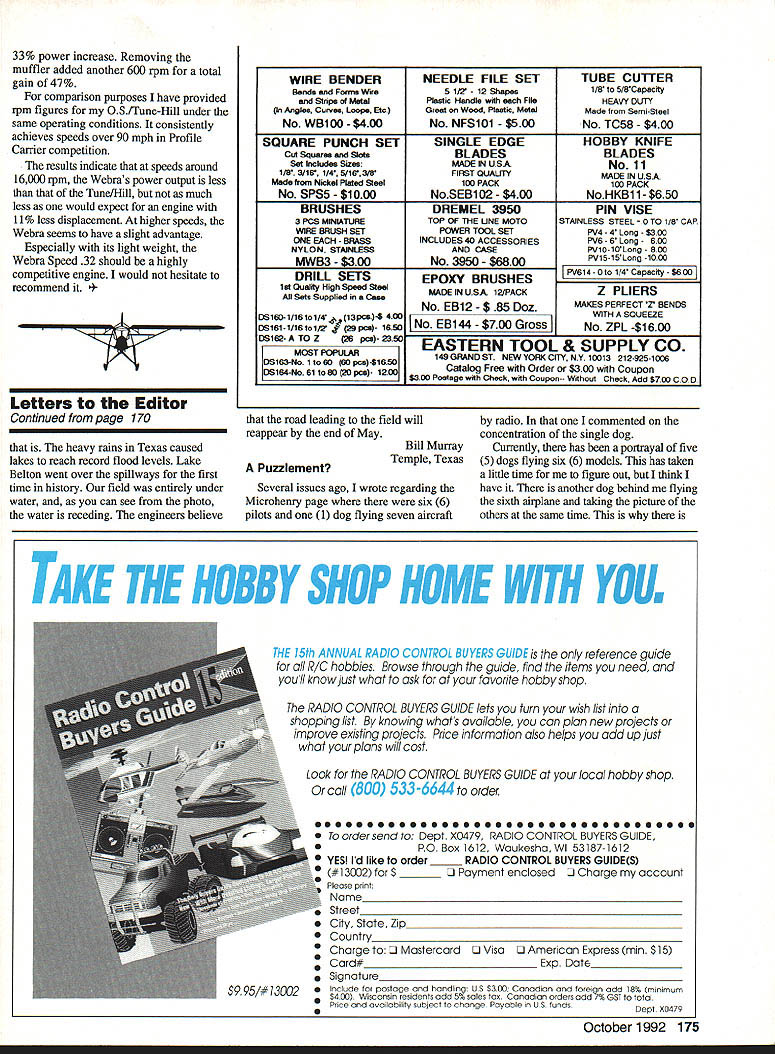
The engine is a Schnuerle configuration with a boost port—the standard configuration for most modern engines. It is a front-intake type with two ball bearings on the crankshaft. The Webra .32 is legal for the Profile Carrier event—the reason I'm writing about it in this column. The ABCD designation refers to the aluminum piston running in a brass sleeve that has been chrome plated. The piston is fitted with a Dykes ring, to complete the string of letters.
The engine is available with two carburetor options. The TN carburetor is a standard rotary-barrel carb with a spraybar and adjustable idle mixture. It is the type of carb with which we are all familiar. The Dynamix carburetor is a slide-valve type without a spraybar.
The .32 is built in Webra's .28 case with the .28's bore dimension (18.5 mm, .728 in.). The stroke is increased to 19.5 mm (.776 in.) to provide a displacement of .323 cu. in. While this is 11% below the allowable displacement limit for Profile Carrier (.36 cu. in.), the Webra has a couple of advantages.
The Webra Speed .32's greatest advantage is availability. That can't be said for the often-preferred powerplants in Profile Carrier—the O.S./Tune-Hill .36 and the K&B .58.
Its second advantage is its weight. Because of the small case from which it is derived, the engine (not including the carburetor) weighs only 7.5 ounces. The TN carb brings the weight to 8.7 ounces; the Dynamix, to 9.2 ounces. The difference between the Webra .32 and either the O.S./Tune-Hill or the K&B is at least three ounces.
With a few exceptions, construction of the Webra is conventional. The backplate seal is accomplished with an O-ring that fits inside the crankcase bore. Thus the seal is effective even if the screws are loose. In fact, all but one of the screws could be missing without affecting the engine. To accommodate the increased stroke, a channel cut into the wall of the crankcase removes about half the normal thickness of the case to clear the bottom of the connecting rod.
The other less conventional feature is the flush head. While most of us are familiar with cylinder heads that protrude into the cylinder bore, the head on the Webra Speed .32 sits on top of the cylinder liner and does not extend into the liner at all. The top of the piston reaches the top of the liner, and the combustion chamber is machined as a depression in the head. The head is secured by four socket-head screws and accepts a standard long-reach glow plug. The combustion chamber consists of a 3 mm canted squish band surrounding a 12.5 mm-diameter hemisphere.
The crankshaft on the Webra Speed .32 is small compared to the .40 engines from which most of the current class of .36s are derived. The smaller shaft is part of the weight savings, and the 8 mm gas passage seems to be quite adequate. The crankshaft runs in an unshielded 10-ball bearing with a steel retainer at the rear and an unshielded eight-ball bearing with a brass retainer at the front.
The thrust washer is secured by a shallow-taper brass collet, and the propeller shaft is a standard 1/4-28 thread. The thrust washer is a close fit to the case and should provide adequate protection for the front bearing. The case has an oil hole drilled from the intake to the front bearing to ensure adequate lubrication.
The connecting rod is bronze-bushed with two oil holes at the lower end. The wristpin is 4.5 mm in diameter, and the crankpin is 5 mm. The wristpin is secured by wire clips.
The piston is relieved around the base to allow free gas passage to the bypasses. A small skirt covers the exhaust port when the piston is at the top of the stroke. The Dykes ring is pinned so that it will not rotate; the ring gap is centered on the boost-port. A small bridge in the exhaust port controls the ring when the exhaust port is closed.
The carburetor shown in the photograph—and the one I tested—is the Dynamix carb. The Dynamix is a slide-valve carb with a circular throat unobstructed by a spraybar. Mixture is controlled by means of a sliding tube with a tapered slot that acts as a fuel meter. The sliding tube is constructed to reduce the volume of the fuel passage between the carb throat and the needle valve as the throttle is opened. Thus, if the throttle is opened rapidly—a condition that can cause engines with conventional carbs to temporarily run very lean—the metering valve acts as a pump to force a little extra fuel into the throat to assist with acceleration. The throat diameter of 6.5 mm (.256 in.) yields a choke area of 33 sq. mm.
Because of the large throat area, the operating instructions for the Dynamix carb recommend using a pressurized fuel system, but the throat area is identical to that of the O.S. 4B and 4D carbs used on the O.S. .40-.46 engines. With proper tank setup, there should be no problem with the Dynamix carb on the suction fuel system required by Profile Carrier rules.
During testing I found the Dynamix carb to be a little sensitive to fuel head, but I was able to enrich the mixture adequately on FAI fuel to produce a very rich mixture. Idle was good, and transition from a rich idle was good, but the midrange was slightly lean—probably to avoid flooding with a pressurized fuel system. The Dynamix carb is designed for R/C use, and there is no idle stop. For Carrier operation on a suction fuel system, the TN carb would be more familiar to most modelers and a little easier to operate. The TN is also lighter.
The engine was run on FAI fuel for break-in using the muffler supplied with the engine. The muffler is effective and causes little power loss—especially at speeds below 16,000 rpm. All testing was accomplished with a Fox RC long glow plug. Conditions approximated sea level standard (59°F).
WEBRA SPEED .32 SPECIFICATIONS
- Displacement: 0.323 cu. in.
- Bore: .728 in. (18.5 mm)
- Stroke: .776 in. (19.5 mm)
- Intake open (ABDC): 40°
- Intake close (ATDC): 58°
- Bypass period: 120°
- Boost port period: 111°
- Exhaust period: 152°
- Combustion chamber volume: 4.5 cc
- Compression ratio: 8.3:1
Weight:
- Engine (no carb): 7.5 oz.
- With TN carb: 8.7 oz.
- With Dynamix carb: 9.2 oz.
Mounting dimensions:
- Case width: 32 mm / 1.26 in.
- Bolt spacing: 15 mm / .591 in.
- Bolt width: 38 mm / 1.50 in.
PERFORMANCE COMPARISON
(70% nitromethane fuel)
- Props and RPM (Webra Speed .32 vs. O.S. Tune/Hill)
- APC 9 x 7.5: Webra 15,400 rpm — O.S./Tune-Hill 15,800 rpm
- APC 9 x 7: Webra 16,300 rpm — O.S./Tune-Hill 16,800 rpm
- APC 8 x 7: Webra 18,300 rpm — O.S./Tune-Hill 18,000 rpm
I used fuels and props representative of competition for testing. Fuel was 70% nitromethane, 15% Klotz, 5% castor oil, and 10% propylene oxide. Props were APC 9 x 7 and APC 9 x 7.5, with an APC 8 x 7 to simulate flight loading and engine response. At the end of the break-in period, the Webra turned an APC 8 x 7 prop at 16,100 rpm on FAI fuel with the muffler. Switching to 70% nitro yielded 17,700 rpm on the APC 8 x 7, a 33% power increase. Removing the muffler added another 600 rpm for a total gain of 47%.
For comparison purposes I have provided rpm figures for my O.S./Tune-Hill under the same operating conditions. It consistently achieves speeds over 90 mph in Profile Carrier competition.
The results indicate that at speeds around 16,000 rpm, the Webra's power output is less than that of the Tune/Hill, but not as much less as one would expect for an engine with 11% less displacement. At higher speeds, the Webra seems to have a slight advantage. Especially with its light weight, the Webra Speed .32 should be a highly competitive engine. I would not hesitate to recommend it.
Transcribed from original scans by AI. Minor OCR errors may remain.

