
CONTROL LINE: Navy Carrier-Scale
Richard L. Perry
THE CL SCALE event was, as usual, one of the big crowd pleasers at the NATS, drawing a large number of spectators on Thursday afternoon. The Scale judging cage drew on-lookers throughout the week and helped generate interest in the flying end of the competition.
There were a total of 12 aircraft submitted for static judging: three in Junior, four in Senior, and five in the Open age category. Most of the names were familiar, many of the modelers having competed in previous NATS. Last year's winner, Ernie Violett, brought out his beautiful DeHavilland Comet 88 once again. The three members of the 1974 CL Scale team (Mike Gretz, Bill Harney, and Mike Stott) were also there, with Ralph Burnstine filling out the ranks and making the fifth Open contestant.
With the Scale World Championships scheduled for Bremen, Germany, next summer, the competition was particularly exciting. All five Open contestants were trying for a spot on the team, with only the top three to be selected. At the completion of the static judging only 19 points separated the top four scores, Ernie Violett's Comet leading with 427 points out of a possible 450. With such close static scores, the flight judging was to play an important part in the final outcome.
Flying was scheduled to begin at noon on Thursday. A higher than normal probability of rain was forecast, but the skies were not threatening. In fact, the sun had been shining brightly through scattered clouds for most of the morning, and the temperature, particularly on the huge concrete parking ramp which used to hold the full-scale aircraft of Chennault Airbase, was rising and becoming rather uncomfortable. Even the 5-mph wind didn't help the comfort level as the temperature rose. The temperature and wind were to cause a few problems as well-concealed engines overheated and lost power, causing some models to lose altitude on the downwind side of the circle.
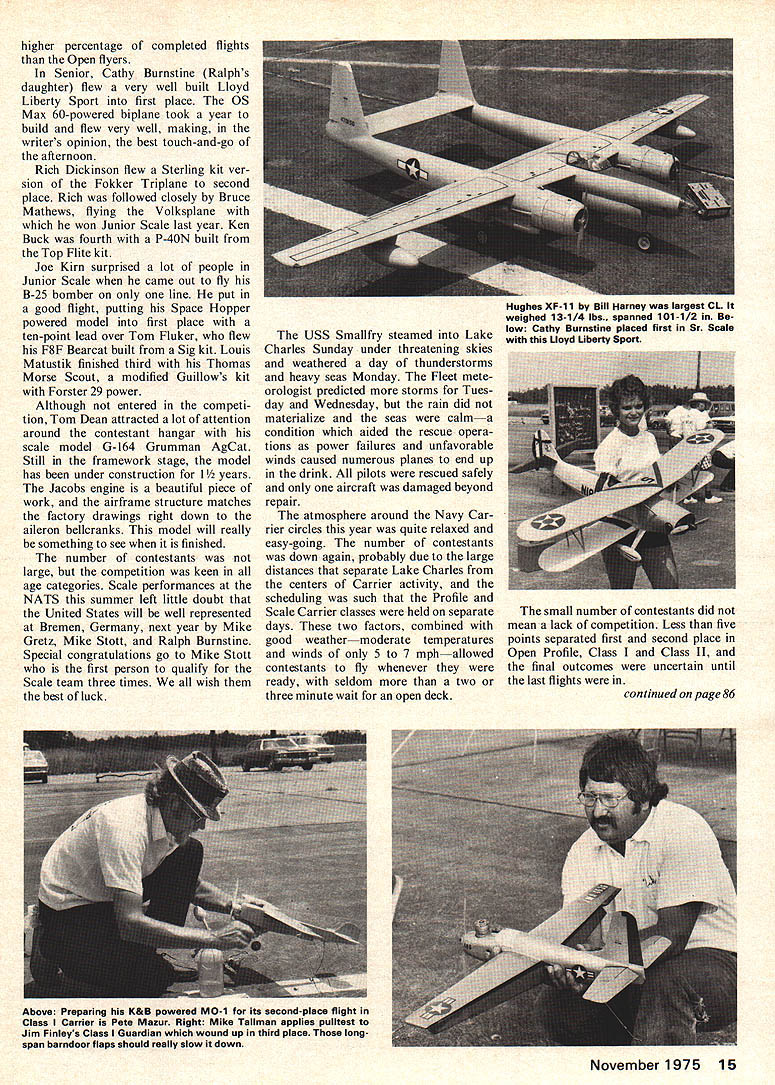
Mike Gretz was the first one up in Open Scale, flying the Zlin Akrobat 526A that he flew at the 1974 Scale World Championship. Mike used a digital controller developed by Mike Stott to retract the gear and flaps and operate the throttle. In addition to gear and flap operation, Mike flew the Zlin through a wingover and used the throttle for touch-and-go and taxi demonstrations, ending the flight with engine shut-off for a flight score of 134. With a static score of 421, Mike's total of 555 set a high target for the others to try.
Ernie Violett's red DeHavilland Comet was next to fly. The Comet took three years to research and two more years to build. It is a credit to the skill of its builder — as verified by its high static score. The Comet was bothered a little by the wind, but the flight was completed quite successfully, only to be declared an attempt because Ernie had forgotten to put on his safety thong. On the second attempt the engines would not start, and the third attempt resulted in a premature landing as one engine failed on take-off. None of the attempts officially covered the five laps necessary for qualification, so Ernie had to accept a zero score which was far short of his Comet's potential.
The white Meyers 145 flown by Mike Stott was also having trouble as the engine lost power shortly after take-off, causing a gear-up landing prior to the fifth lap. Fortunately the model was not damaged beyond some scraped paint and went on to make the second highest flight score of the afternoon. The electronic control system for gear, flaps, and throttle helped complete a very realistic flight for a score of 540 which put Mike in second place.
The twin engines, sleek appearance, and large size (101" span) made Bill Harney's Hughes XF-11 a real crowd pleaser. Everyone was anxiously awaiting its flight as Bill cranked up the twin HP 40's; but, unfortunately, electrical difficulties, probably caused by the heat, had drained the batteries of the electronic control unit, and the flight could not be made in that condition. Because the faulty circuit could not be identified on the field, the XF-11 with Howard Hughes seated at the controls had to fly without the benefit of its operating gear, flaps, spoilers, cowl flaps, landing lights, or droppable fuel tanks. The flight score of 98 gave a total score of 446.
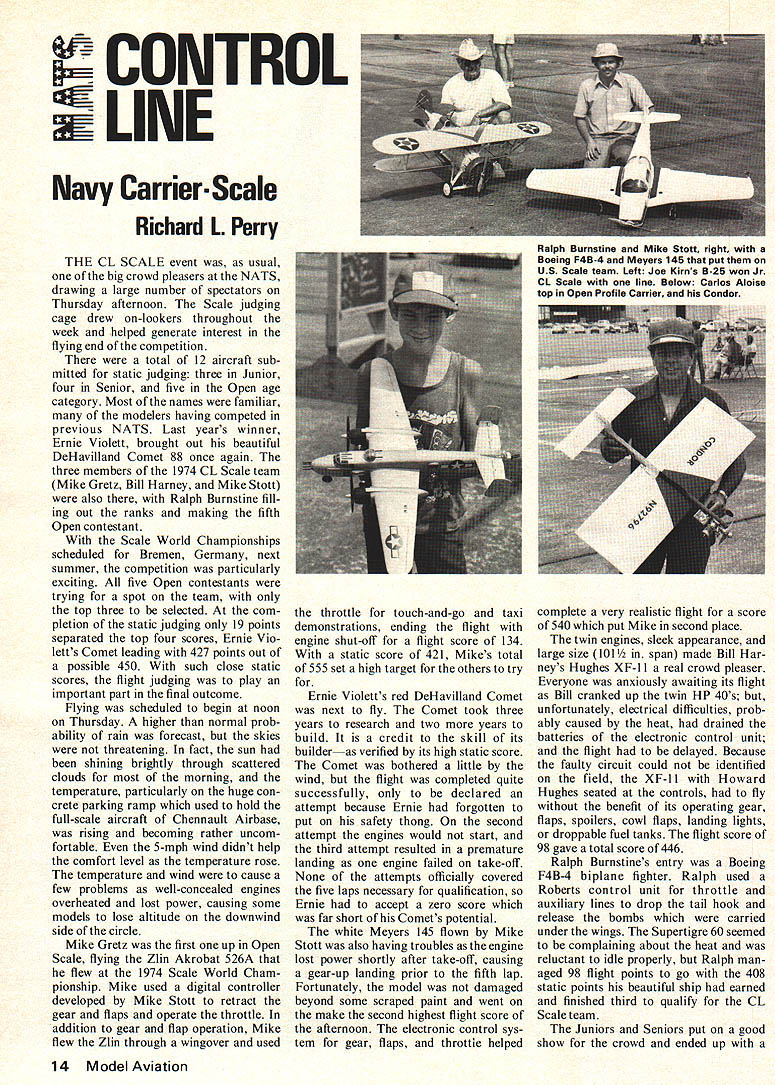
Ralph Burnstine's entry was a Boeing F4B-4 biplane fighter. Ralph used a Roberts control unit for throttle and auxiliary lines to drop the tail hook and release the bombs which were carried under the wings. The Supertigre 60 seemed reluctant to idle properly, but Ralph managed 98 flight points to go with 310 static points; his beautiful ship earned him third place and qualified him for the CL Scale team.
The Juniors and Seniors put on a good show for the crowd and ended up with a higher percentage of completed flights than the Open flyers.
In Senior, Cathy Burnstine (Ralph's daughter) flew a very well built Lloyd Liberty Sport into first place. The OS Max 60-powered biplane took a year to build and flew very well, making, in the writer's opinion, the best touch-and-go of the afternoon.
Rich Dickinson flew a Sterling kit version of the Fokker Triplane to second place. Rich was followed closely by Bruce Mathews, flying the Volksplane with which he won Junior Scale last year. Ken Buck was fourth with a P-40N built from the Top Flite kit.
Joe Kim surprised a lot of people in Junior Scale when he came out to fly his B-25 bomber on only one line. He put in a good flight, putting his Space Hopper-powered model into first place with a ten-point lead over Tom Fluker, who flew his F8F Bearcat built from a Sig kit. Louis Matusik finished third with his Thomas Morse Scout, a modified Guillows kit with Forster 29 power.
Although not entered in the competition, Tom Dean attracted a lot of attention around the contestant hangar with his scale model G-164 Grumman AgCat. Still in the framework stage, the model has been under construction for 1 1/2 years. The Jacobs engine is a beautiful piece of work, and the airframe structure matches the factory drawings right down to the aileron bellcranks. This model will really be something to see when it is finished.
The number of contestants was not large, but the competition was keen in all age categories. Scale performances at the NATS this summer left little doubt that the United States will be well represented at Bremen, Germany, next year by Mike Gretz, Mike Stott, and Ralph Burnstine. Special congratulations go to Mike Stott who is the first person to qualify for the Scale team three times. We all wish them the best of luck.
The USS Smallfry steamed into Lake Charles Sunday under threatening skies and weathered a day of thunderstorms and heavy seas Monday. The Fleet meteorologist predicted more storms for Tuesday and Wednesday, but the rain did not materialize and the seas were calm—a condition which aided the rescue operations as power failures and unfavorable winds caused numerous planes to end up in the drink. All pilots were rescued safely and only one aircraft was damaged beyond repair.
The atmosphere around the Navy Carrier circles this year was quite relaxed and easy-going. The number of contestants was down again, probably due to the large distances that separate Lake Charles from the centers of Carrier activity, and the scheduling was such that the Profile and Scale Carrier classes were held on separate days. These two factors, combined with good weather—moderate temperatures and winds of only 5 to 7 mph—allowed contestants to fly whenever they were ready, with seldom more than a two or three minute wait for an open deck.
The small number of contestants did not mean a lack of competition. Less than five points separated first and second place in Open Profile, Class I and Class II, and the final outcomes were uncertain until the last flights were in.
Control Line: Navy Carrier-Scale
Richard L. Perry
THE CL SCALE event usually drew big crowd pleasers at the NATS, drawing a large number of spectators. Thursday afternoon the scale judging cage drew onlookers throughout the week and helped generate interest at the flying end of the competition. A total of 12 aircraft submitted to static judging — three Junior, four Senior, five Open. Most names were familiar to modelers having competed at previous NATS. Last year's winner Ernie Violett brought out his beautiful DeHavilland Comet 88 once again. Three members of the 1974 CL Scale team — Mike Gretz, Bill Harney and Mike Stott — and Ralph Burnstine filled out the ranks, making five Open contestants. The Scale World Championships, scheduled at Bremen, Germany next summer, made the competition particularly exciting, five Open contestants trying for a spot on the team; the top three were selected on completion of static judging. Nineteen points separated the top four scores, Ernie Violett's Comet leading with 427 points out of a possible 450. With such close static scores, flight judging would play an important part in the final outcome.
Flying was scheduled to begin at noon Thursday due to the higher-than-normal probability of rain forecast; the skies were threatening. In fact, the sun was shining brightly through scattered clouds that morning and the temperature, particularly on the huge concrete parking ramp used to hold full-scale aircraft at Chennault Airbase, was rising and becoming rather uncomfortable. A 5-mph wind didn't help the comfort level. As the temperature rose the wind caused a few problems; some well-concealed engines overheated and lost power, causing some models to lose altitude on the downwind side of the circle.
Mike Gretz was first up in Open Scale, flying a Zlin Akrobat 526A which he had flown in the 1974 Scale World Championship. Mike used a digital controller developed by Mike Stott to operate the retract gear, flaps and throttle. In addition to gear and flap operation, Mike flew the Zlin through a wingover, used throttle touch-and-go taxi demonstrations and ended the flight with an engine shut-off. Flight score 134, static score 421 — Mike's total of 555 set a high target for others to try.
Ernie Violett's red DeHavilland Comet was next to fly. The Comet took three years of research and two years to build; credit for the skill of its builder was verified by its high static score. The Comet was bothered little by the wind and the flight was completed quite successfully on what Ernie declared the first attempt because Ernie had forgotten to put the safety thong on. On the second attempt the engines would not start. The third attempt resulted in a premature landing when an engine failed at take-off. None of the attempts officially covered the five laps necessary for qualification and Ernie accepted a zero score, far short of the Comet's potential.
The white Meyers 145 flown by Mike Stott also had troubles. An engine lost power shortly after take-off, causing a gear-up landing prior to the fifth lap. Fortunately the model was not damaged beyond some scraped paint and went on to make the second-highest flight score of the afternoon. The electronic control system for gear, flaps and throttle helped complete a very realistic flight; score 540 put Mike in second place.
The twin-engined, sleek appearance and large size (101" span) of Bill Harney's Hughes XF-11 made it a real crowd pleaser. Everyone anxiously awaited its flight. Bill cranked up twin .40s; unfortunately electrical difficulties — probably caused by heat — drained the batteries in the electronic control unit and the flight was delayed. Because the faulty circuit could not be identified in the field, the XF-11 did not perform. The model featured operating gear, flaps, spoilers, cowl flaps, landing lights and droppable fuel tanks. Its flight score of 98 gave a total of 446.
Ralph Burnstine's entry, a Boeing F4B-4 biplane fighter, used a Roberts control unit for throttle and auxiliary lines to drop the tail hook and release bombs carried under the wings. A Super Tigre 60 seemed to be complaining about the heat and was reluctant to idle properly. Ralph managed 98 flight points to go with 310 static points; the beautiful ship earned 408 and finished third to qualify for the CL Scale team.
Transcribed from original scans by AI. Minor OCR errors may remain.

