
CONTROL LINE PRECISION AEROBATICS
Frank McMillan, 12106 Gunter Grove, San Antonio TX 78231
Event overview
The sign at the front gate boldly read "71st National Model Airplane Championships," which set off a series of Nats memories and a great sense of anticipation. How would this edition be? It didn't take long to get the answer during the Control Line Aerobatics competition, held Monday, July 14 to Saturday, July 19. It was to be a very hot Nats in more ways than one!
Bene Rodrigues, a longtime international competitor from Brazil, was there early working to get his setup tuned to the site.
International competitors
Led by international competitor and former U.S. resident Kaz Minato, the Japanese sent a strong, experienced team. In Open Precision Aerobatics, Masaru Hiki and Shoichiro Nosome placed eighth and ninth respectively to Kaz's strong seventh-place showing. Mitsuru Yokoyama also showed well at 14th. This was a highly competitive Nationals; five of the U.S.'s guests placed in the Top 20.
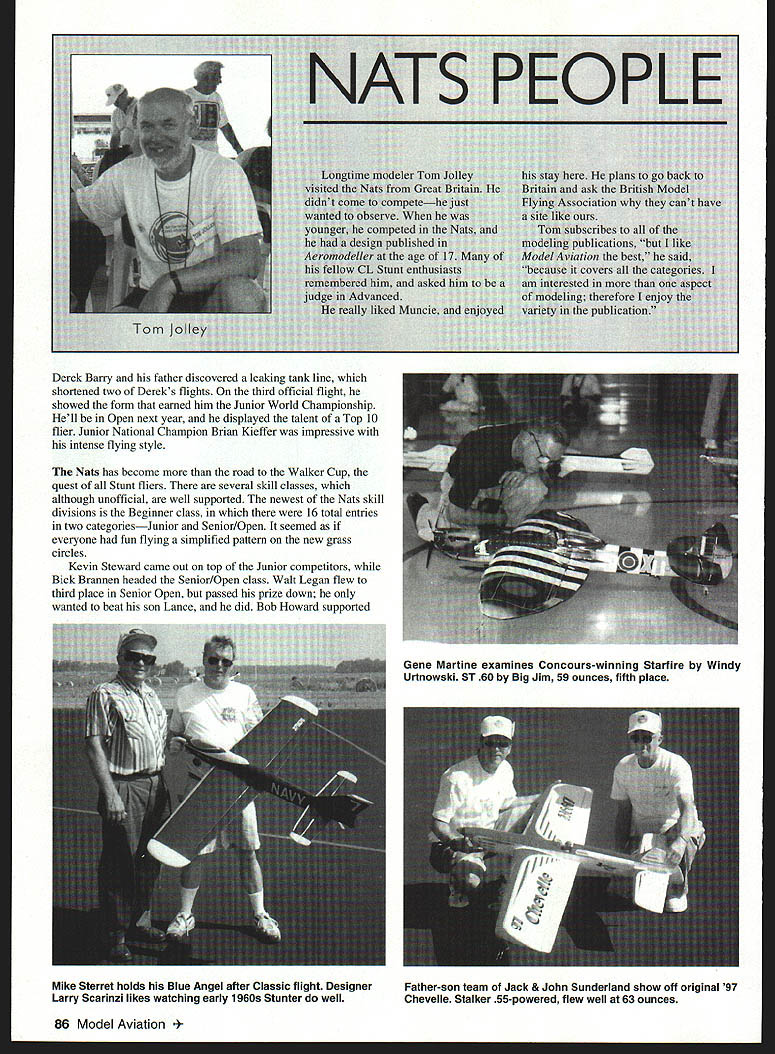
England's Tom Jolley, a veteran international competitor and judge, visited the Nats for the first time and served as a judge. Thanks for your insight, Tom.
Open Precision Aerobatics and the Walker Cup
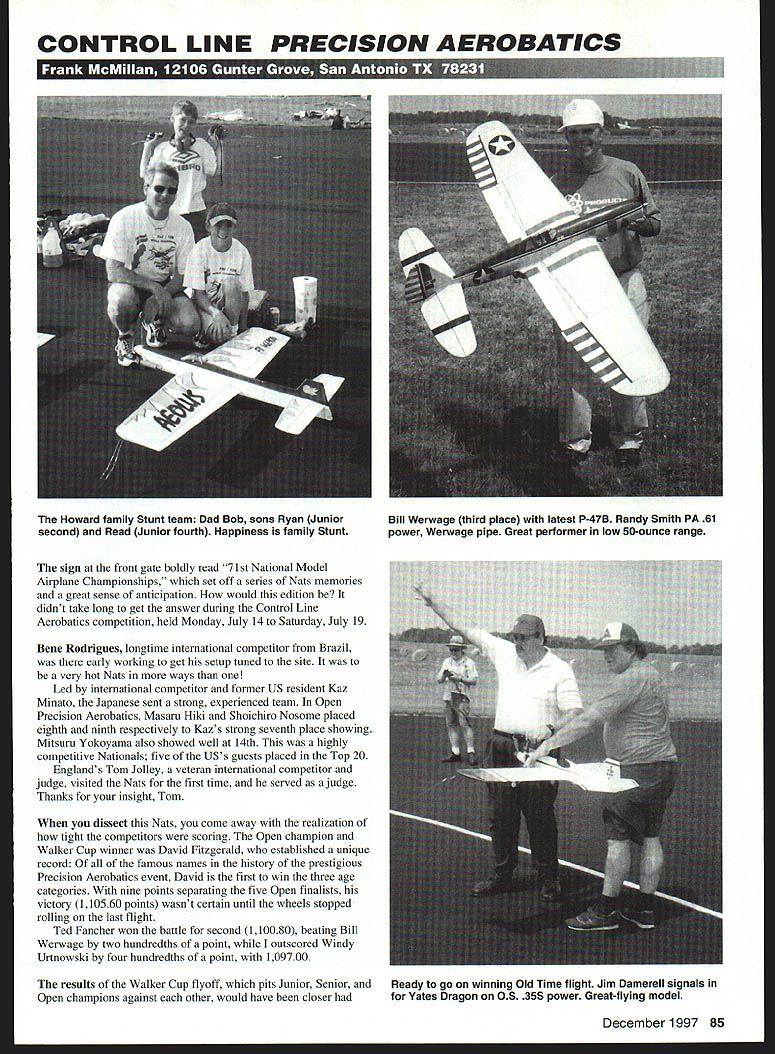
When you dissect this Nats, you come away with the realization of how tight the competitors were scoring. The Open champion and Walker Cup winner was David Fitzgerald, who established a unique record: of all the famous names in the history of the prestigious Precision Aerobatics event, David is the first to win the three age categories. With nine points separating the five Open finalists, his victory (1,105.60 points) wasn't certain until the wheels stopped rolling on the last flight.
Ted Fancher won the battle for second (1,100.80), beating Bill Werwage by two hundredths of a point. He outscored Windy Urtnowski by four hundredths of a point, with 1,097.00.
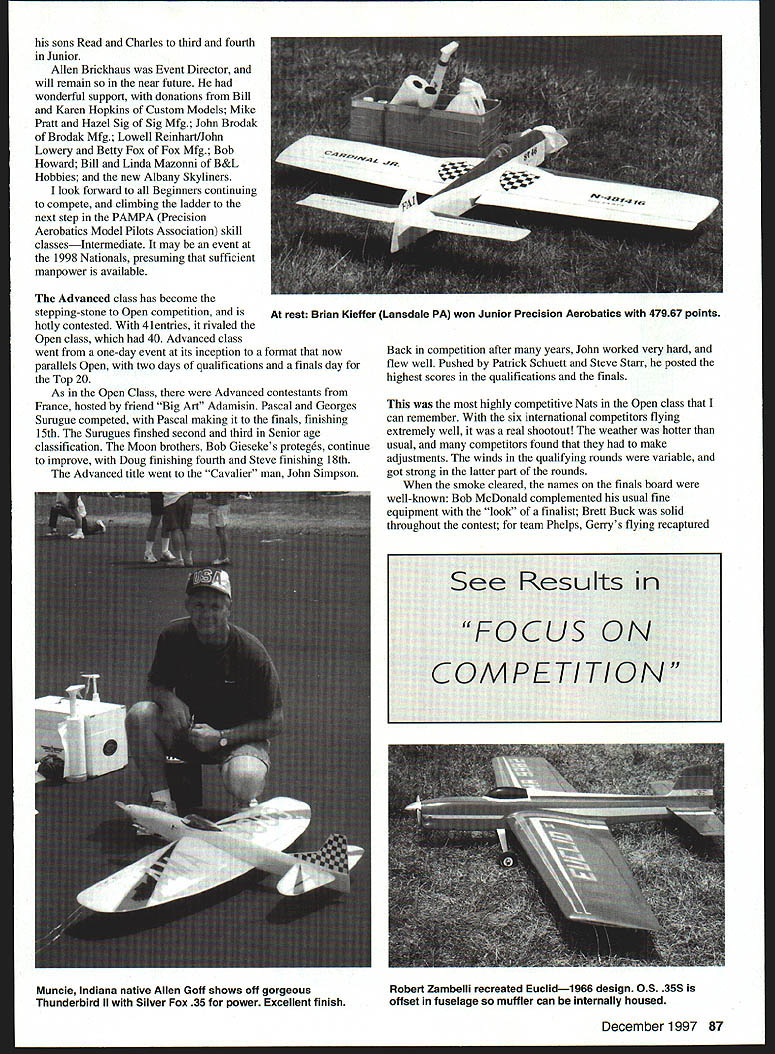
The Walker Cup flyoff, which pits Junior, Senior, and Open champions against each other, would have been closer had Derek Barry and his father not discovered a leaking tank line, which shortened two of Derek's flights. On the third official flight, he showed the form that earned him the Junior World Championship. He'll be in Open next year, and he displayed the talent of a Top 10 flier. Junior National Champion Brian Kieffer was impressive with his intense flying style.
Beginners and skill classes
The Nats has become more than the road to the Walker Cup—the quest of all stunt fliers. There are several skill classes, which, although unofficial, are well supported. The newest of the Nats skill divisions is the Beginner class, in which there were 16 total entries in two categories—Junior and Senior/Open. It seemed as if everyone had fun flying a simplified pattern on the new grass circles.
- Kevin Steward came out on top of the Junior competitors.
- Bick Brannen headed the Senior/Open class.
- Walt Legan flew to third place in Senior/Open but passed his prize down; he only wanted to beat his son Lance, and he did.
Bob Howard supported the event.
Wonderful support and donations came from:
- Bill and Karen Hopkins, Custom Models
- Mike Pratt, Hazel Sig; Sig Mfg
- John Brodak, Brodak Mfg
- Lowell Reinhart
- John Lowery
- Betty Fox, Fox Mfg
- Bob Howard
- Bill and Linda Mazonni, B&L Hobbies
- The Albany Skyliners
We look forward to Beginners continuing to compete and climbing the ladder to the next step.
PAMPA (Precision Aerobatics Model Pilots Association) skill classes may be part of the 1998 Nationals, presuming sufficient manpower is available.
Advanced class and Senior classification
The Advanced class has become a stepping-stone to Open competition. With 41 entries, the Advanced field rivaled the Open class's 40. The Advanced class began as a one-day event at its inception; the format now parallels Open with two days—qualifications and finals day, Top 20.
As Open-Class Advanced contestants, France hosted friends Big Art Adamisin and Pascal Georges Surugue. Pascal made the finals, finishing 15th. Surugue finished second.
In the Senior age classification, the Moon brothers, Bob Gieseke's proteges, continue to improve—Doug finishing fourth and Steve finishing 18th. The Advanced title went to the "Cavalier" man, John Simpson.
Back in competition after many years, John worked very hard and flew well. Pushed by Patrick Schuett and Steve Starr, he posted the highest scores in the qualifications and the finals.
Open-class finals
This was the most highly competitive Nats in the Open class that I can remember. With the six international competitors flying extremely well, it was a real shootout! The weather was hotter than usual, and many competitors found that they had to make adjustments. The winds in the qualifying rounds were variable and got strong in the latter part of the rounds.
When the smoke cleared, the names on the finals board were well-known:
- Bob McDonald complemented his usual fine equipment with the "look" of a finalist.
- Brett Buck was solid throughout the contest.
- For Team Phelps, Gerry's flying recaptured the form that made him an international team member in the early 1970s.
- The man on the bubble—the hardest position—was Bill Rich, a consistently outstanding flier with superb equipment.
- The three Japanese fliers—Minato, Hiki, and Nosome—followed closely.
- Flying his unique Bear, Bob Gieseke rounded out an awesome Top 10.
Old Time and Classic
Old Time and Classic events were part of a "fun day" for many. Jim Damerell was the Old Time winner, flying a Yates Dragon with an O.S. .35S. Bob Whitely was the clear winner in Classic, flying his Mako Shack .35, powered by an O.S. .40. This was Bob's third Classic win.
Jim Lynch returned to the Nats after a 20-year absence with a recreation of a Sheeks FW 190; he had some of the most perfect finish work I've seen. Unusual was the well-documented "Home Defense" color scheme—two-tone gray topped with red-and-white stripes on the bottom.
Concours and outstanding models
A custom at the Nats is awarding the Concours plaque to the outstanding airplanes in each event. In what has become almost routine, Windy Urtnowski's Seafire was selected by his peers as the outstanding Nats model—finish and detail were gorgeous. A strong rival was Bill Werwage's P-47, showing accurate weathering detail.
Engines and equipment
This Nats should be called "the year of the engine." I can't recall a competition where there were so many exceptional engine runs (which supported the outstanding flying), but even more unusual was the variety. Many of the fliers used the Precision Aero .61, and different setups worked well, which is a tribute to an exceptional engine. The top four fliers used PA .61s, and there were several ST .60s in the Top 10, along with O.S. .40 FRS on pipe. I also watched one of the Stuka stunt works O.S. FP ABC .35s run well in some heavy wind. (I'll follow up with more details on setups, propellers, etc., in a future column.)
Organization and thanks
As has become the norm, this was a smoothly run Nats, thanks to judges, runners, and volunteers. When an undertaking of this magnitude works, it is directly related to the effort of those who labor behind the scenes. PAMPA's people are volunteers who generously give their time to make this the greatest event in modeling!
- Warren Tiahrt was the Director, ably assisted by Head Judge Gary McClelland.
- Sheran Fancher and Lila Lee handled the tabulation. Special mention goes to Sheran; along with her son, she developed a software program that tabulated and printed contestants' information on the scoresheets.
Next year
Next year is going to be bigger and better, so make plans now for July 12–19 at Muncie.
Transcribed from original scans by AI. Minor OCR errors may remain.

