
Control Line: Racing
Bill Lee
WRITE A COLUMN for a magazine? Who, me? Sure, you never know what's going to happen if you don't try. But I've never done anything like that before! Who cares? You've got some ideas and you don't seem to be afraid of mouthing about them, no matter who's listening.
That was just about the gist of a conversation I had recently with Carl Wheeley of AMA. It seems we've a new publication here and some special interest columns are in order. Carl and I had a long conversation at last year's Nats awards banquet and he remembered!
I feel that there are several areas of control-line Racing that I want to talk about in the months ahead. Some of these subjects I hope will be in each column, some I hope only occasionally.
- This column is first of all only what you as Racing flyers want it to be. I can supply information and ideas out of my own experience and knowledge for a while, but if that is all that ever gets written, the column will not be worth too much in only a short time. I want input from all interested readers! If you don't like what I'm saying or how I'm saying it, let me know. If you want a forum for your own views, let me know. I promise I'll respond to every letter I receive, either in print or by letter.
- One problem we all face in any special interest category is "Where do I get the special equipment needed to fly my event?" There must be a whole swarm of people who produce and sell special hardware for control-line Racing events. If I can find out who you are and what you have, I'll see to it that it gets into this column. If you need some equipment and don't know where to get it, let me know. If I can't tell you personally, I'll ask in the column for information. Again, this service will only be as good as you readers make it.
- A column such as this is a beautiful place for how-to-do-it information. I have a few ideas of my own that I'll show. If you have any slick little tricks that you're proud of and that you think might interest other racing flyers, send them in. We'll try to get them in as space permits. Good black-and-white pictures and/or sketches are desirable.
Now let's get on to the good stuff. A couple of years ago at the Nats, I was watching the Rat Race heats when a potentially very dangerous event took place. "Big Bad" John Ballard had a plastic handle of a well known brand break in his hand, leaving John to fly a 150-mph Rat with nothing but a thin wire through the palm of his hand. To John's credit, he got the plane down and nothing serious happened. But think what could have happened!
The plastic adjustable handles are fine for the slower events where the stresses on the handle are low, but I feel that they... should not be allowed in Rat Race. Of course, there has to be a reasonable alternative before you throw out anything and there just aren't any real good handles on the market that are strong enough and yet fully adjustable.
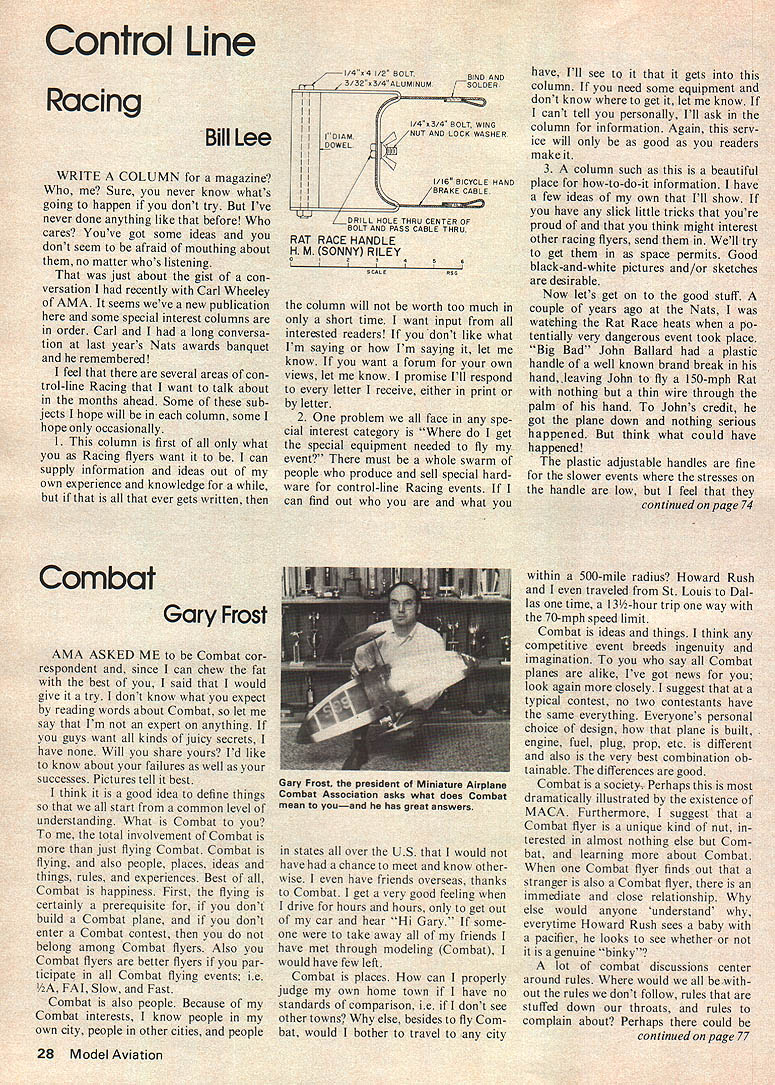
Here in Texas, several of the flyers have made their own handles that are super strong and yet easily and simply adjustable. The sketch shows pretty well how they go together. "But," you say, "I don't have time nor the materials to build one of those super trick handles." So I say "Good, 'cause I've got a guy who'll sell you one already built for $5.00." That's just not very much to spend for safety. Write to H. M. (Sonny) Riley, 2201 Wirt #441, Houston, Tex. 77055 and send money. You'll get a good, safe, Rat Race handle by return mail. We've been using this type of handle for a couple of years now with complete satisfaction.
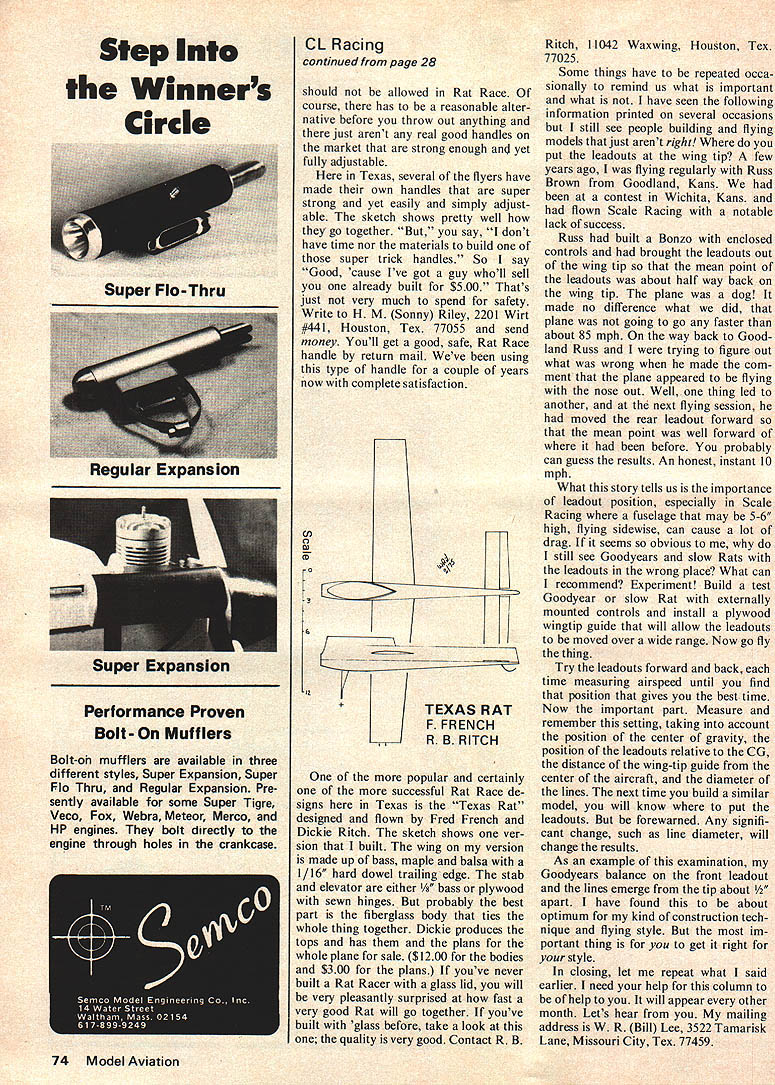
One of the more popular and certainly one of the more successful Rat Race designs here in Texas is the "Texas Rat" designed and flown by Fred French and Dickie Ritch. The sketch shows one version that I built. The wing on my version is made up of bass, maple and balsa with a 1/16" hard dowel trailing edge. The stab and elevator are either 1/8" bass or plywood with sewn hinges. But probably the best part is the fiberglass body that ties the whole thing together. Dickie produces the tops and has them and the plans for the whole plane for sale. ($12.00 for the bodies and $3.00 for the plans.) If you've never built a Rat Racer with a glass lid, you will be very pleasantly surprised at how fast a very good Rat will go together. If you've built with glass before, take a look at this one; the quality is very good. Contact R. B. Ritch, 11042 Waxwing, Houston, Tex. 77025.
Some things have to be repeated occasionally to remind us what is important and what is not. I have seen the following information printed on several occasions but I still see people building and flying models that just aren't right! Where do you put the leadouts at the wing tip? A few years ago, I was flying regularly with Russ Brown from Goodland, Kans. We had been at a contest in Wichita, Kans. and had flown Scale Racing with a notable lack of success.
Russ had built a Bonzo with enclosed controls and had brought the leadouts out to the tip of the wing so that the mean point of the leadouts was about half way back on the wing tip. The plane was a dog! It made no difference what we did, that plane was not going to go any faster than about 85 mph. On the way back to Goodland Russ and I were trying to figure out what was wrong when he made the comment that the plane appeared to be flying with the nose out. Well, one thing led to another, and at the next flying session, he had moved the rear leadout forward so that the mean point was well forward of where it had been before. You probably can guess the results. An honest, instant 10 mph.
What this story tells us is the importance of leadout position, especially in Scale Racing where a fuselage that may be 5-6" high, flying sideways, can cause a lot of drag. If it seems so obvious to me, why do I still see Goodyears and slow Rats with the leadouts in the wrong place? What can I recommend? Experiment! Build a test Goodyear or slow Rat with externally mounted controls and install a plywood wingtip guide that will allow the leadouts to be moved over a wide range. Now go fly the thing.
Try the leadouts forward and back, each time measuring airspeed until you find that position that gives you the best time. Now the important part. Measure and remember this setting, taking into account the position of the center of gravity, the position of the leadouts relative to the CG, the distance of the wing-tip guide from the center of the aircraft, and the diameter of the lines. The next time you build a similar model, you will know where to put the leadouts. But be forewarned. Any significant change, such as line diameter, will change the results.
As an example of this examination, my Goodyear balances the front leadout and the lines emerge from the tip about 1/2" apart. I have found this to be about optimum for my kind of construction technique and flying style. But the most important thing is for you to get it right for your style.
In closing, let me repeat what I said earlier. I need your help for this column to be of help to you. I will appear every other month. Let's hear from you. My mailing address is W. R. (Bill) Lee, 3522 Tamarisk Lane, Missouri City, Tex. 77459.
Transcribed from original scans by AI. Minor OCR errors may remain.

