
Control Line: Racing
Bill Lee
RAT RACE is dying, and we're going to have to do something about it before it's too late. The past few years have seen a steady decline in Rat Race participation in virtually all parts of the country until, in many local meets, it just isn't flown any more. Why? Too fast? Too complex? Too expensive? Unsafe? Yes, probably all of these reasons and more. Let's look at each of these areas a little closer.
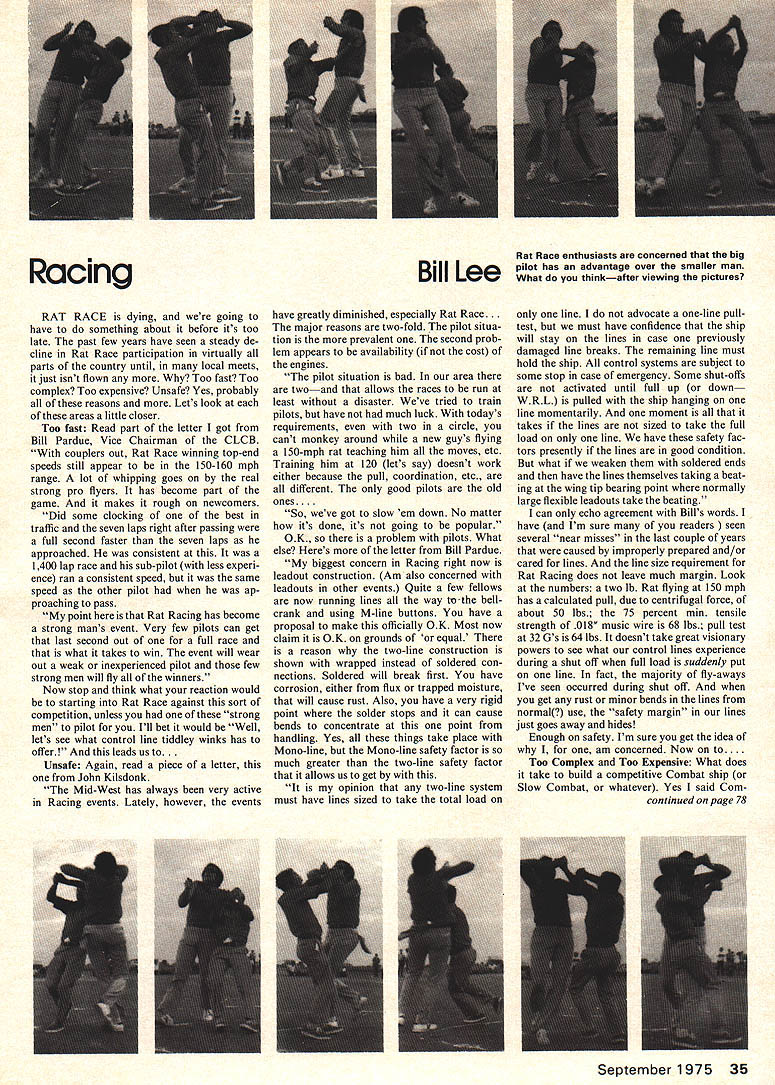
Too fast: Read part of the letter I got from Bill Pardue, Vice Chairman of the CLCB. "With couplers out, Rat Race winning top-end speeds still appear to be in the 150-160 mph range. A lot of whipping goes on by the rear strong pro flyers. It has become part of the game. And it makes it rough on newcomers.
"Did some clocking one of the best in traffic and the seven laps right after passing were a full second faster than the seven laps as he approached. He was consistent at this. It was a 1,400 lap race and his sub-pilot (with less experience) ran a consistent speed, the same speed as the other pilot approaching to pass.
"My point here is that Rat Racing has become a strong man's event. Very few pilots can get that last second out for a full race and that is what it takes to win. The event will wear out a weak or inexperienced pilot and those few strong men will fly all of the winners."
Now stop and think what your reaction would be to starting into Rat Race against this sort of competition, unless you had one of these "strong men" to pilot for you. I'll bet it would be "Well, let's see what control line tiddley winks has to offer." And this leads us to...
Unsafe: Again, read a piece of a letter, this one from John Kilsdonk.
"The Mid-West has always been very active in Racing events. Lately, however, the events have greatly diminished, especially Rat Race... The major reasons are two-fold. The pilot situation is the more prevalent one. The second problem appears to be availability (if not the cost) of the engines.
"The pilot situation is bad. In our area there are two — and that allows the races to be run at least without a disaster. We've tried to train pilots, but have not had much luck. With today's requirements, even with two in a circle, you can't monkey around while a new guy's flying a 150-mph rat teaching him all the moves, etc. Training him at 120 (let's say) doesn't work either because the pull, coordination, etc., are all different. The only good pilots are the old pilots.
"So, we've got to slow 'em down. No matter how it's done, it's not going to be popular."
O.K., so there is a problem with pilots. What else? Here's more of the letter from Bill Pardue.
"My biggest concern in Rat Racing right now is leadout construction. (Am also concerned with leadouts in other events.) Quite a few fellows are now running lines all the way to the bellcrank and using M-line buttons. You have a proposal to make this officially O.K. Most now claim OK on grounds of 'or equal'? There is a reason why the two-line construction is shown with wrapped instead of soldered connections. Soldered will break first. You have corrosion, either from flux or trapped moisture, that will cause rust. Also, you have a very rigid point where the solder stops and it can cause bends to concentrate at this one point from handling. Yes, all these things take place with Mono-line, but the Mono-line safety factor is so much greater than the two-line safety factor that it allows us to get by with this.
"It is my opinion that any two-line system must have lines sized to take the total load on only one line. I do not advocate a one-line pull-test, but we must have confidence that the ship will stay on the lines in case one previously damaged line breaks. The remaining line must hold the ship. All control systems are subject to some stop in case of emergency. Some shut-offs are not activated until full up (or down) — when a pulled ship is hanging on a line momentarily — and one takes if the lines are not sized to take the full load on only one line, we
I can only echo agreement with Bill's words. I have (and I'm sure many of you) read several "near misses" in the last couple of years that were caused by improperly prepared and/or corroded lines. And the line size requirement for Rat Racing does not have much margin. Look at the numbers: a two lb. rat flying at 150 mph has a calculated pull, due to centrifugal force, of about 50 lbs.; the 75% min. tensile strength of .018" music wire is 58 lbs.; pull test at 32 g's is 64 lbs. It doesn't take great vision or powers to see what our control lines experience during a hot full out pull is suddenly put on one line. In fact, the majority of fly-aways I've seen occurred during shut off. And when your shut off is not aerospace quality, spontaneous failure occurs in lines from normal use. That's the "safety margin" in our lines just goes away and hides!
Enough on safety. I'm sure you get the idea of why, for one, I am concerned. Now on to...
Control Line: Racing
My suggestions may or may not be popular, but I feel the important thing is that we get a discussion going among active racing members.
Bill Pardue suggested towing "a 12" dia. parachute or something!" What do you think? You who race these crazy things called Rats are the ones who should be doing the talking. I've heard from a few on the subject; I want to hear from many. Maybe we can make just enough changes in this "King" of the racing events to keep it from dying. Let's give it a try.
Control Line Racing Advisory Committee.
You will be reading this for the first time some time in July. I'm writing in the middle of May. But what I'm about to talk about has already had some action by the AMA CL Contest Board. We badly need a control-line racing advisory committee to the CLCB! The rules proposals that flooded AMA this year are indicative of the need for a knowledgeable advisory group on the subject of control line racing. The story on Rat Race points up the need. Let me pass on some more correspondence on the subject:
From Bill Pardue: "...purpose of this letter is to again urge you to form a 'Racing Advisory Committee' to the CLCB. We now have such advisory committees representing: Speed, Combat, Navy Carrier, and Aerobatics. It is time for you Racing fellows... to do the same or do not care complain about racing rules that either do get passed (and you don't like) or fail to pass (when you wanted them passed).
"There is no way for the 11 members of the CLCB to know very much about all of the events we have to deal with. It is my personal opinion that the appointment of advisory committees, as allowed for in the Contest Board Procedures, is the best way under our present system to have the individual areas of interest have a firm voice with the CLCB..."
Others from around the country have voiced a similar opinion.
John Kilsdonk has taken the bull by the horns and proposed to the Contest Board that a six-man Racing Advisory Committee be authorized. CLCB Chairman Jean Paillet in early June was seeking advice from the board concerning the proposed appointments, and assuming no objections are raised, the committee likely will be functioning by the time this issue is in readers' hands.
My address is: 3522 Tamarisk Lane, Missouri City, Tex. 77459.
Transcribed from original scans by AI. Minor OCR errors may remain.

