
Control Line: Racing
Bill Lee
IN THE LAST column I mentioned one of the special interest publications which is available, the Gazette of the FAI Control Line Society and North American Speed Assoc. Well, to give you an idea of just what it is you're missing, I'm going to take this column and probably most of the next to present to you one article out of the Gazette that should be of interest to all racing followers, pilots for sure, but officials as well. The title is "Flying Tactics, Flying Rules, and Race Performance." The article was written by that world-renowned purveyor of wisdom, Marion Gofast. As I copy the article, I reserve the right of editorial comment; sorry about that, Marion. A word of explanation, though, before I get into the article; this was written specially for FAI Team Race and all the calculations are directed at that facet of Control Line Racing. However, the technique described and the results, while not quantitative for events like Rat, still describe what is going on in the center of the circle. And now, into the article.
Section I
Before one can talk about flying in competition, the speed when flying alone as it is affected by the way the flying is done, has to be pretty well understood. To this end I will try to show in the first section how pilot action is connected to the speed the racer is timed at. This section will end up with a method of estimating just how much speed is gained or lost by any flying technique.
Assume there is a pilot in the center flying inside the 3-meter radius flying circle, and someone on the outside with a stopwatch timing him (and for ten laps please, no old eight- or four-lap bad habits held over from AMA racing — my apologies to Dunkin and Wright!). (Oh well, you can't win 'em all — W.R.L.) The person on the outside computes the speed from the ten-lap times. This is only an apparent speed as, for example, if the plane is flown arm extended, the distance covered is more than one kilometer per ten laps, but the formula used for speed calculations assumed the standard one-kilometer distance for ten laps that, say, an FAI speed plane flies when in the pylon.
Since everyone has electronic calculators these days, the formulae are given below. Although rounded off, they provide more accuracy than you need even if you're timing with a millisecond timing error. Speed in kilometers/hour — 3600/T Speed in miles/hour — 2237/T
"T," in the formula above, is the time in seconds to fly ten laps. The reason for using this as the speed is that it is the only one we can measure easily, and it is the only thing that really counts.
Now that this person is assumed to be out there flying, let us perform some experiments to determine the relation between speed and technique.
"The easiest effects to understand are those that occur when the plane is flying a circular path — no "yo-yo" (e.g., pulling the arm in to suddenly reduce the flying circle radius), and no wind. If the pilot is leading or holding back on the airplane, he does so continually, not just for a fraction of a lap. The handle and the airplane will both move in a circle at a steady rate. In short, what is called "steady state operation" is established. Under these conditions there are two kinds of effects: those due to changed flying radius and those attributable to power added (subtracted) by leading (holding back) on the plane.
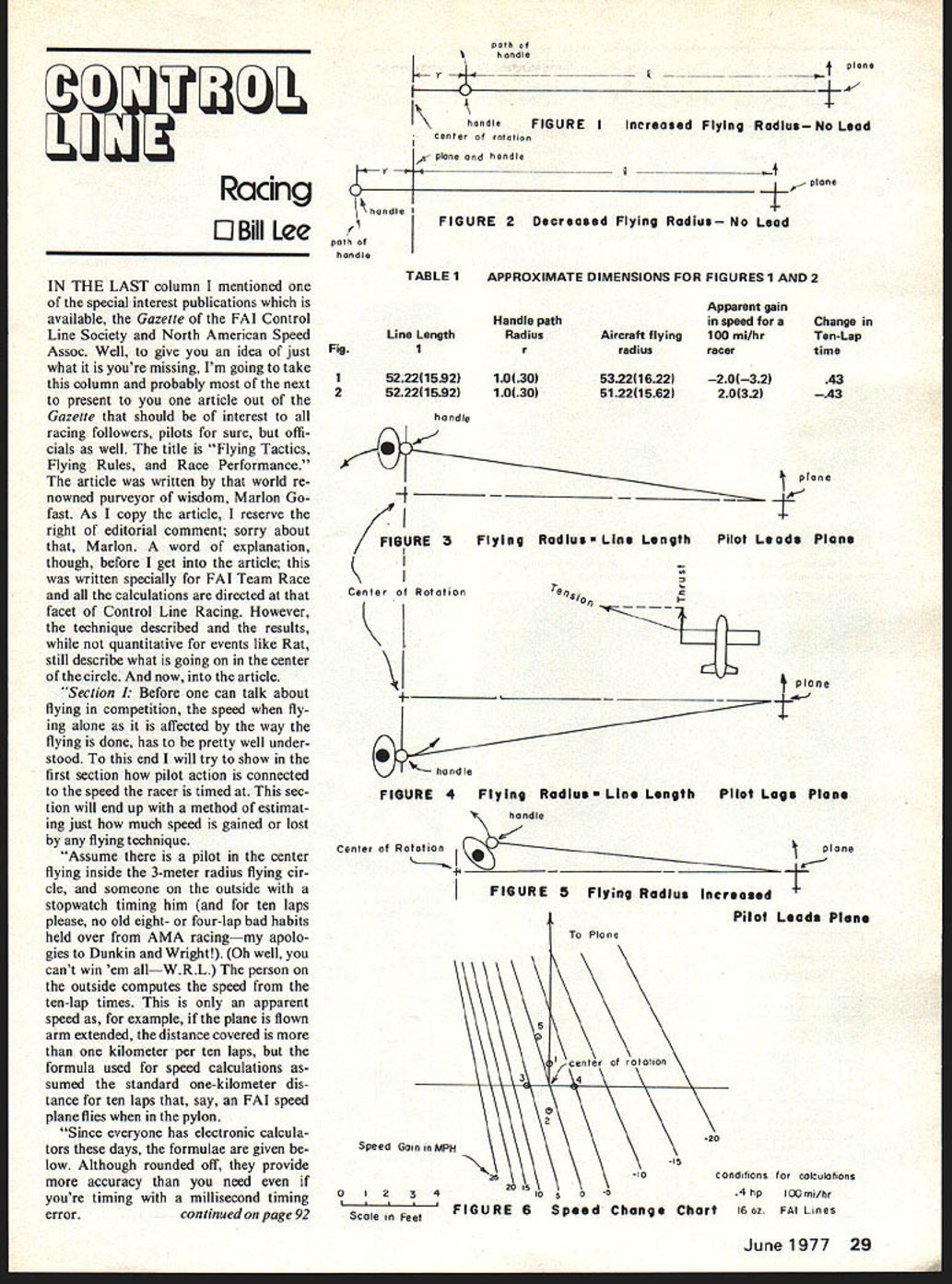
"For discussion purposes, say that the speed achieved when flown from an FAI pylon is the standard. Compared to flying from a speed pylon, if the plane is flown according to the new Team Race rules (center of rotation, handle, plane all in a line), the line length is effectively increased. Except for a tiny increase in line drag, the true air speed will not change. The speed (based on time per lap) goes down because the aircraft flies further than 100 meters per lap. If the pilot's hand moves in a one-foot (.3 meter) radius circle, for example, and the handle is between the airplane and the center of rotation, there is about a 2% decrease in timed speed (see Fig. 1 and Table I). If the pilot gets way "behind the plane" the lines pass over the left shoulder (center of rotation between the handle and plane) and the effect is reversed (see Fig. 2). Most of us thought this latter position is where Herb Stocton flies; Herb was probably just setting up for a pass.
"Note from Fig. 2 that shortening the radius means the pilot must lean toward the plane while he flies and the lines will come off his left shoulder. Increasing the radius just reverses things. Note that the net change is .86 seconds in the time to fly ten laps and neither pilot is "whipping."
"The foregoing illustrates apparent speed change by changing the flying radius without whipping. Before discussing the most general case, two more special cases will be discussed. These two cases will be maintaining the same flying radius (approximately), but changing speed by leading or lagging, one might call it the "pure whipping case." The first one, shown in Fig. 4, is the natural flying posture most beginners and sport fliers assume without being instructed. The pilot walks around in a circle with the lines perpendicular to his shoulders. In Fig. 3 the pilot walks backward as you might right after a pass in AMA competition (not legally; it's whipping! — W.R.L.) or, as some stunt fliers do, between maneuvers to get high maneuver entry speeds. By calculation for an example world-class racer, the speed lost is 5 mi./hr. in Fig. 4 and in Fig. 3 the speed gained is 6 mi./hr. The reason the gain is more than the loss is "the feedback; the pilot whips, the airplane speed increases, increasing the line tension which further increases the effect of whipping.
"Table II summarizes the four positions discussed so far and how to detect them. In each case a line drawn from the center of rotation will go right through the shoulders of the pilot. This will not be the case in intermediate positions.
TABLE 2
FOUR BASIC FLYING POSITIONS AND IDENTIFYING FEATURES
Increased flying radius, no lead (see Fig. 1)
- pilot leans away from airplane
- shoulders parallel to lines, right shoulder closest to plane
- pilot and plane face the same way
- pilot seems to walk straight ahead
Decreased flying radius, no lead (see Fig. 2)
- pilot leans toward airplane
- shoulders parallel to lines, left shoulder closest to plane
- pilot faces in opposite direction to plane
- pilot seems to walk straight ahead
Little change in flying radius, pilot leads plane (see Fig. 3)
- pilot faces plane
- shoulders at right angles to lines, right shoulder towards center of rotation
- pilot walks backward
Little change in flying radius, pilot lags plane (see Fig. 4)
- pilot faces airplane
- shoulders at right angles to lines, left shoulder towards center of rotation
- pilot seems to walk straight ahead
"There are a lot of flying stances other than the four just discussed, of course, and they all involve leading or lagging the airplane. That is, the handle will be ahead of or behind a line drawn through the center of rotation and the airplane. If the handle is ahead of the line (displaced in the direction of flight) then the pilot is leading the plane (commonly, "whipping") and, if the handle is behind, then the pilot is lagging, for which condition there is no slang word equivalent. For those of you who would like to coin a word, here is the place — it could be call whoaing or maybe dewhipping or . . . .
"On an FAI team racer the line tension is from 10 to 15 pounds (44 to 67 Newtons) for most planes. With a little lead the line tension is pointed slightly forward and this is an added thrust force. This force causes a power input to the plane. The faster and heavier the plane the more added power for a given lead; the more horsepower that's taken away for a given lag, too.
"To help fix ideas, a specific example will be given. Consider a world-class racer capable of flying 100 mi./hr. (161 km./hr.) in a pylon, and with a mass equivalent to a weight of 1.00 lbs. (454 gm.). In an FAI speed pylon the line tension would be about 12.8 lbs. (56.3 Newtons). Assume the pilot flies with the handle 2.0 feet (.61 meters) from the center of rotation and leads the plane by .5 feet (.15 meters). The power input to the plane from the line is .165 horsepower (4.45 watts). Considering that the thrust power from the engine is about .4 horsepower (11 watts; this includes the propeller efficiency), this is a substantial increase. The top view in Fig. 5 shows what is meant. Clearly, the racer will lose some speed because it is flying in a larger radius circle, but it will also gain because the airplane will fly faster due to the extra power. The whole problem is then to find out exactly what the net effect is, considering both effects. As it turns out in this example there is a net loss of about one mi./hr.
"I have done a lot of calculation, but to explain what was done without going through a bunch of formulae (I can send them to you if you want) the assumptions and explanations are given as follows: The position of the handle relative to the center of rotation and airplane are given. The problem is to calculate the resulting change in apparent speed for any given airplane. First, the effective flight circle radius from geometry is calculated. The centrifugal force is then related to the line tension and the line tension plus the lead (lag) of the lines relative to the airplane show how much extra thrust is being applied. Assuming that the engine thrust power was constant, the resulting increase in air speed is computed. This, in effect, assumes that the power required is proportional" to the cube of the speed. Once the flying speed is known and the effective flight circle radius is also known, the time for ten laps and the apparent speed can be computed. I've done all this for many cases and the results are shown in Fig. 6.
"Calculations are done for the assumed world-class racer described above. To use Fig. 6 just imagine the center of rotation as is marked, the plane way off the paper in the direction indicated. Then imagine the handle position somewhere in relation to these and read the gain or loss in speed off the graph. The positions shown in the figures are marked on this graph by a small dot and the corresponding figure number next to it.
"The next section (in the next column—W.R.L.) will describe unsteady or "yo-yo" effects and wind effects and then take up flying tactics.
(Editor's Note: Inadvertently left out of the last issue was the copy below which related to the three-view of the Shadow in that issue: "One of the newcomers to FAI TR out of the central Florida area is the team of Walt Perkins and Pete Fambrough. Walt and Pete have developed a design for a TR that they call the Shadow. The design is in its fourth stage now and is a good looking design. And one of the most pleasing aspects of the design is that the Shadow boys have the plans and a carbon fiber reinforced fiberglass body for sale for $25. The kit consists of the glass body, plans for the plane, and a set of drawings for the fuel shutoff that Walt and Pete use. I've included a drawing with this column (actually, the May issue—Ed.) that will give you an idea of what the Shadow is. Get in touch with Walt at 1100 S.E. 28th St., Ocala, FL 32670."
W. R. Lee, 3522 Tamarisk Lane, Missouri City, TX 77459
Transcribed from original scans by AI. Minor OCR errors may remain.

