

CONTROL LINE RACING
Stewart Willoughby, 627 Bakewell Lane, Naperville, IL 60565
ENGINE TESTING:
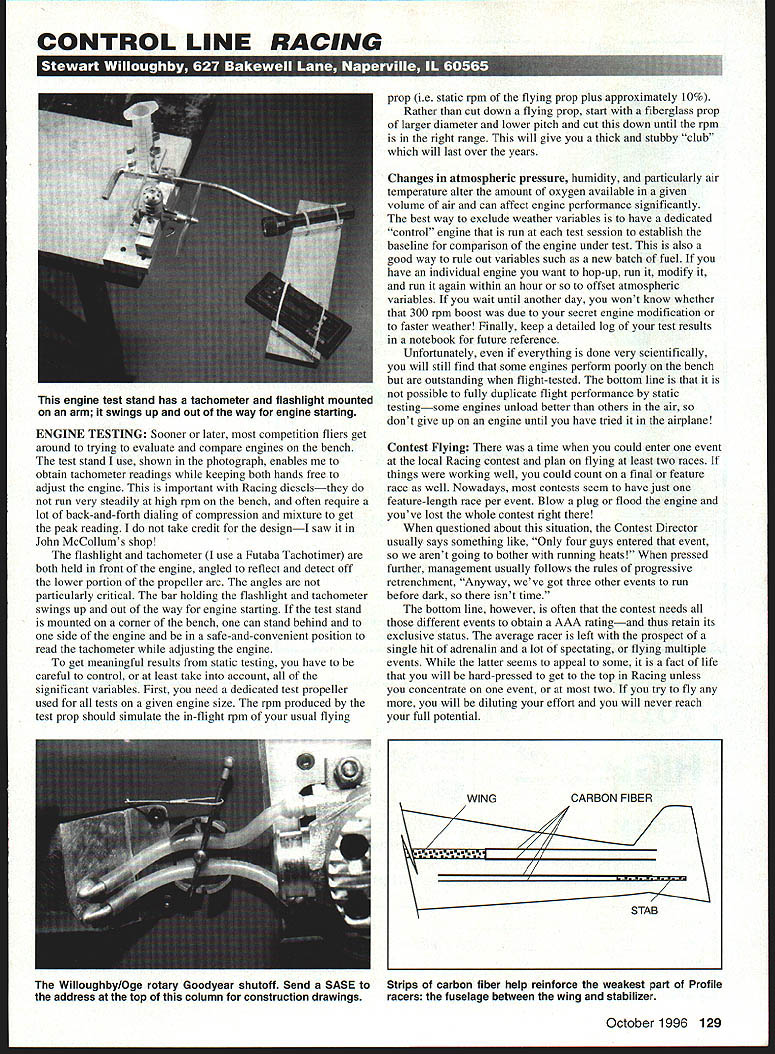
Sooner or later most competition fliers get around to evaluating and comparing engines on the bench. The test stand I use, shown in the photograph, enables me to obtain tachometer readings while keeping both hands free to adjust the engine. This is important with racing diesels — they do not run very steadily at high rpm on the bench and often require a lot of back-and-forth dialing of compression and mixture to get the peak reading. I do not take credit for the design — I saw it in John McCollum's shop!
The flashlight and tachometer (I use a Futaba Tachotimer) are both held in front of the engine, angled to reflect and detect off the lower portion of the propeller arc. The angles are not particularly critical. The bar holding the flashlight and tachometer swings up and out of the way for engine starting. If the test stand is mounted on a corner of the bench, you can stand behind and to one side of the engine and be in a safe, convenient position to read the tachometer while adjusting the engine.
To get meaningful results from static testing you have to be careful to control, or at least take into account, all of the significant variables:
- Use a dedicated test propeller for all tests on a given engine size. The rpm produced by the test prop should simulate the in-flight rpm of your usual flying prop (i.e., static rpm of the flying prop plus approximately 10%). Rather than cut down a flying prop, start with a fiberglass prop of larger diameter and lower pitch and cut this down until the rpm is in the right range. This will give you a thick, stubby "club" prop that will last for years.
- Account for atmospheric changes. Variations in pressure, humidity, and especially air temperature alter the amount of oxygen available in a given volume of air and can affect engine performance significantly. The best way to exclude weather variables is to have a dedicated "control" engine that is run at each test session to establish the baseline for comparison.
- Control other variables such as fuel batches. Running a control engine also helps rule out variables like a new batch of fuel.
- If you are modifying an engine, run it, make the modification, and run it again within an hour or so to offset atmospheric variables. If you wait until another day, you won't know whether a 300 rpm boost was due to your modification or to different weather.
Finally, keep a detailed log of your test results in a notebook for future reference.
Unfortunately, even if everything is done very scientifically, some engines will perform poorly on the bench but be outstanding in flight. Static testing cannot fully duplicate flight performance — some engines unload better than others in the air — so don't give up on an engine until you have tried it in the airplane.
CONTEST FLYING:
There was a time when you could enter one event at the local racing contest and expect to fly at least two races. If things were working well you could count on a final or feature race as well. Nowadays most contests seem to have just one feature-length race per event. Blow a plug or flood the engine and you've lost the whole contest!
When questioned about the situation, the Contest Director usually says something like, "Only four guys entered that event, so we aren't going to bother running heats." Pressed further, management often follows the rules of progressive retrenchment: "Anyway, we've got three other events to run before dark, so there isn't time."
The bottom line is often that the contest needs all those different events to obtain an AAA rating — and thus retain its exclusive status. The average racer is left with the prospect of a single hit of adrenaline and a lot of spectating, or the alternative of flying multiple events. While the latter seems to appeal to some, it is a fact of life that you will be hard-pressed to get to the top in racing unless you concentrate on one event, or at most two. If you try to fly more, you will be diluting your effort and you will never reach your full potential.
A further aspect of the "one race event" is that there is less incentive to push the limits or try something new. With two separate heats you can take it easy and post a time in Heat One, then raise the compression ratio or try those one-third-lap pit stops in the second heat without risking the contest. Heats should be flown in rounds, not back-to-back — I think the latter system was conceived by contest management for their benefit alone!
The racing community in the US has spread itself too thin among too many events. The time has come to try single-event specialty contests for AMA racing. The department-store-type contests currently available do not really meet the need.
How about four-heat races of Scale Racing (or Slow Rat), with the two best times taken to compute the winner? The number of heats flown could vary with the number of contestants — with fewer entrants there would be time to run more heats, so you would actually fly more races if the turnout was low. This kind of contest is popular in Combat and has worked very well for FAI Team Race. I don't know anyone who has flown Ken Smith's US Team Race Champs or the FAI Team Trials who did not enjoy the opportunity to fly a lot of races.
PROFILE CONSTRUCTION:
The diagram shows a lightweight but effective way to strengthen the weakest part of profile racers: the fuselage between the wing and stab. I use four strips of .014 x 1/2-in. carbon-fiber laminate (Magnalite from Bob Violet Models) on scale and racing models. Adding strips above and below the wing and stab, as shown, is the best way I have found to stop cracks from developing at these highly stressed joints.
Transcribed from original scans by AI. Minor OCR errors may remain.

