
CONTROL LINE RACING
Stewart Willoughby, 627 Bakewell Lane, Naperville, IL 60565
The 70th AMA Nationals will go down in history as the first Nats held at the AMA's International Aeromodeling Center. For the first time in many years, a newly constructed, purpose-built, well-marked circle was available for racing. This was much appreciated by all, especially by those competitors who in the past had to spend many hours weeding, patching, and marking out the circle prior to the contest. The only reminder from past Nats was the old, sagging safety nets—hopefully a chain-link fence is not too far down on AMA's list of future site improvements (a practice circle would be nice too!).
The weather was great for the whole week, with temperatures in the mid-80s, light winds, low humidity, and no rain. Although competitors came from all areas of the US and from Canada (as expected with a central location), the number of entries was average. Many top racing fliers did not attend because they were due to depart for the CL World Championships in Sweden the week after the Nats. This had a bearing on the results—no records were posted, despite the excellent weather and facilities.
Mouse Race
The first event of the 1996 Nats was Mouse II, run on Sunday, July 7 as a supplemental event by the National Control Line Racing Association (NCLRA). It drew 13 entries. Class II allows the use of any 1/2A engine; AMEs and other engines were seen racing with the ubiquitous Tee Dees.
- Fastest heat time: Ron Salo (Canada) — 3:40, using a reed-valve engine.
- Qualifying cutoff for sixth place: 5:01.
- Finals: 1st Bill Cave — 10:05; 2nd Pat & Mike Matson — 12:12; 3rd Ron Salo — 12:13.
Mouse I, flown on Monday, had the most entries of all the racing events. The seven Juniors flew first, with top qualifier Philip Peters, Russell Whitney, and Andy Westerheim making the final. Andy Westerheim prevailed in 6:27 using a Black Widow–powered Streaker V. Philip Peters finished second with 7:21, and Russell Whitney was third.
Open Mouse I was closely contested among 20 fliers. Gabe Manfredi was the top qualifier with 2:38; 2:54 was the cutoff for sixth position. In the finals:
- 1st Rich McIntyre — 5:19
- 2nd Gabe Manfredi — 5:28
- 3rd Kenn Smith — 5:44
- 4th Allen Goff — 5:51
- 5th Mike MacCarthy — 5:51
- 6th Ron Salo — DNF
Airplane types were diverse. Thanks to Dave McDonald for assisting with the Mouse report.
Scale Racing
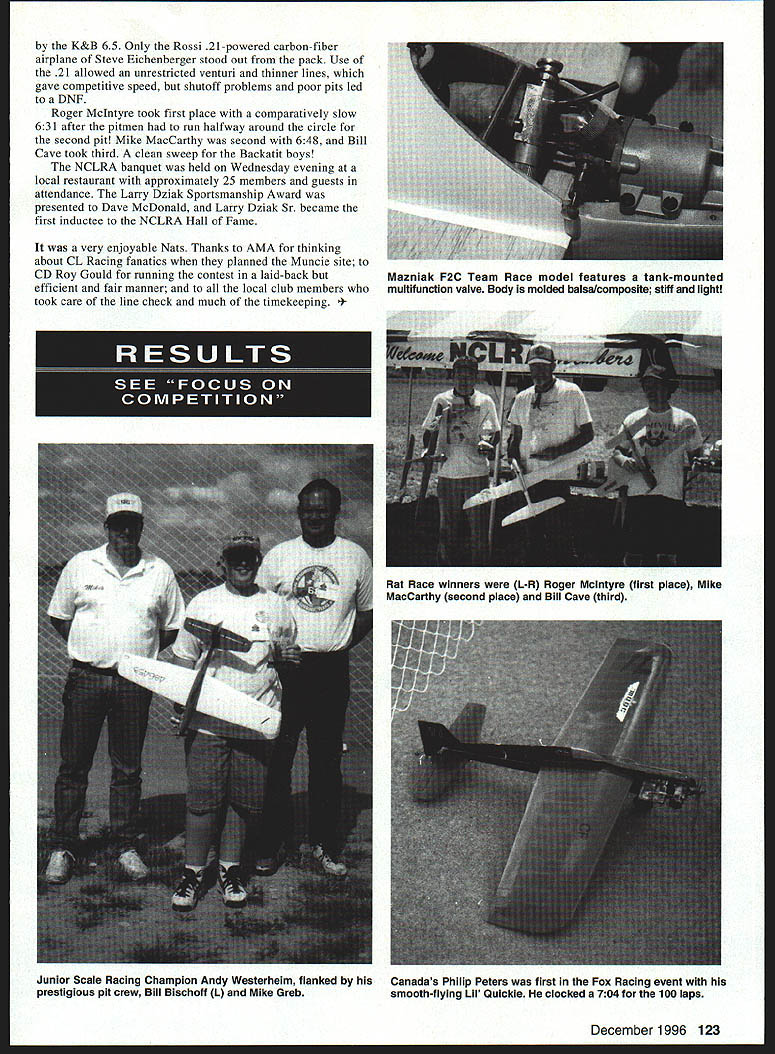
Scale Racing began Tuesday morning. The five Junior entrants used a refreshing variety of models and powerplants—Grey Ghosts, Nemesises, Busters, Lil' Quickies powered by Mokis, Foxes, Irvines, and Rossis. Andy Westerheim followed up his win in Mouse I to finish first in 9:06 for the 140 laps using his Fox .15–powered Lil' Quickie. He was a bit lucky—he lost one wheel at the third pit stop, and the other wheel fell off when he landed at the end of the race!
Krystal King placed second with her Fox .15–powered Buster in 10:34. Ten-year-old Krystal did a super piloting job and took home trophies in Racing and Combat from her first Nats.
Combat
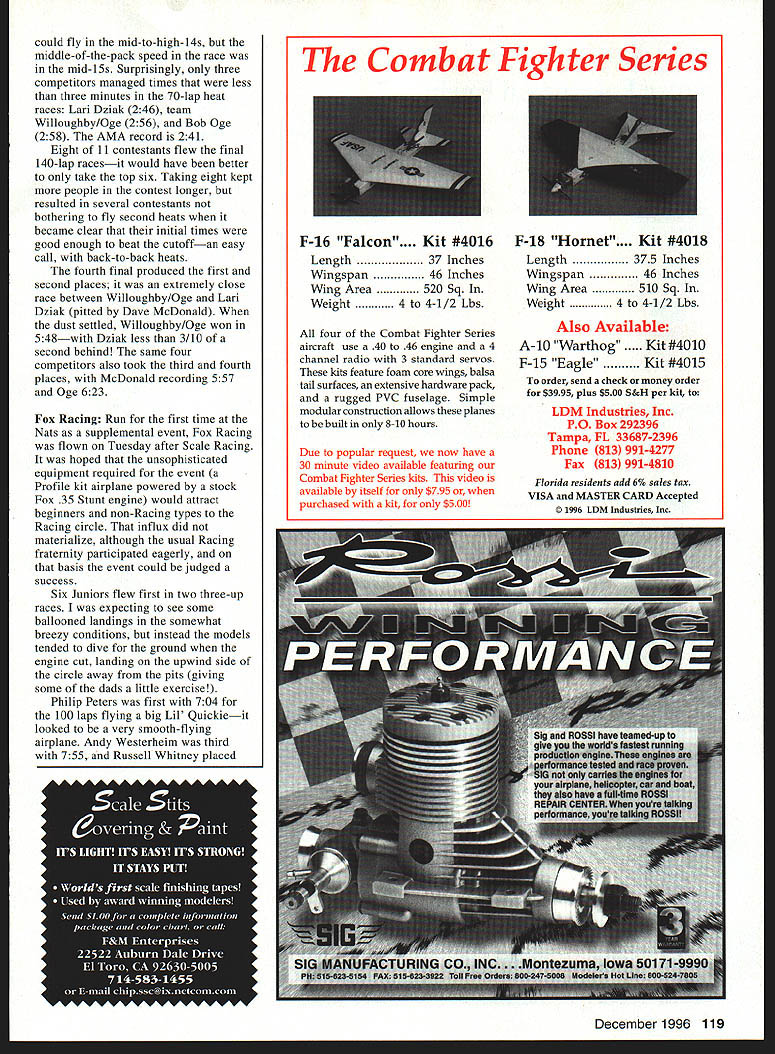
Eleven entrants flew in the Open event. By far the most popular equipment was a Lil' Quickie powered by a Gillott-prepared Rossi .15 Mk. III. A few Nelson .15s were seen, but they did not place high in the results. The most popular props were Bolly G3s or G23s (or their copies) cut down to approximately six inches in diameter. A few contestants could fly mid-to-high-14s; middle-of-the-pack speed was mid-15s. Surprisingly, three competitors managed times less than three minutes in the 70-lap heat races—Lan Dziak (2:46), team Willoughby/Oge (2:56), and Bob Oge (2:58). The AMA record is 2:41.
Eight contestants flew the final 140-lap races. It would have been better to take the top six; taking eight kept people in the contest longer and resulted in several contestants botching a fly-off when they became tired. It became clear initial times were good enough to beat the cutoff—an easy call. Back-to-back heats for the fourth final produced an extremely close first and second. The race between Willoughby/Oge and Lan Dziak pitted Dave McDonald; when the dust settled Willoughby/Oge won 5:48, with Dziak less than 3/10 second behind. The same four competitors also took third and fourth places, McDonald recording 5:57, Oge 6:23.
Fox Racing
Run for the first time as a Nats supplemental event, Fox Racing was flown Tuesday after Scale Racing. The unsophisticated equipment required by the event—a Profile kit airplane powered by a stock Fox .35 stunt engine—was intended to attract beginners and non-racing types. A racing-circle influx did materialize, although the usual racing fraternity participated eagerly, and on that basis the event could be judged a success.
Six Juniors flew first in two three-up races. I was expecting to see some ballooned landings in the somewhat breezy conditions, but instead the models tended to dive for the ground when the engine cut, landing on the upwind side of the circle away from the pits (giving some of the dads a little exercise!). Philip Peters was first with 7:04 for the 100 laps flying a big Lil' Quickie—it looked to be a very smooth-flying airplane. Russell Whitney placed second, and Andy Westerheim was third with 7:55. All three received new Fox .35 engines, courtesy of Fox Manufacturing.
Open competition was deadly serious for some, but for most it was time to unwind and have some fun. It included the occasional suspiciously fast Fox and a few obscure airplanes, like the Vultee Carrier kit flown by the Backdraft Racing Team.
- 1st Les Byrd — 6:32 (won a Fox .35)
- 2nd Mike MacCarthy — 6:43 (cash prize)
- 3rd Allen Goff — 7:00 (cash prize)
Slow Rat
Wednesday was Slow Rat day; activities began with 70-lap heats flown to select the six finalists. Dave McDonald flew the fastest heat with a 2:42 using a Super Tigre X.36; the cutoff time for the final races was 2:58.
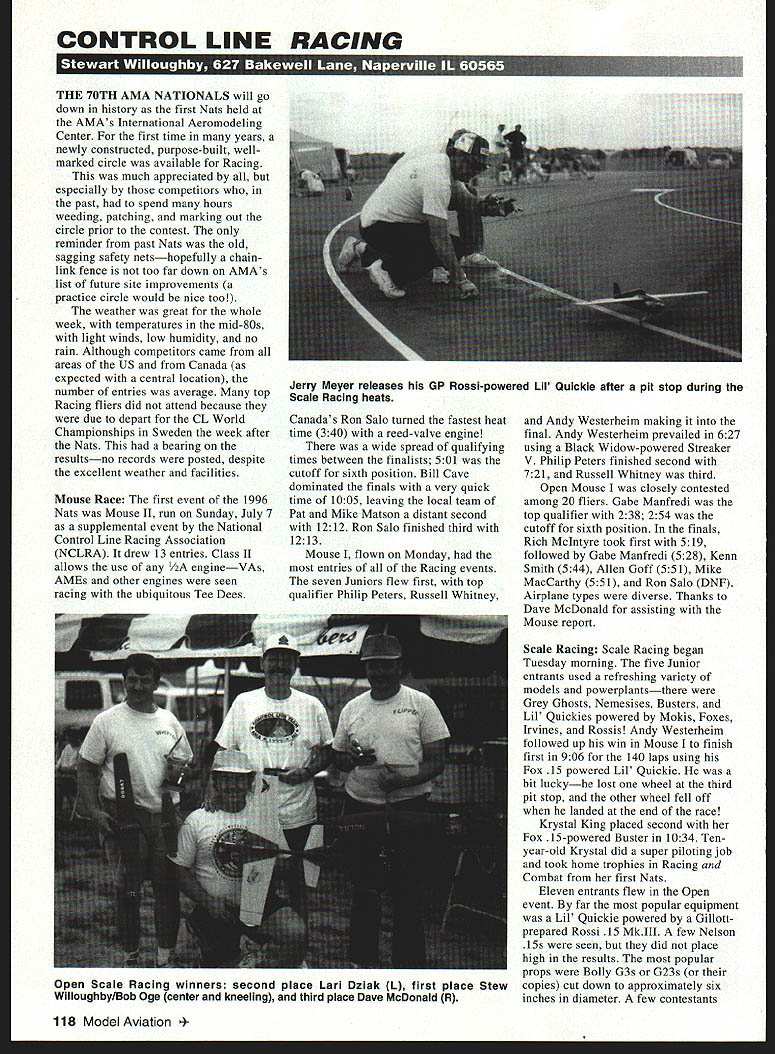
Two finalists used the ST X.36 and four used the Nelson .36—two were front-induction engines and two were rear-induction. Jerry Meyer flew an excellent 140-lap race with one-or-two-flip pits and a steady run in the high 14s/low 15s to take first place in 5:47 using an ST X.36 with a cut-down-and-thinned 8x8 Bolly carbon-fiber prop.
This was a well-deserved win—Jerry has put a great deal of effort into this event; he last won at the Reno Nats in 1984. Dave McDonald took second with 5:49, followed by Allen Goff with 6:00, using a Nelson. Mike Greb placed fourth; after qualifying with the second-fastest heat time, his race was ruined by a poor start and shutoff problems.
The Californian medfly threat did not materialize—Mike MacCarthy and Roger McIntyre had problems in the finals.
F2C Team Race
Entry in F2C Team Race was low again this year, with four teams flying six entries. All of the equipment was of Russian origin, powered by either Mazniak or Vorobiev engines. Despite the sophisticated hardware, performances ranged from mediocre to average—no one went faster than the high 18s in the race. Ballard/Oge recorded the fastest heat time (3:37) using a Mazniak installed in a Nazin kitplane. The time would have been faster had the engine not abruptly slowed toward the end of the race because of a bearing failure.
- Ballard/Oge — 3:37 (fastest heat)
- Perkins/Goldsmith — 3:51
- Dziak/McDonald — 3:55
- Willoughby/Oge — 3:56 (poor settings in both heats)
The last heat was memorable for its midair collision as Lari Dziak attempted to overtake Kenny Perkins, who was high and gliding. Lari's model performed what John Ballard described as a "reverse torque roll," then it shot back out on the lines and continued flying to complete the race! Unfortunately the leadouts ripped out through the bottom of the wing so Dziak/McDonald had to scratch from the final.
Ballard was out due to engine problems; Dick Lambert only gave him one engine to play with, leaving a two-up final between Willoughby/Oge and Perkins/Goldsmith. The race was uneventful, with Willoughby/Oge winning in 7:25 and Perkins/Goldsmith second with a commendable 7:33.
If the Team Trials for the 1998 World Champs are held in conjunction with the Nats next year (as has been proposed), a bigger turnout can be expected in F2C.
Fast Rat
John Ballard ran Fast Rat, giving CD Roy Gould a much-needed break. It turned out to be an easy task, with only five of eight entries flying in the event. Most competitors used Shark, inverted-style models powered by the K&B 6.5. Only the Rossi .21–powered carbon-fiber airplane of Steve Eichenberger stood out from the pack. Use of the .21 allowed an unrestricted venturi and thinner lines, which gave competitive speed, but shutoff problems and poor pits led to a DNF.
Roger McIntyre took first place with a comparatively slow 6:31 after the pitmen had to run halfway around the circle for the second pit! Mike MacCarthy was second with 6:48, and Bill Cave took third. A clean sweep for the Backatit boys!
NCLRA Banquet and Closing
The NCLRA banquet was held on Wednesday evening at a local restaurant with approximately 25 members and guests in attendance. The Larry Dziak Sportsmanship Award was presented to Dave McDonald, and Larry Dziak Sr. became the first inductee to the NCLRA Hall of Fame.
It was a very enjoyable Nats. Thanks to AMA for thinking about CL racing fanatics when they planned the Muncie site; to CD Roy Gould for running the contest in a laid-back but efficient and fair manner; and to all the local club members who took care of the line check and much of the timekeeping.
Transcribed from original scans by AI. Minor OCR errors may remain.

