
CONTROL LINE RACING
Stewart Willoughby 627 Bakewell Lane, Naperville IL 60565
TAMING THE TRs:
For as long as I have flown F2C Team Race (more than 25 years), there have been rumors that the Federation Aeronautique Internationale (FAI) would make draconian rule changes to slow the models down. The engine size would be reduced to .09, suddenly rendering everyone's equipment obsolete.
When smaller engines were proposed in 1976, the top competitors were just beginning to consistently break the four-minute barrier. Despite persistent debate, neither engine-size reduction nor any other rules change has transpired — in fact, no significant changes have occurred since 7 cc tanks arrived in 1967!
Rules stability is good — except now, 20 years later, 3:14 is the heat record and anything more than the mid-3:20s is too slow! Years ago, only a few teams went fast, but now competitive equipment from eastern Europe combined with dropping the builder-of-the-model rule lets virtually anyone achieve warp speeds just by spending a few bucks (okay — many bucks!).
However, high airspeed itself is not really the problem; the pilot's increased groundspeed is the problem. With two other people in the circle, pilots have a tough time keeping up with the model, and this is compounded by the aging pilot population and few newcomers joining the ranks.
There are only two ways to reduce the pilots' rotational speed:
- Increase line length so the model flies a bigger circle.
- Reduce airspeed by increasing drag or restricting power.
Increasing the line length is the most logical, least-restrictive, and most-predictable approach.
If the lines were increased from 52 feet, three inches to 58 feet, a model circulating 18.0 seconds for 10 laps would go the equivalent of 20.0 seconds for 10 laps. This is the rotational speed of about 20 years ago, and it would represent a significant change. The 10 km race would be 90 laps rather than 100 laps, but airspeed and race times would be essentially unchanged, and the character of the event would be maintained. Remember, changing the line length is not unprecedented — the event started out in 1954 on 43-foot lines and 120 laps for the 10 km.
The standard objection to increasing line length is that "a larger diameter circle won't fit on our site — we'd have to tear down the fence and rebuild it." I wonder how much of a problem this really is. At most sites I have seen 10 feet or more between the flight circle and the fence — 58-foot lines would require less than six extra feet.
Solving the problem by reducing airspeed (e.g., reducing engine capacity, restricting the venturi, using standard fuel, etc.) is philosophically wrong and oppressive; implementation would be problematic, and I think that event interest would decline.
During the 1996 World Championships in Sweden, increasing wire diameter to 0.4 mm (0.016 inch) was suggested. This would slow models down about 1 second every 10 laps — not enough to be a long-term solution, and I doubt you would even see this much of a reduction. Larger wires are probably safer (0.3 mm [0.012 inch] has been used since 1960, when race times were about 4:30), but an increase to 0.35 mm (0.014 inch) is all that would be indicated.
Perhaps the FAI should adopt a plan to formulate a series of changes to be implemented incrementally; or perhaps making the rules change effective in five years would be more palatable to the various interests. To my knowledge, neither approach has been tried. A critical point has been reached, and the FAI needs to take action to prevent Team Racing from spiraling into oblivion.
Custom pilots:
Kermit the Frog has been flying my FAI TRs for about 20 years, and he has done a good job — except at the 1994 Nationals, where he ate an asphalt sandwich! My pilot choice was not determined by a love for amphibians (which I have eaten in France, dissected in school, and occasionally used as bait!), but by a need to meet the rule requirement that the pilot has "direct visibility forward." The canopy of the model I had built at the time was so raked back that only a frog with eyes on the top of his head could fly it according to visual flight rules!
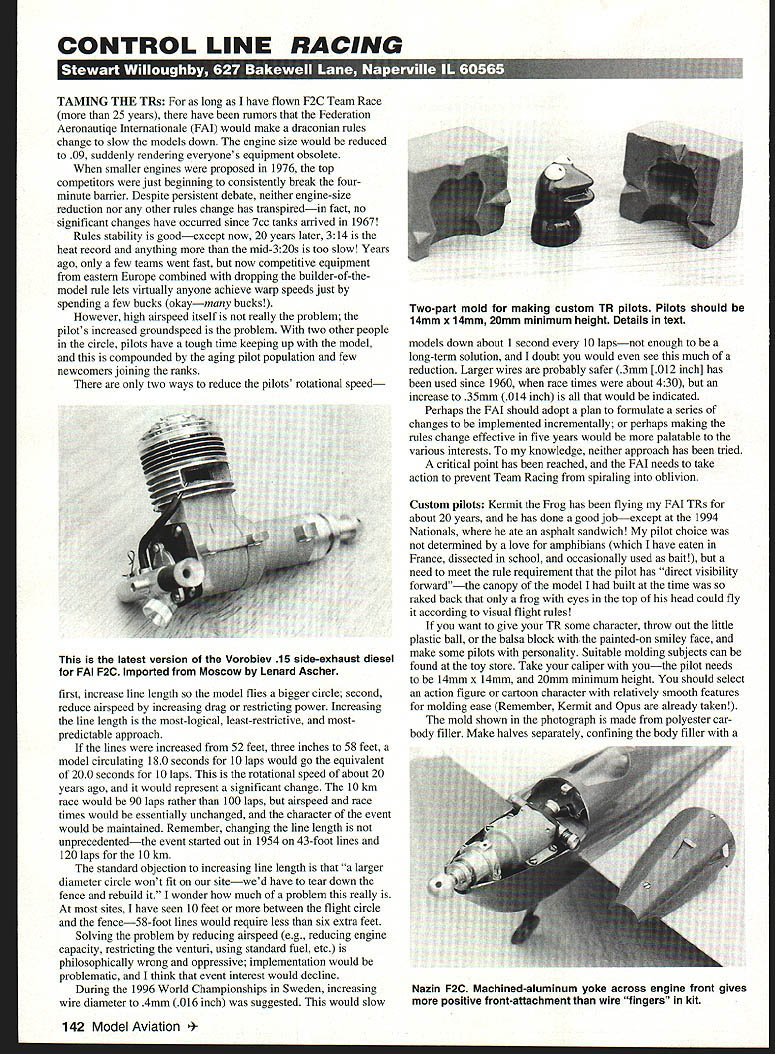
If you want to give your TR some character, throw out the little plastic ball or the balsa block with the painted-on smiley face, and make some pilots with personality. Suitable molding subjects can be found at the toy store. Take your caliper with you — the pilot needs to be 14 mm x 14 mm, 20 mm minimum height. You should select an action figure or cartoon character with relatively smooth features for molding ease. Remember, Kermit and Opus are already taken.
The mold shown in the photograph is made from polyester car-body filler. Make halves separately, confining the body filler. Lay up mold halves using polyester laminating resin and three layers of 3/4-oz. glass cloth. The complexity of the subject will dictate whether big pieces of cloth can be used, or multiple smaller pieces are needed to get the layup flat in the mold and across the parting line without air bubbles. Close the mold and secure with a rubber band; check through the open shoulder area to ensure that the cloth remains flat against the mold surfaces.
To make the base: lay up three pieces of cloth on a flat surface previously covered with plastic film and set the mold on the cloth, with a weight on top. After curing, open the mold, remove the flash, and fill any air bubbles before painting. The result is a lightweight (1/2–3/4 g) and more appealing pilot. At the very least, you will have someone else to blame those poor race times on!
Vorobiev J5D:
The engine in the photograph is the latest version of the side-exhaust Vorobiev Team Race diesel. The side-exhaust and front-exhaust Vorobiev, and the Nazin TR model kit are imported from Moscow by Lenard Ascher. This equipment is world-class and state of the art.
Lenard reports that a good stock of engine parts is on hand at all times, but the availability of complete engines and kits varies. It is best to order early. Current prices are:
- Engines: $480
- Matching model kit: $220
Lenard Ascher 215 N. Prospectors Road Diamond Bar, CA 91765 (909) 860-9476
Gillott Products:
I have received several requests for information about the GP Rossi 1.5 Mk 3, which invariably takes the top places at the Nationals Scale Racing event. These engines are prepared by Tim Gillott and feature his own piston/sleeve, head, and venturi. The crankshaft and crankcase are extensively modified to adjust the intake timing, and the bearings are carefully shimmed for alignment.
The cost is $260 (or more, depending on engine condition), and you supply the engine. Tim will work on most engines from .049 to .65 — you won't be disappointed!
Also available are plans and instructions for the Circus Circus Shoestring Goodyear racer, including all of the hardware (engine mounts, bellcrank, shutoff, tank, and landing gear mounting block) for $200. Just the detailed plan and instructions are $20.
Tim also has plans for his Shark AMA Rat Racer for sale.
Gillott Products 1063 Harding St. Salinas, CA 93906 (408) 449-2052
Transcribed from original scans by AI. Minor OCR errors may remain.

