
CONTROL LINE RACING
Stewart Willoughby, 627 Bakewell Lane, Naperville IL 60565
Getting Started in Racing
My first Control Line (CL) racing experience was in England in the early 1960s; a new event called Rat Race was to be held at a nearby United States Air Force base. My local clubmates and I flew mostly "A" Combat with .15 diesels at the time, so glow .35 racing was new ground.
One fellow produced a well-used Fox .35. I built a boxy all-sheet model around it and off we went to the contest. We did quite well; there was no blistering speed, but our model possessed the other important attribute of a racing airplane — it restarted!
In the finals we succumbed to a condition that we later learned is almost endemic with Foxes — the pit-stop fire. It melted the fuel line I had neatly (but inaccessibly) routed under the engine to the tank. A lesson was learned, but the racing bug had bitten — by the late 1960s I was flying Rat Race, Federation Aeronautique Internationale (FAI), Team Race (TR), and Goodyear!
If racing appeals to you, an important first step is to find out which events are popular in your region. Start with an event that has substantial local interest so you will have people to get ideas from, practice with, race against, and eventually beat.
The best way to assess the local racing scene is to go to contests: see which events are being flown; ask which club most of the racers belong to, and become a member; plan on hooking up with a "steady" pitman or pilot — racing is a team event, and to be successful you will need to work closely with your partner so that each of you knows what the other will do in any situation; and be prepared to put in many hours of practice honing your skills and testing your equipment.
It makes sense for the novice racing enthusiast to start with the least-sophisticated event. Each of the current AMA CL Racing events (Fast Rat, Slow Rat, Scale Racing, and Mouse Race) started as an attempt to provide entry-level racing as an alternative to Team Racing. Team Racing was considered unsuitable for the beginner because of the requirements for a built-up fuselage, cowled engine, and restricted fuel capacity.
With the exception of Mouse Race, the other CL Racing events have evolved into high-tech, big-bucks events — not the best place to get started in racing. My recommendations for beginner events are:
- Fox Racing
- Sportsman Goodyear
- Mouse Race
Fox Racing
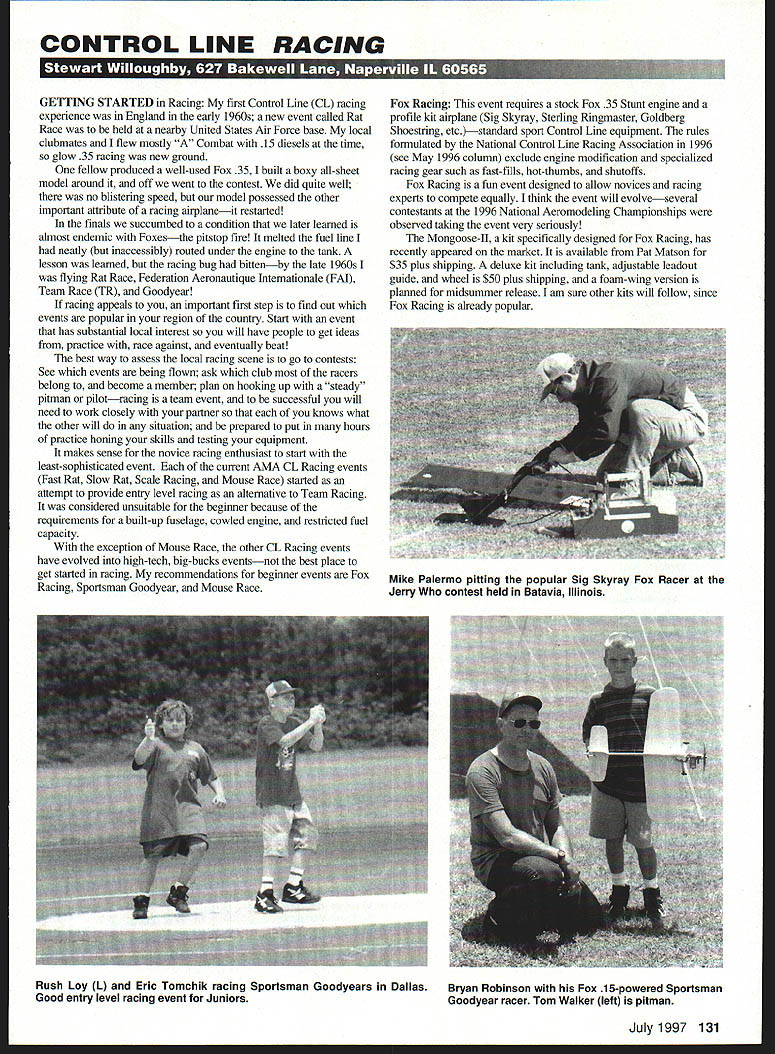
This event requires a stock Fox .35 Stunt engine and a profile kit airplane (Sig Skyray, Sterling Ringmaster, Goldberg Shoestring, etc.) — standard sport Control Line equipment. The rules formulated by the National Control Line Racing Association in 1996 (see May 1996 column) exclude engine modification and specialized racing gear such as fast-fills, hot-thumbs, and shutoffs.
Fox Racing is a fun event designed to allow novices and racing experts to compete equally. I think the event will evolve — several contestants at the 1996 National Aeromodeling Championships were observed taking the event very seriously!
The Mongoose-II, a kit specifically designed for Fox Racing, has recently appeared on the market. It is available from Pat Matson for $35 plus shipping. A deluxe kit including tank, adjustable leadout guide, and wheel is $50 plus shipping, and a foam-wing version was planned for midsummer release. I am sure other kits will follow, since Fox Racing is already popular.
Transcribed from original scans by AI. Minor OCR errors may remain.

