
CONTROL LINE RACING
Stewart Willoughby, 627 Bakewell Lane, Naperville, IL 60565
US TEAM RACE CHAMPIONSHIPS
The sixth annual T/R Champs was held in mid-April at the Whittier Narrows control-line site in Southern California. The contest follows a format similar to the FAI F2C team trials, with six races flown over the two-day weekend, making it a good early-season workout.
Turnout was low—just three teams—but that's a quorum for Team Race, so the contestants were at least happy. All teams used Nazin/Vorobiev engines and kitplanes, with Willoughby/Oge and Kusik/Braun employing the latest side-exhaust engine variant.
My model was new and unflown, so we had to deal with the usual teething troubles, such as tightening the shut-off spring. The engine comes with a restrictor in the exhaust prime line; when we removed it on the second day, we found an immediate improvement in restarting.
The only other significant modification to the stock engine was to turn down the offset cooling fins on the head. I could not see how they would make much difference in cooling, and modifying the kit-supplied cooling duct to fit the new head design would have been a lot more work—maybe I'm just getting lazy! Anyway, performance was good, and we were encouraged to find that the engine preferred a little more pitch on the single-blade prop than our front-exhaust engines.
Results (averages for three best races):
- Ascher/Ascher — 3:30 average (3:29, 3:31, 3:30) — 1st place. Lenard Aaron claims to have equally reliable 3:25 equipment for the team trials in the fall.
- Willoughby/Oge — 3:33 average (3:39, 3:34, 3:24) — 2nd place.
- Kusik/Braun — 3:42 average (3:43, 3:44, 3:39) — 3rd place.
All the F2C participants agreed they had a good time and got useful practice—thanks to Kenn Smith (organizer) and Ken Mogi (jury).
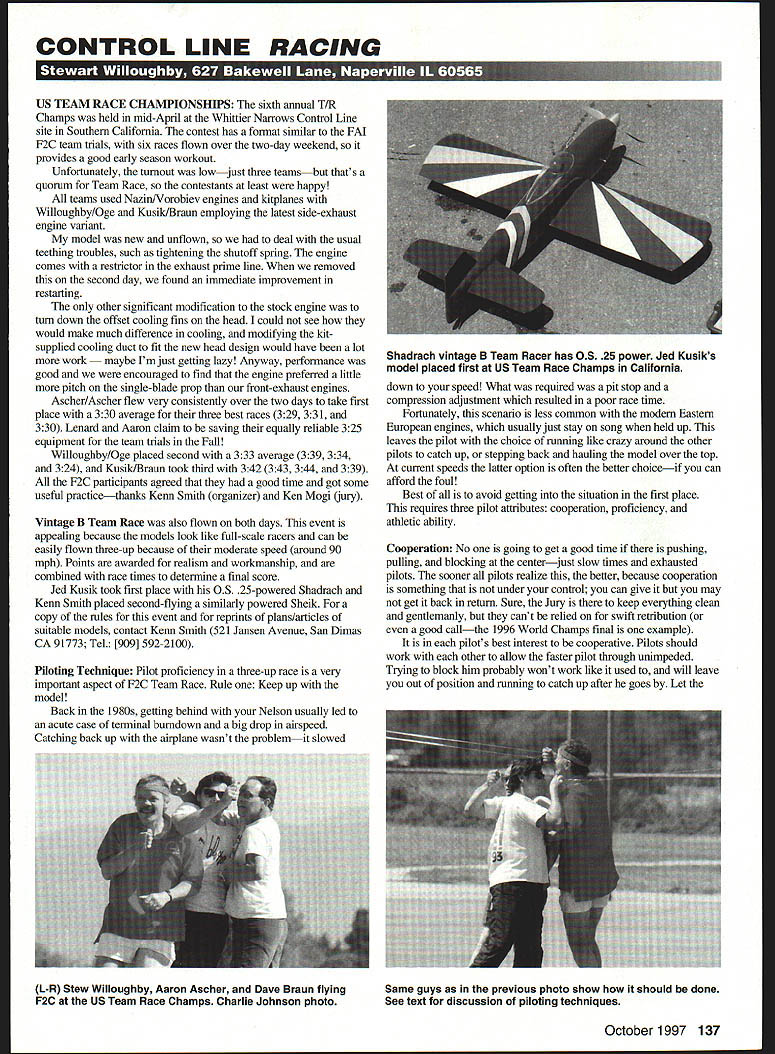
Vintage B Team Race was also flown on both days. This event is appealing because the models look like full-scale racers and can be easily flown three-up because of their moderate speed (around 90 mph). Points are awarded for realism and workmanship, and are combined with race times to determine a final score.
Vintage B results:
- Jed Kusik — O.S. .25-powered Shadrach — 1st place.
- Kenn Smith — similarly powered Sheik — 2nd place.
For a copy of the rules for this event and for reprints of plans/articles of suitable models, contact Kenn Smith, 521 Jansen Avenue, San Dimas, CA 91773; Tel.: (909) 592-2100.
PILOTING TECHNIQUE
Rule one: Keep up with the model!
Back in the 1980s, getting behind with your Nelson usually led to an acute case of terminal burndown and a big drop in airspeed. Catching back up wasn't the problem—the airplane slowed down to your speed! What was required was a pit stop and a compression adjustment, which resulted in a poor race time.
Fortunately, this scenario is less common with modern Eastern European engines, which usually just stay on song when held up. This leaves the pilot with the choice of running like crazy around the other pilots to catch up, or stepping back and hauling the model over the top. At current speeds the latter option is often the better choice—if you can afford the foul!
Best of all is to avoid getting into the situation in the first place. This requires three pilot attributes:
- Cooperation
- Proficiency
- Athletic ability
Cooperation
No one is going to get a good time if there is pushing, pulling, and blocking at the center—just slow times and exhausted pilots. The sooner all pilots realize this, the better, because cooperation is something that is not under your control; you can give it but you may not get it back in return. Sure, the jury is there to keep everything clean and gentlemanly, but they can't be relied on for swift retribution (the 1996 World Champs final is one example).
It is in each pilot's best interest to be cooperative. Pilots should work with each other to allow the faster pilot through unimpeded. Trying to block him probably won't work like it used to, and will leave you out of position and running to catch up after he goes by. Let the guy in and out of the center huddle as needed.
I think it is okay to guide yourself and the other pilots with your left hand. This helps keep the center of rotation in the same place so everyone is circling at the same pace and on as small a diameter as possible.
What is not acceptable is hanging on so another pilot has to pull you around, or not letting go when necessary to allow changes in position at the center as models overtake or pit. Save your two "free" fouls for getting yourself out of trouble, rather than being sloppy or trying to mess with someone else.
Pilot proficiency
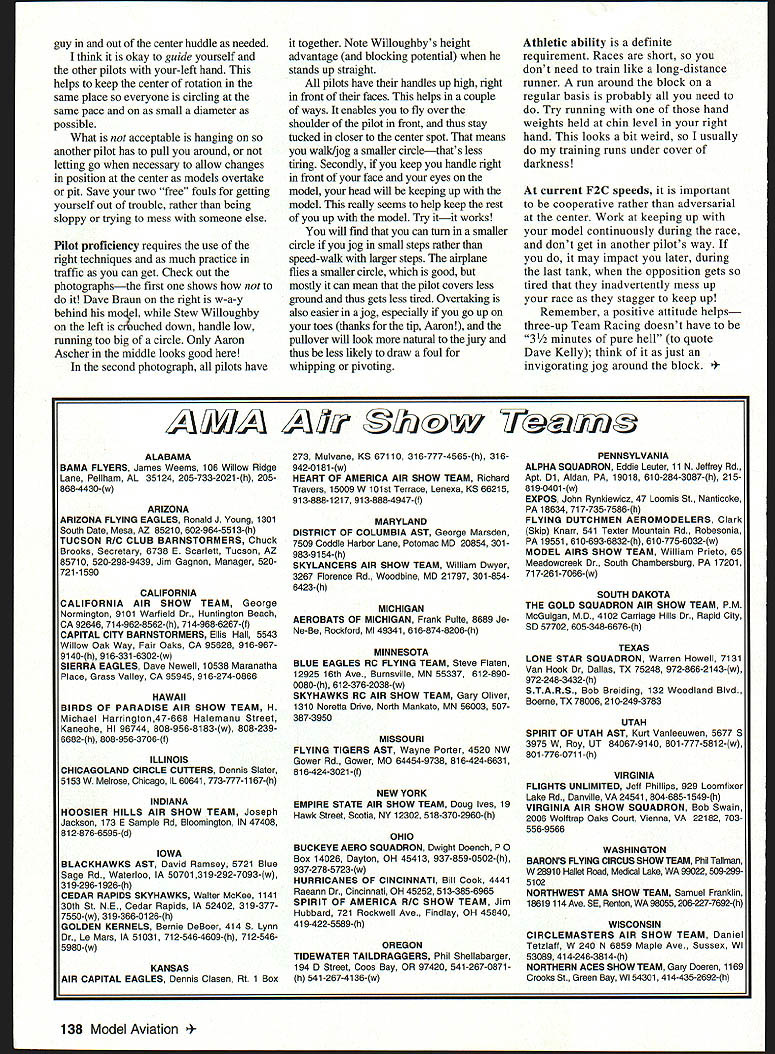
Pilot proficiency requires the use of the right techniques and as much practice in traffic as you can get. Check out the photographs—the first one shows how not to do it: Dave Braun on the right is way behind his model, while Stew Willoughby on the left is crouched down, handle low, running too big of a circle. Only Aaron Ascher in the middle looks good there.
In the second photograph, all pilots have it together. Note Willoughby's height advantage (and blocking potential) when he stands up straight.
Tips for proficiency:
- Keep your handle up high, right in front of your face. This enables you to fly over the shoulder of the pilot in front and stay tucked in closer to the center spot, which means you walk/jog a smaller circle and tire less.
- Keep your eyes on the model; holding the handle in front of your face keeps your head tracking with the model and helps the rest of you keep up.
- Jog in small steps rather than speed-walking with larger steps. The airplane flies a smaller circle, the pilot covers less ground and tires less, and overtaking becomes easier.
- When overtaking, go up on your toes to make the pullover look more natural to the jury and thus less likely to draw a foul for whipping or pivoting.
Athletic ability
Athletic ability is a definite requirement. Races are short, so you don't need to train like a long-distance runner. A run around the block on a regular basis is probably all you need. Try running with one of those hand weights held at chin level in your right hand—this helps simulate the arm position used while flying.
At current F2C speeds, it is important to be cooperative rather than adversarial at the center. Work at keeping up with your model continuously during the race, and don't get in another pilot's way. If you do, it may impact you later during the last tank, when the opposition gets tired and may inadvertently mess up your race as they stagger to keep up!
Remember, a positive attitude helps—three-up Team Racing doesn't have to be "3½ minutes of pure hell" (to quote Dave Kelly); think of it as just an invigorating jog around the block.
Transcribed from original scans by AI. Minor OCR errors may remain.

