
CONTROL LINE RACING
Stewart Willoughby, 627 Bakewell Lane, Naperville, IL 60565
THE FAI (Federation Aeronautique Internationale) F2C team trials for the 1998 World Championships (to be in Kiev, Ukraine) were the first weekend in October 1997 at the Whittier Narrows site in California. Eight teams participated and each flew six races, with the best three times combined to determine final placing.
The team of John Ballard/Dick Lambert flew consistently, using Mazniak equipment, and won first place with 3:19, 3:24, and 3:25. John got a good working-over at the 1996 World Champs in Sweden, but his knee has nearly recovered from surgery, so look for his team to place high in Kiev.
Aaron Ascher and Lenard Ascher were close behind the leaders with their Vorobiev front-exhaust models, posting a personal-best 3:22 backed up by two 3:25s. The most noticeable improvement from previous years for this team was better restarts during pit stops.
John McCollum/Bill Lee took the third team spot with a 3:21 and two 3:27s. This team had its share of problems last year; the two were lucky that they didn't destroy their only competitive model, the ex-Shabashov/Ivanov racer, which ran at least three times during the weekend.
The rest of the field did not pose a significant threat to the leaders. Tim Gillott did well to place fourth with an unfamiliar pilot (Tom Fluker), and he only had a day-and-a-half of practice after a four-year layoff. Tim's Nelsons are capable of keeping up with the best of the Russian gear, but the setting is not as comfortable. That team's best time was 3:28.
Bob Oge and I could not find a steady race setting with any of the three models that we brought to the trials; 3:36 was the best we could do. A fuel problem may have been partially to blame. California ingredients mixed to our usual formula required much more compression to run steadily. We countered it by adding more DII (Diesel Ignition Improver), but now we wish that we had tried a little more oil.
The only way to eliminate this variable is to ship your own fuel; we will make that a priority next time!
The other mistake we made was winning the Nationals (Nats) in a team trials year—just ask Jed Kusik, John McCollum, and Lenard Ascher, previous recipients of "the curse."
The team of Dave Braun and Jed Kusik (1994 team members) experienced various problems and finished only three races; 3:36 was its fastest time. Kenny Perkins and Lester Goldsmith, flying in their first team trials, lacked pilot proficiency on Day One, but Kenny was beginning to look like a pro by the end of Day Two. Their quickest time was 3:47.
Lari Dziak/Dave McDonald started with a fair 3:39 in race one, but their fortunes progressively declined throughout the rest of the contest. In one race, Lari got strung out on lap 97 by another pilot who got way behind his model. The situation worsened and Dziak/McDonald's new Mazniak model got wiped out on lap 99 2/3; the engine backplate (or the major portion of it) crossed the finish line!
Ken Smith and his crew of timekeepers and line-checkers did a competent job of running the contest, and the jury of Tom Knoppi, Vic Garner, and Jim Dunkin, with "Doc" Jackson for the FAI, made fair decisions. Thanks, guys!
Ascher Studs
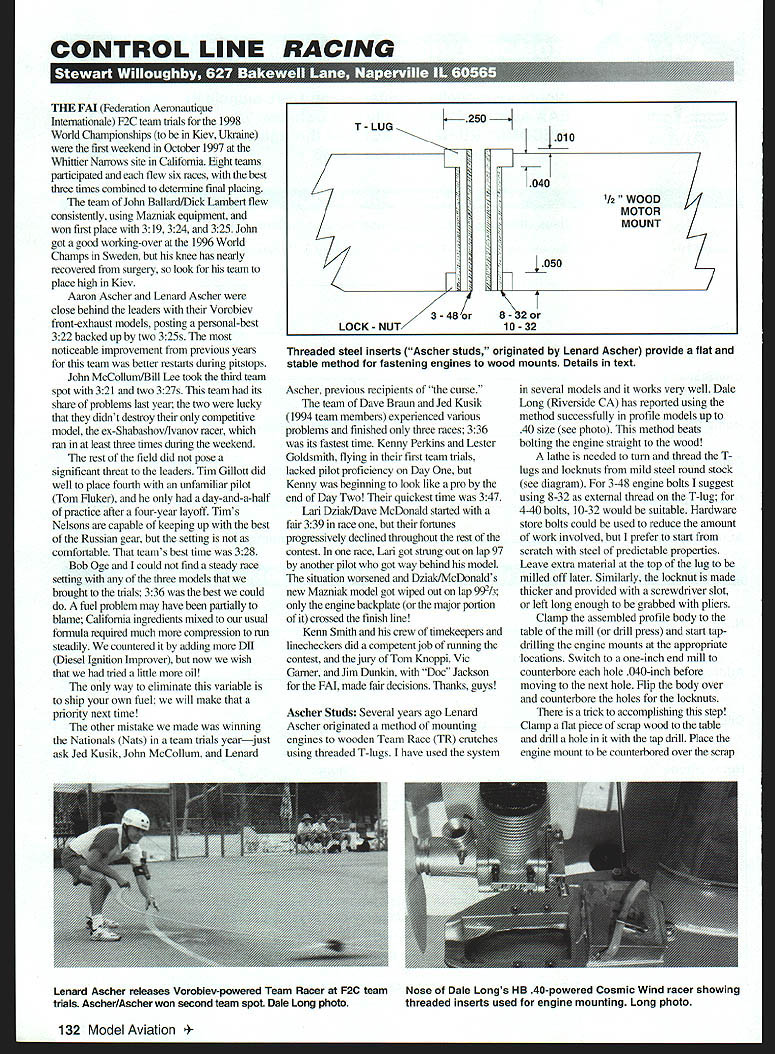
Several years ago Lenard Ascher originated a method of mounting engines to wooden Team Race (TR) crutches using threaded T-lugs. I have used the system in several models and it works very well. Dale Long (Riverside, CA) has reported using the method successfully in profile models up to .40 size. This method beats bolting the engine straight to the wood!
A lathe is needed to turn and thread the T-lugs and locknuts from mild steel round stock. For 3-48 engine bolts I suggest using 8-32 as the external thread on the T-lug; for 4-40 bolts, 10-32 would be suitable. Hardware-store bolts could be used to reduce the amount of work involved, but I prefer to start from scratch with steel of predictable properties. Leave extra material on the top of the lug to be milled off later. Similarly, make the locknut thicker and provide a screwdriver slot long enough to be grabbed with pliers.
Clamp the assembled profile body to the table of the mill or drill press and start tap-drilling the engine mounts at the appropriate locations. Switch to a one-inch end mill and counterbore the holes 0.040 inch before moving to the next hole. Flip the body over and counterbore the holes for the locknuts.
There is a trick to accomplishing this step: clamp a flat piece of scrap wood to the table and drill a hole in it with the tap drill. Place the engine mount counterbored over the scrap and push the tap drill through by hand. Clamp the body down and pull out the tap drill—the engine mount is now centered for counterboring. Tap the hole and insert the locknut.
Screw an engine mounting bolt into each T-lug. Coat the holes and lugs with a good steel-filled epoxy (e.g., JB Weld from the auto parts store) and screw them into the engine mounts, driving them in tight using the engine mounting bolts. Put epoxy on the locknuts and screw them onto the bottom of the lugs. Remove the engine mounting bolts and leave the assembly to cure overnight. When set, mill the nuts off flush with the bottom of the engine mounts. Turn the body over and mill the tops of the T-lugs down and level, but leave them about 0.010 inch proud of the wood surface. This allows the mounting pads to remain clear of the paint finish, enabling final leveling using 400-grit paper on a thick glass slab after the model is completed.
I think this system would work well in Scale Race models. I currently use basswood engine mounts and a 3/16-inch aluminum plate. The aluminum plate effectively enlarges the surface area of the engine lugs which, in turn, allows use of the relatively soft basswood. Boy, did I save some weight getting rid of the maple! I would have no hesitation using Ascher studs mounted in basswood for a .15 with front mounts like some of the Nelsons.
I have done this in the TRs without a problem. For engines with standard lugs, I think maple would be needed and I'm not sure I want to carry the extra weight!
While I am on the subject of engine mounting, remember to use cheap mild steel bolts rather than cap screws. The soft steel bolts stretch a little and will stay tight better, and in a crash, they tend to shear off, often avoiding a bent crankshaft or broken engine lug.
Transcribed from original scans by AI. Minor OCR errors may remain.

