
CONTROL LINE RACING
Dave McDonald Box 384, Daleville IN 47334 E-mail: DMCd143@aol.com
Goals and submissions
In preparing this, my first column, I thought it important to lay out some goals so you will know what I intend to do:
- Encourage readers to send information concerning contests, questions, building projects, comments, etc.
- Use this column to continue to promote CL racing on an international, national, and local level.
- Rely on reader contributions to accomplish these goals.
Please note: there is typically a three-month lead time for submissions. If you have photos, do not write on the back of them; enclose a note or put a Post-it on the back.
With that information aside, let's continue to make CL racing a premier event.
Preseason checklist
With the season getting underway, look at a few extremely important areas on your airplane—be it a Mouse, Slow Rat, Scale Racer, Fast Rat, Team Race model, or something else. By checking these areas you will (hopefully) have a safer and more enjoyable season.
How many times have you seen the fastest airplane fail to win because of a bad tank? Now is the time to remove the tank and visually scrutinize it for fatigue.
- Are the attachment points secure?
- Are the pickups in good condition?
- How is the filling mechanism?
- If any of these look remotely suspect, fix them now—do not fool yourself into thinking you can get by. Remember: if it can be bad, it usually will.
When I clean tanks, I make it standard operating procedure each season to parboil the tank in a baking soda solution, then thoroughly clean each tank with a methanol wash. After cleaning and rinsing, pressure-check each tank to determine if any leaks are present. If they are, take corrective action and repeat the parboiling and pressure-testing.
After you are satisfied with the tank's integrity, reattach and replace old fuel tubing. Fuel tubing does not last indefinitely; I suggest you replace the tubing before each event.
"Fast Fill" Mounting
I have noticed several competitors having trouble with their Quick Fills. Good maintenance and mounting will help minimize inverted Quick Fills and the tears usually associated with them.
- When you get a new batch of rubber Quick Fills, examine the bottom of the fueling slot. Occasionally you will need to use a sharp X-Acto blade on the corners of the slot.
- Many pitmen use fuel bulbs with 3/16" tubing; with a fueling slot that is too small, you can invert the Quick Fill when removing the bulb. A trick is to rotate the fuel bulb as you insert and remove it from the Quick Fill.
- Solder the end of the filling probe to form a rounded surface. This helps prevent tears to the Quick Fill and makes rapid insertion easier. Make a series of slots or holes along the lower portion of the fueling probe to allow the tank to fill.
Methods of attachment for Quick Fills I've seen:
- Insert the Quick Fill into the filler pipe (not recommended—without a clamp the pressure in the tank can blow off the Quick Fill).
- Double wrap of copper wire.
- Small wire tie (my preference—gives wider point contact and will not distort the fill easily).
Engine Inspection
If you took the engine off the airplane last fall, oiled it, and properly stored it for the season, now is the time to remove it again and inspect.
- Make sure the bearings have a nice smooth feel.
- Check head bolts and backplate for tightness.
- Check the spray bar—ensure it is tight and not plugged with dried sediment from last year.
This is the best time to remedy these problems.
I also recommend some form of after-run lubrication. Over time I've seen substances used such as automatic transmission fluid, Marvel Mystery Oil, and Rislone (available at your local auto parts store). I like to use a few drops of Rislone after a session: put a small amount in the exhaust venturi and flip the engine through a few times. This keeps the inside of the engine clean and protected, and makes starting easier at the next session.
Airplane Inspection
Now check the general condition of the airplane.
- Are there cracks between the wing and fuselage?
- Are the landing gear and wheels secure?
- Are the elevator hinges in good shape, with minimal play in the control system?
- Does the shutoff work? Does it need adjustment?
Finally, and importantly: when you make new lines, always replace flying lines at the beginning of the season. I am continually amazed at the number of competitors who use the same lines for years. It takes only a few moments to make and install a new set.
When you make a new set of lines, be sure you follow the prescribed AMA procedure for the construction of lines; the proper procedure may be found on pages 28–29 of your AMA Competition Regulations. This simple act could prevent an injury or save a model from almost certain destruction because of line failure.
Practice procedures
There is no substitute for practice. You should practice as you race. Develop a sequence of events and adhere to it.
Each time you get the airplane out:
- Check the lines for kinks and twists.
- Clean the lines with a good brake cleaner or straight methanol.
- Warm the engine up just as you would on race day.
- Start the engine just as you would in a race.
- Fly as you would if racing, and practice your landings and pit stops as you would in competition.
The goal is to make the "triangle of racing" (airplane, pilot, and pitman) work as one. Develop absolute trust that your pilot and pitman will successfully perform their roles. After many hours of flying together, the team will reach the point where one member can anticipate the other's actions. Doing this will lead to more success and fewer misfortunes. Following these steps should make a difference in your performance in 1998.
Support the 1998 US F2C Team
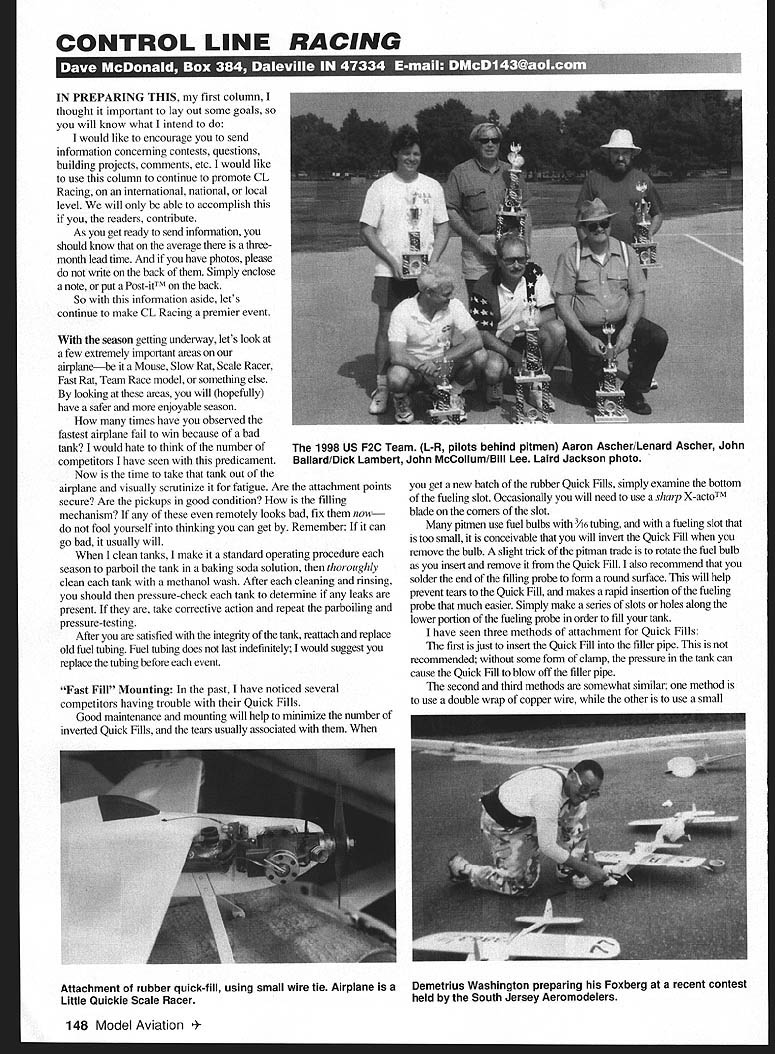
Let's wish our entire CL World Championship team good luck in Kiev—particularly the F2C contingent.
Help support the 1998 US F2C Team. The NCLRA is conducting a raffle/fundraiser:
- Prize: $400 Nelson Merchandise Certificate.
- Drawing: July 15, 1998 at the NCLRA banquet.
- Tickets: $5 each.
- To enter: send your check or money order (payable to NCLRA F2C Fund) to the author's address. Please enclose a SASE.
Join the National Control Line Racing Association (NCLRA)
To join, send your name, address, and AMA number to:
Jerry Meyer 8 S. Grace St. N. Aurora, IL 60542
- Dues: $10 US, $12 outside US.
- The NCLRA publishes a bimonthly publication that is included with membership.
Transcribed from original scans by AI. Minor OCR errors may remain.

